


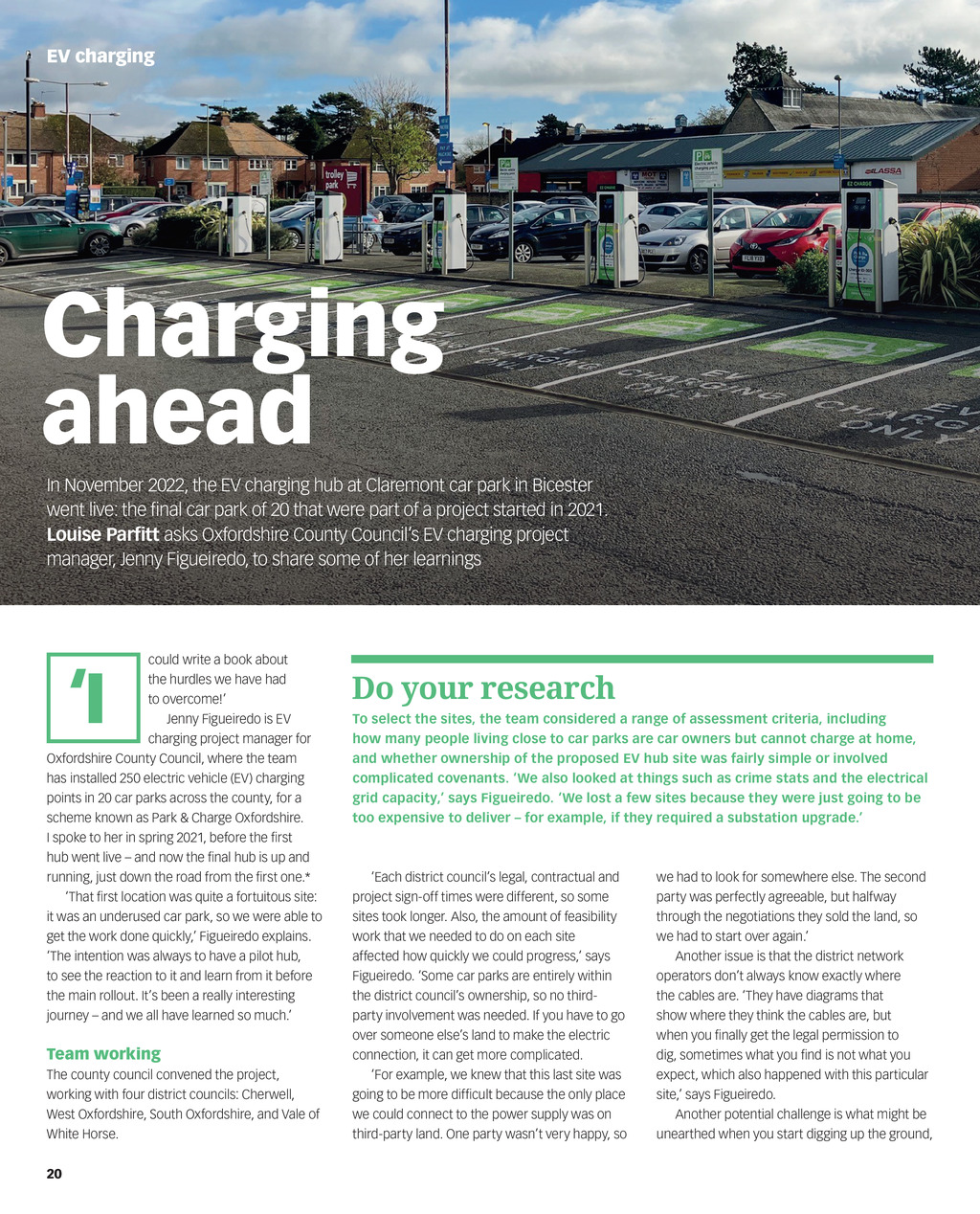


EV charging Charging ahead In November 2022, the EV charging hub at Claremont car park in Bicester went live: the final car park of 20 that were part of a project started in 2021. Louise Parfitt asks Oxfordshire County Councils EV charging project manager, Jenny Figueiredo, to share some of her learnings could write a book about the hurdles we have had to overcome! Jenny Figueiredo is EV charging project manager for Oxfordshire County Council, where the team has installed 250 electric vehicle (EV) charging points in 20 car parks across the county, for a scheme known as Park & Charge Oxfordshire. I spoke to her in spring 2021, before the first hub went live and now the final hub is up and running, just down the road from the first one.* That first location was quite a fortuitous site: it was an underused car park, so we were able to get the work done quickly, Figueiredo explains. The intention was always to have a pilot hub, to see the reaction to it and learn from it before the main rollout. Its been a really interesting journey and we all have learned so much. I Team working The county council convened the project, working with four district councils: Cherwell, West Oxfordshire, South Oxfordshire, and Vale of White Horse. 20 Do your research To select the sites, the team considered a range of assessment criteria, including how many people living close to car parks are car owners but cannot charge at home, and whether ownership of the proposed EV hub site was fairly simple or involved complicated covenants. We also looked at things such as crime stats and the electrical grid capacity, says Figueiredo. We lost a few sites because they were just going to be too expensive to deliver for example, if they required a substation upgrade. Each district councils legal, contractual and project sign-off times were different, so some sites took longer. Also, the amount of feasibility work that we needed to do on each site affected how quickly we could progress, says Figueiredo. Some car parks are entirely within the district councils ownership, so no thirdparty involvement was needed. If you have to go over someone elses land to make the electric connection, it can get more complicated. For example, we knew that this last site was going to be more difficult because the only place we could connect to the power supply was on third-party land. One party wasnt very happy, so we had to look for somewhere else. The second party was perfectly agreeable, but halfway through the negotiations they sold the land, so we had to start over again. Another issue is that the district network operators dont always know exactly where the cables are. They have diagrams that show where they think the cables are, but when you finally get the legal permission to dig, sometimes what you find is not what you expect, which also happened with this particular site, says Figueiredo. Another potential challenge is what might be unearthed when you start digging up the ground,