


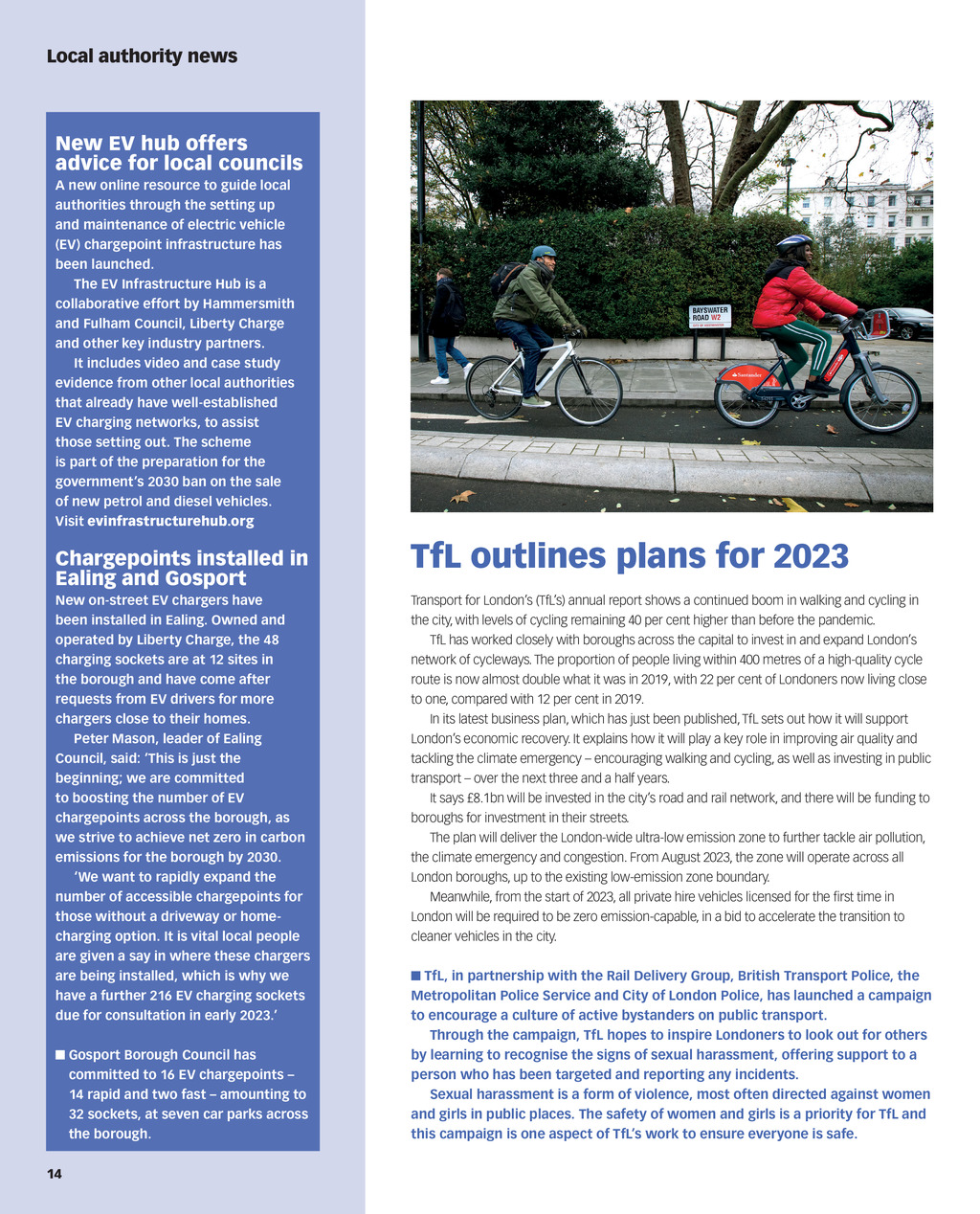


Local authority news New EV hub offers advice for local councils A new online resource to guide local authorities through the setting up and maintenance of electric vehicle (EV) chargepoint infrastructure has been launched. The EV Infrastructure Hub is a collaborative effort by Hammersmith and Fulham Council, Liberty Charge and other key industry partners. It includes video and case study evidence from other local authorities that already have well-established EV charging networks, to assist those setting out. The scheme is part of the preparation for the governments 2030 ban on the sale of new petrol and diesel vehicles. Visit evinfrastructurehub.org Chargepoints installed in Ealing and Gosport New on-street EV chargers have been installed in Ealing. Owned and operated by Liberty Charge, the 48 charging sockets are at 12 sites in the borough and have come after requests from EV drivers for more chargers close to their homes. Peter Mason, leader of Ealing Council, said: This is just the beginning; we are committed to boosting the number of EV chargepoints across the borough, as we strive to achieve net zero in carbon emissions for the borough by 2030. We want to rapidly expand the number of accessible chargepoints for those without a driveway or homecharging option. It is vital local people are given a say in where these chargers are being installed, which is why we have a further 216 EV charging sockets due for consultation in early 2023. Gosport Borough Council has committed to 16 EV chargepoints 14 rapid and two fast amounting to 32 sockets, at seven car parks across the borough. 14 TfL outlines plans for 2023 Transport for Londons (TfLs) annual report shows a continued boom in walking and cycling in the city, with levels of cycling remaining 40 per cent higher than before the pandemic. TfL has worked closely with boroughs across the capital to invest in and expand Londons network of cycleways. The proportion of people living within 400 metres of a high-quality cycle route is now almost double what it was in 2019, with 22 per cent of Londoners now living close to one, compared with 12 per cent in 2019. In its latest business plan, which has just been published, TfL sets out how it will support Londons economic recovery. It explains how it will play a key role in improving air quality and tackling the climate emergency encouraging walking and cycling, as well as investing in public transport over the next three and a half years. It says 8.1bn will be invested in the citys road and rail network, and there will be funding to boroughs for investment in their streets. The plan will deliver the London-wide ultra-low emission zone to further tackle air pollution, the climate emergency and congestion. From August 2023, the zone will operate across all London boroughs, up to the existing low-emission zone boundary. Meanwhile, from the start of 2023, all private hire vehicles licensed for the first time in London will be required to be zero emission-capable, in a bid to accelerate the transition to cleaner vehicles in the city. TfL, in partnership with the Rail Delivery Group, British Transport Police, the Metropolitan Police Service and City of London Police, has launched a campaign to encourage a culture of active bystanders on public transport. Through the campaign, TfL hopes to inspire Londoners to look out for others by learning to recognise the signs of sexual harassment, offering support to a person who has been targeted and reporting any incidents. Sexual harassment is a form of violence, most often directed against women and girls in public places. The safety of women and girls is a priority for TfL and this campaign is one aspect of TfLs work to ensure everyone is safe.