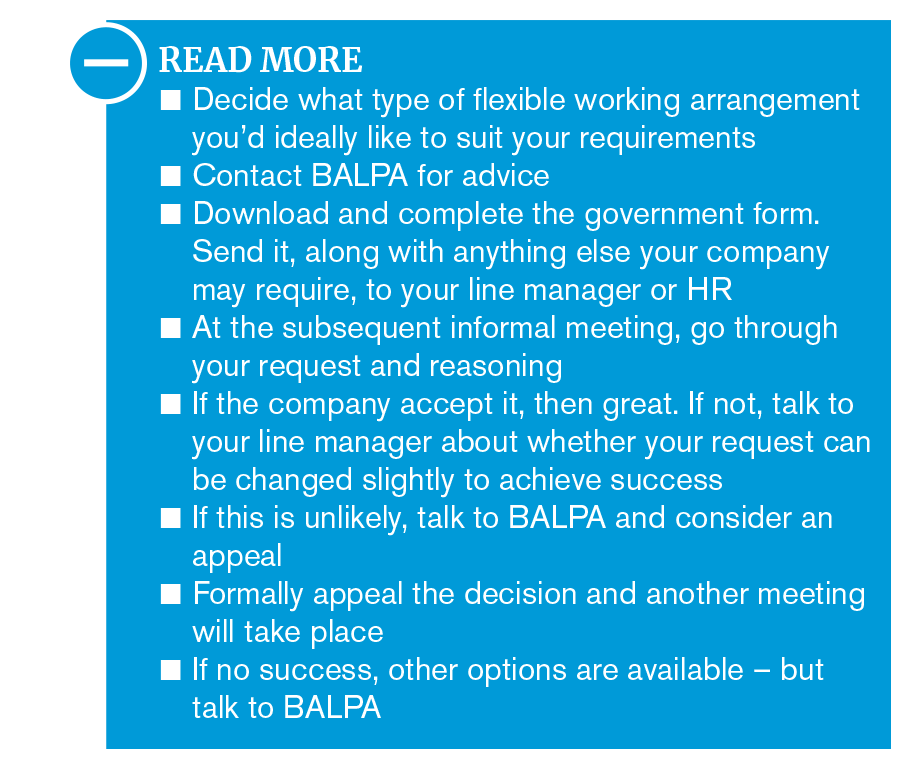








Flexible working What is the impact of requesting part-time and flexible working hours? I By Captain Simon Williams, Log Chief Editor n the good old days, if one felt inclined and was confident that ones employer would be considerate, it was possible to simply ask for part-time working. There was little legal right to support such a request and the employer generally only accommodated part-time working if it suited the needs of the business. Although the statutory right to apply for flexible working has been around for a while, the scope of who can apply was widened in June 2014. Now, all employees with at least 26 weeks continuous service can apply. There is no longer any requirement to be a carer for children or dependent adults. At the same time, many features of the old statutory request procedure were abolished and replaced by a broad duty on the employer to deal with applications in a reasonable manner (sections 80F 80I, Employment Relations Act 1996, Flexible Working Regulations 2014). Since the changes in 2014, many airline employers have been inundated with regular flexible working requests, while several companies have replaced all parttime working bids and so on, opting to only accept flexible working applications. The employee has a legal right to apply, but this does not mean a right to be given flexible working arrangements. The obligation is merely on the employer to make a reasonable consideration of the request and only reject it for statutory business reasons. There are also protections to ensure that any part-time working offer is made with pro rata pay and terms and conditions; if it is not, you are entitled to pursue these via an Employment Tribunal under the Part Time Workers Regulations as a form of discrimination. Furthermore, working flexibly will not affect your statutory employment rights, such as claiming unfair dismissal, statutory redundancy pay, the longer period of maternity leave, and joining an occupational pension scheme. How to apply READ MORE Summary Once you have completed 26 weeks of employment and after talking to BALPA you should write (email is fine) to your line manager, including the date youd like to start part-time work, what work pattern or arrangement youd like, and what effect you think this may have on colleagues and the business. There is a template available on the gov.uk website (see references). If you are making a statutory request, the company has three months to consider it and make a decision. This can be longer only if agreed with the employee, or if you are making a non-statutory request. During this process, you will almost certainly be invited to a meeting with your line manager or an HR representative to discuss your application. Although the flexible working regulations do not require employees to state their reasons for requesting flexible working, it is BALPAs considered advice that, during these discussions, the full context of your situation is outlined. In other words, dont simply say workload or fatigue, but expand your reasoning to include any family commitments, outside interests, commuting and so on. The more considered your application, the more likely you are to garner sympathy from your company. Employers must consider flexible working requests in a reasonable manner. This is a famously nebulous phrase but, to help, Acas has produced a guide, which is available on its website (see references, below). Your ideal working pattern may require a certain degree of negotiation. It is becoming more common for an employer to work towards a mutually agreeable solution rather than simply approving or rejecting a flexible working request. We suggest that you approach the negotiations in a constructive and pragmatic manner. For example, you should find out what your employers concerns (if any) may be about your new working pattern, and try to suggest solutions or find out if any of your colleagues have agreed to work flexibly and what arrangements theyve made. If in doubt, talk to your BALPA rep or National Officer, who will almost certainly be able to help and give advice. Despite all of the above, employers can reject an application for many reasons, none of them particularly enshrined in law. Employees also do not have a statutory right to an appeal. On both these counts, however, an employer still has to demonstrate that it has acted reasonably so, reasons for rejection must be properly explained and understandable to the employee, and there ought to be an appeals process. How to appeal Hopefully, as a result of good negotiations and reasonably behaved management, you wont need to appeal. Neither of these are guaranteed, however. It is very important that the employer notes that there is no legal right to appeal, but most companies to be seen to behave reasonably do have a policy. Your line manager or HR representative will explain the companys appeals process and, again, BALPA will no doubt have some advice for you at this stage. We recommend you look at your application again, and consider any discussions during the negotiation process and the reasons given for rejection. You will have more chance of success if you are willing to compromise, but dont simply accept any options presented to you by the employer if you are unhappy if anything, the need to negotiate is even more appropriate at this stage. Should this still not yield acceptable results, your BALPA rep or National Officer may advise a more formal negotiation, such as an ACAS arbitration. Your case could be escalated to an Employment Tribunal, but, generally, this is only a realistic option if it seems the employer is discriminating against you. It is also important to note that a tribunal has no power to order an employer to comply with a request for flexible working. It can order an employer to reconsider the request and/or pay the employee such compensation as the tribunal considers just and equitable in all the circumstances, up to a limit of eight weeks pay, subject to the statutory cap. Implementation Once agreed between employer and employee, there is no minimum or maximum time before a flexible working scheme has to be put in place. Indeed, this may be part of the negotiations. Airlines will often consider the seasonal demand for pilots and time needed to plan their establishment levels. An employer may also state or request (depending on their levels of reasonableness) that a review takes place after six or 12 months. Generally, this is an opportunity to discuss the mutual situation and an employer should not simply use it to unilaterally change or withdraw your new pattern. If they do, speak to BALPA as soon as possible. It is possible that, eventually, youd like to return to full time. Employers cant discriminate against you, but it would not be unreasonable for them to say the business cant accommodate more working hours for the time being. References Gov.uk Right to request flexible working Print the form here Citizens Advice Flexible working: what is it? ACAS Handling in a reasonable manner requests to work flexibly ME N TA L HE A LT H READ MORE n Decide what type of flexible working arrangement youd ideally like to suit your requirements n Contact BALPA for advice n Download and complete the government form. Send it, along with anything else your company may require, to your line manager or HR n At the subsequent informal meeting, go through your request and reasoning n If the company accept it, then great. If not, talk to your line manager about whether your request can be changed slightly to achieve success n If this is unlikely, talk to BALPA and consider an appeal n Formally appeal the decision and another meeting will take place n If no success, other options are available but talk to BALPA