


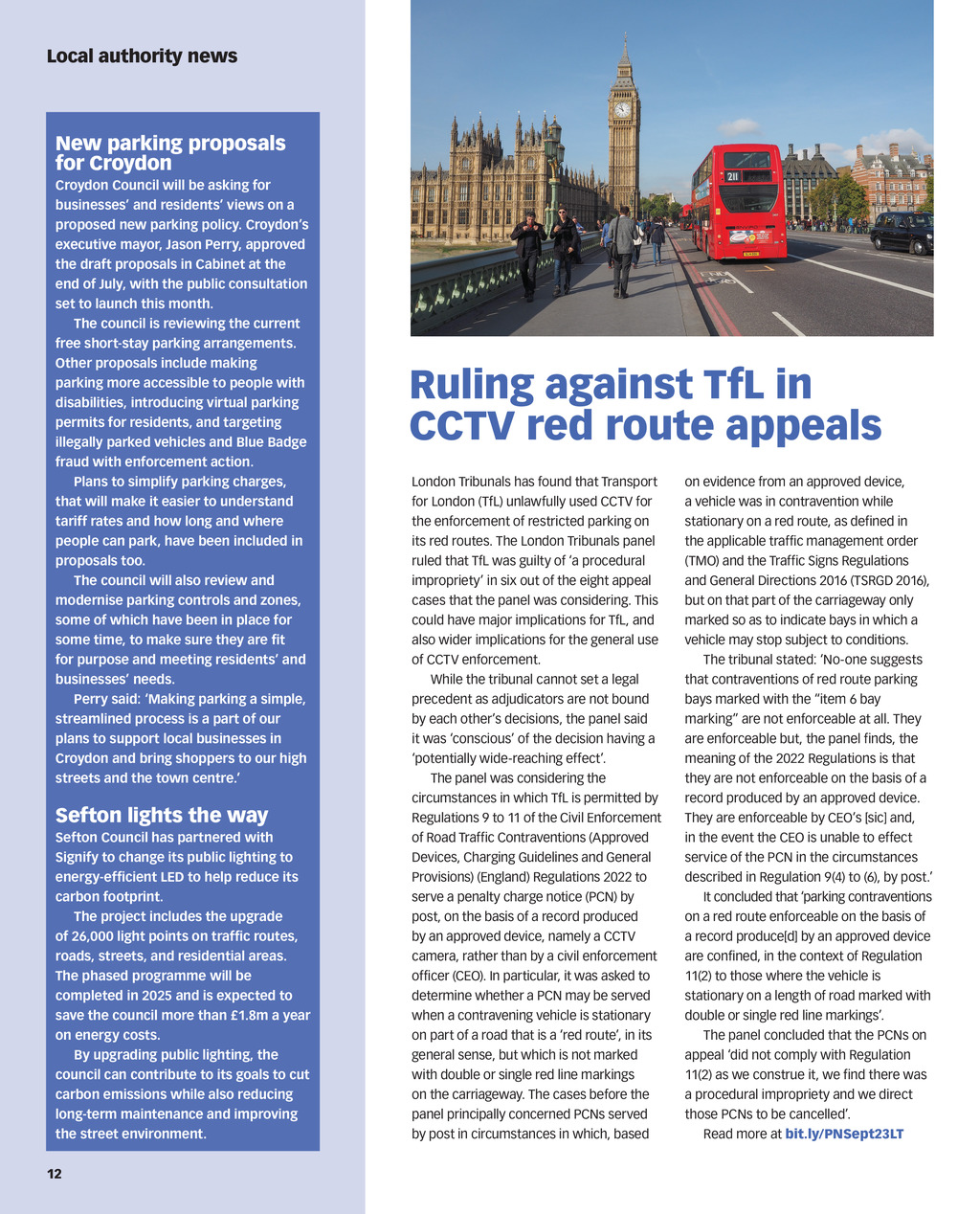


Local authority news New parking proposals for Croydon Croydon Council will be asking for businesses and residents views on a proposed new parking policy. Croydons executive mayor, Jason Perry, approved the draft proposals in Cabinet at the end of July, with the public consultation set to launch this month. The council is reviewing the current free short-stay parking arrangements. Other proposals include making parking more accessible to people with disabilities, introducing virtual parking permits for residents, and targeting illegally parked vehicles and Blue Badge fraud with enforcement action. Plans to simplify parking charges, that will make it easier to understand tariff rates and how long and where people can park, have been included in proposals too. The council will also review and modernise parking controls and zones, some of which have been in place for some time, to make sure they are fit for purpose and meeting residents and businesses needs. Perry said: Making parking a simple, streamlined process is a part of our plans to support local businesses in Croydon and bring shoppers to our high streets and the town centre. Sefton lights the way Sefton Council has partnered with Signify to change its public lighting to energy-efficient LED to help reduce its carbon footprint. The project includes the upgrade of 26,000 light points on traffic routes, roads, streets, and residential areas. The phased programme will be completed in 2025 and is expected to save the council more than 1.8m a year on energy costs. By upgrading public lighting, the council can contribute to its goals to cut carbon emissions while also reducing long-term maintenance and improving the street environment. Ruling against TfL in CCTV red route appeals London Tribunals has found that Transport for London (TfL) unlawfully used CCTV for the enforcement of restricted parking on its red routes. The London Tribunals panel ruled that TfL was guilty of a procedural impropriety in six out of the eight appeal cases that the panel was considering. This could have major implications for TfL, and also wider implications for the general use of CCTV enforcement. While the tribunal cannot set a legal precedent as adjudicators are not bound by each others decisions, the panel said it was conscious of the decision having a potentially wide-reaching effect. The panel was considering the circumstances in which TfL is permitted by Regulations 9 to 11 of the Civil Enforcement of Road Traffic Contraventions (Approved Devices, Charging Guidelines and General Provisions) (England) Regulations 2022 to serve a penalty charge notice (PCN) by post, on the basis of a record produced by an approved device, namely a CCTV camera, rather than by a civil enforcement officer (CEO). In particular, it was asked to determine whether a PCN may be served when a contravening vehicle is stationary on part of a road that is a red route, in its general sense, but which is not marked with double or single red line markings on the carriageway. The cases before the panel principally concerned PCNs served by post in circumstances in which, based on evidence from an approved device, a vehicle was in contravention while stationary on a red route, as defined in the applicable traffic management order (TMO) and the Traffic Signs Regulations and General Directions 2016 (TSRGD 2016), but on that part of the carriageway only marked so as to indicate bays in which a vehicle may stop subject to conditions. The tribunal stated: No-one suggests that contraventions of red route parking bays marked with the item 6 bay marking are not enforceable at all. They are enforceable but, the panel finds, the meaning of the 2022 Regulations is that they are not enforceable on the basis of a record produced by an approved device. They are enforceable by CEOs [sic] and, in the event the CEO is unable to effect service of the PCN in the circumstances described in Regulation 9(4) to (6), by post. It concluded that parking contraventions on a red route enforceable on the basis of a record produce[d] by an approved device are confined, in the context of Regulation 11(2) to those where the vehicle is stationary on a length of road marked with double or single red line markings. The panel concluded that the PCNs on appeal did not comply with Regulation 11(2) as we construe it, we find there was a procedural impropriety and we direct those PCNs to be cancelled. Read more at bit.ly/PNSept23LT 12 PN Sept 2023 pp12-13 LA News.indd 12 24/08/2023 11:01