


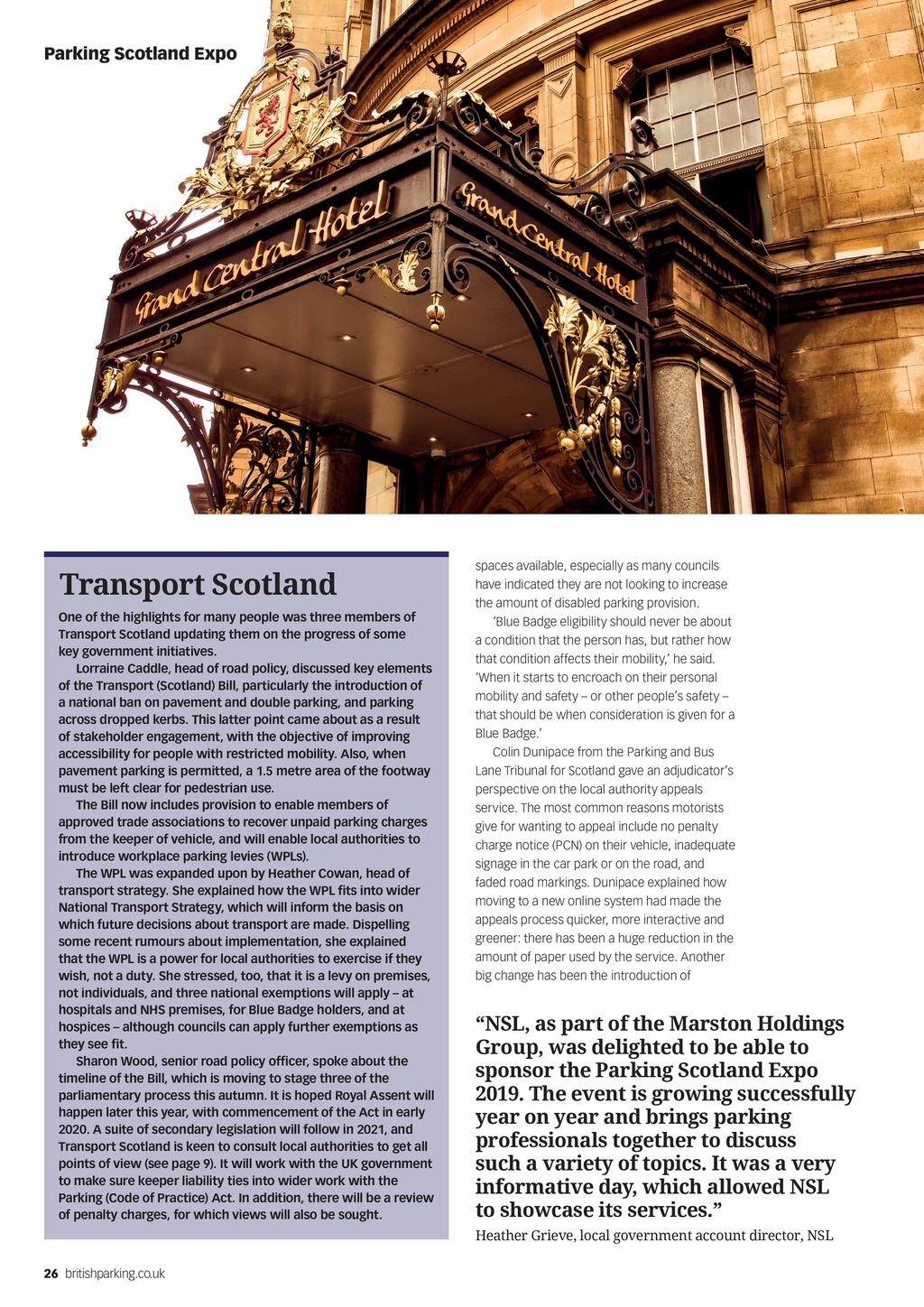


Parking Scotland Expo Transport Scotland One of the highlights for many people was three members of Transport Scotland updating them on the progress of some key government initiatives. Lorraine Caddle, head of road policy, discussed key elements of the Transport (Scotland) Bill, particularly the introduction of a national ban on pavement and double parking, and parking across dropped kerbs. This latter point came about as a result of stakeholder engagement, with the objective of improving accessibility for people with restricted mobility. Also, when pavement parking is permitted, a 1.5 metre area of the footway must be left clear for pedestrian use. The Bill now includes provision to enable members of approved trade associations to recover unpaid parking charges from the keeper of vehicle, and will enable local authorities to introduce workplace parking levies (WPLs). The WPL was expanded upon by Heather Cowan, head of transport strategy. She explained how the WPL fits into wider National Transport Strategy, which will inform the basis on which future decisions about transport are made. Dispelling some recent rumours about implementation, she explained that the WPL is a power for local authorities to exercise if they wish, not a duty. She stressed, too, that it is a levy on premises, not individuals, and three national exemptions will apply at hospitals and NHS premises, for Blue Badge holders, and at hospices although councils can apply further exemptions as they see fit. Sharon Wood, senior road policy officer, spoke about the timeline of the Bill, which is moving to stage three of the parliamentary process this autumn. It is hoped Royal Assent will happen later this year, with commencement of the Act in early 2020. A suite of secondary legislation will follow in 2021, and Transport Scotland is keen to consult local authorities to get all points of view (see page 9). It will work with the UK government to make sure keeper liability ties into wider work with the Parking (Code of Practice) Act. In addition, there will be a review of penalty charges, for which views will also be sought. spaces available, especially as many councils have indicated they are not looking to increase the amount of disabled parking provision. Blue Badge eligibility should never be about a condition that the person has, but rather how that condition affects their mobility, he said. When it starts to encroach on their personal mobility and safety or other peoples safety that should be when consideration is given for a Blue Badge. Colin Dunipace from the Parking and Bus Lane Tribunal for Scotland gave an adjudicators perspective on the local authority appeals service. The most common reasons motorists give for wanting to appeal include no penalty charge notice (PCN) on their vehicle, inadequate signage in the car park or on the road, and faded road markings. Dunipace explained how moving to a new online system had made the appeals process quicker, more interactive and greener: there has been a huge reduction in the amount of paper used by the service. Another big change has been the introduction of NSL, as part of the Marston Holdings Group, was delighted to be able to sponsor the Parking Scotland Expo 2019. The event is growing successfully year on year and brings parking professionals together to discuss such a variety of topics. It was a very informative day, which allowed NSL to showcase its services. Heather Grieve, local government account director, NSL 26 britishparking.co.uk PN Oct19 pp24-27 Scotland Expo.indd 26 23/09/2019 13:58