


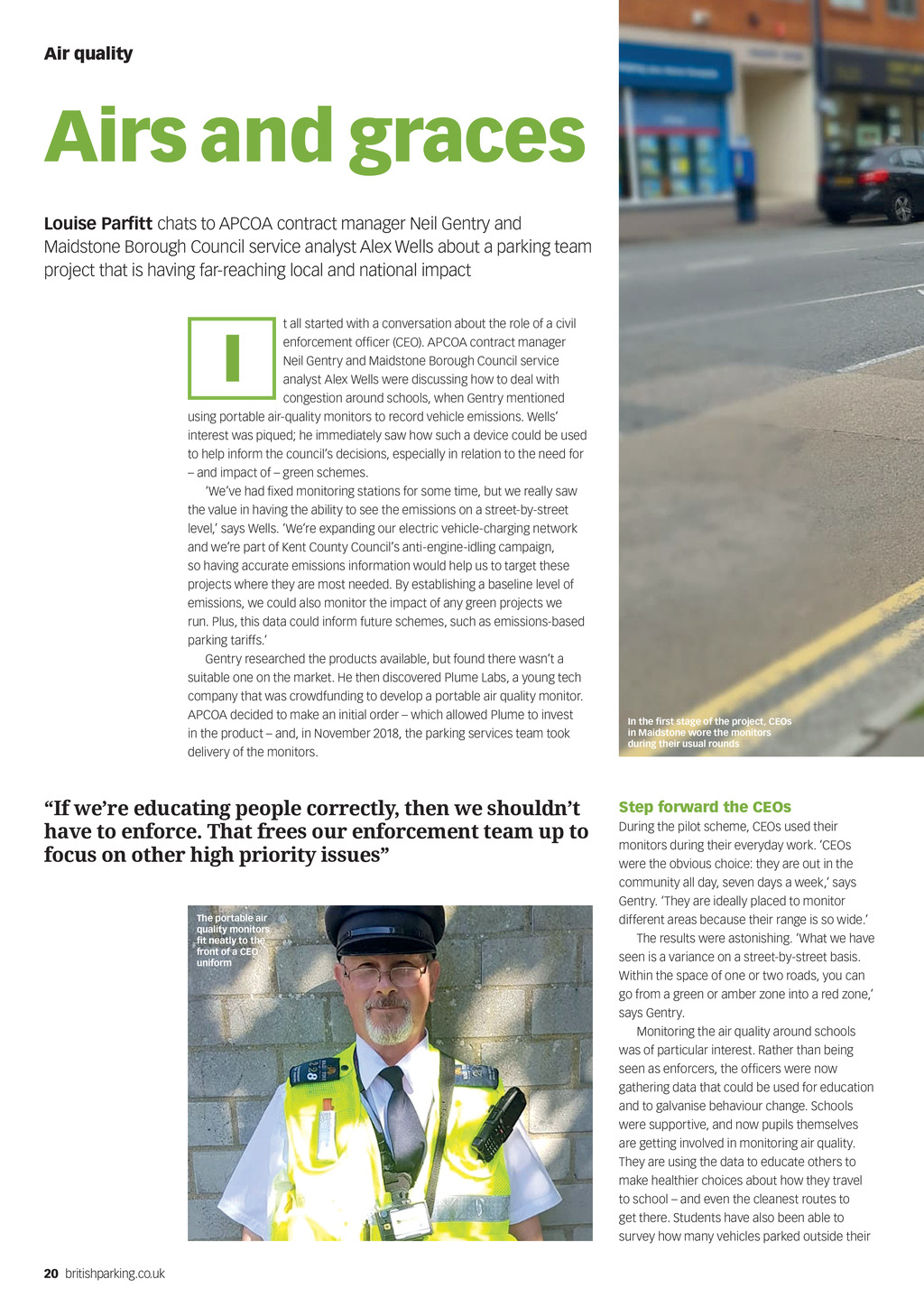


Air quality Airs and graces Louise Parfitt chats to APCOA contract manager Neil Gentry and Maidstone Borough Council service analyst Alex Wells about a parking team project that is having far-reaching local and national impact t all started with a conversation about the role of a civil enforcement officer (CEO). APCOA contract manager Neil Gentry and Maidstone Borough Council service analyst Alex Wells were discussing how to deal with congestion around schools, when Gentry mentioned using portable air-quality monitors to record vehicle emissions. Wells interest was piqued; he immediately saw how such a device could be used to help inform the councils decisions, especially in relation to the need for and impact of green schemes. Weve had fixed monitoring stations for some time, but we really saw the value in having the ability to see the emissions on a street-by-street level, says Wells. Were expanding our electric vehicle-charging network and were part of Kent County Councils anti-engine-idling campaign, so having accurate emissions information would help us to target these projects where they are most needed. By establishing a baseline level of emissions, we could also monitor the impact of any green projects we run. Plus, this data could inform future schemes, such as emissions-based parking tariffs. Gentry researched the products available, but found there wasnt a suitable one on the market. He then discovered Plume Labs, a young tech company that was crowdfunding to develop a portable air quality monitor. APCOA decided to make an initial order which allowed Plume to invest in the product and, in November 2018, the parking services team took delivery of the monitors. I If were educating people correctly, then we shouldnt have to enforce. That frees our enforcement team up to focus on other high priority issues The portable air quality monitors fit neatly to the front of a CEO uniform In the first stage of the project, CEOs in Maidstone wore the monitors during their usual rounds Step forward the CEOs During the pilot scheme, CEOs used their monitors during their everyday work. CEOs were the obvious choice: they are out in the community all day, seven days a week, says Gentry. They are ideally placed to monitor different areas because their range is so wide. The results were astonishing. What we have seen is a variance on a street-by-street basis. Within the space of one or two roads, you can go from a green or amber zone into a red zone, says Gentry. Monitoring the air quality around schools was of particular interest. Rather than being seen as enforcers, the officers were now gathering data that could be used for education and to galvanise behaviour change. Schools were supportive, and now pupils themselves are getting involved in monitoring air quality. They are using the data to educate others to make healthier choices about how they travel to school and even the cleanest routes to get there. Students have also been able to survey how many vehicles parked outside their 20 britishparking.co.uk PN Oct19 pp20-21 Air Quality Feature.indd 20 23/09/2019 16:35