


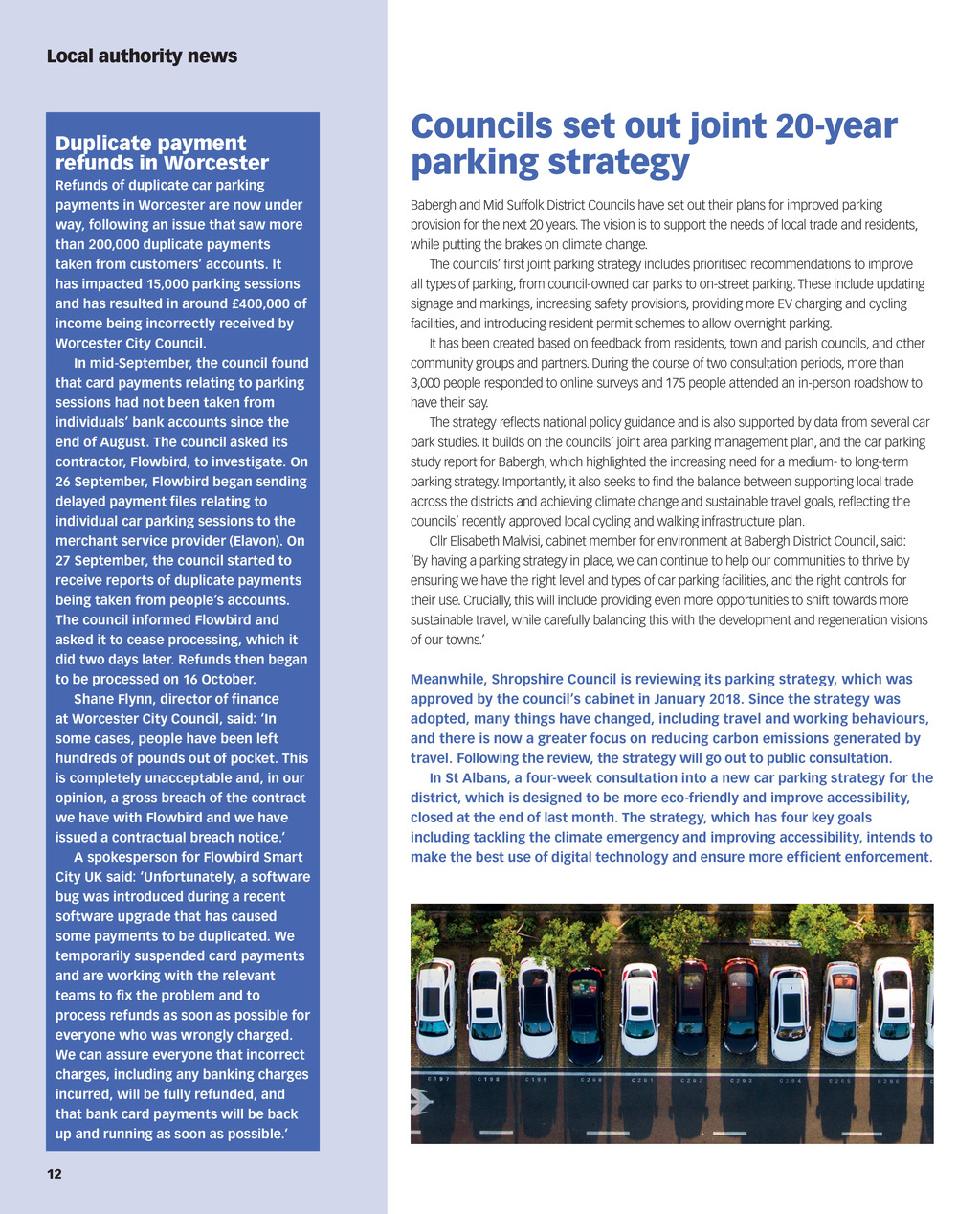


Local authority news Duplicate payment refunds in Worcester Refunds of duplicate car parking payments in Worcester are now under way, following an issue that saw more than 200,000 duplicate payments taken from customers accounts. It has impacted 15,000 parking sessions and has resulted in around 400,000 of income being incorrectly received by Worcester City Council. In mid-September, the council found that card payments relating to parking sessions had not been taken from individuals bank accounts since the end of August. The council asked its contractor, Flowbird, to investigate. On 26 September, Flowbird began sending delayed payment files relating to individual car parking sessions to the merchant service provider (Elavon). On 27 September, the council started to receive reports of duplicate payments being taken from peoples accounts. The council informed Flowbird and asked it to cease processing, which it did two days later. Refunds then began to be processed on 16 October. Shane Flynn, director of finance at Worcester City Council, said: In some cases, people have been left hundreds of pounds out of pocket. This is completely unacceptable and, in our opinion, a gross breach of the contract we have with Flowbird and we have issued a contractual breach notice. A spokesperson for Flowbird Smart City UK said: Unfortunately, a software bug was introduced during a recent software upgrade that has caused some payments to be duplicated. We temporarily suspended card payments and are working with the relevant teams to fix the problem and to process refunds as soon as possible for everyone who was wrongly charged. We can assure everyone that incorrect charges, including any banking charges incurred, will be fully refunded, and that bank card payments will be back up and running as soon as possible. Councils set out joint 20-year parking strategy Babergh and Mid Suffolk District Councils have set out their plans for improved parking provision for the next 20 years. The vision is to support the needs of local trade and residents, while putting the brakes on climate change. The councils first joint parking strategy includes prioritised recommendations to improve all types of parking, from council-owned car parks to on-street parking. These include updating signage and markings, increasing safety provisions, providing more EV charging and cycling facilities, and introducing resident permit schemes to allow overnight parking. It has been created based on feedback from residents, town and parish councils, and other community groups and partners. During the course of two consultation periods, more than 3,000 people responded to online surveys and 175 people attended an in-person roadshow to have their say. The strategy reflects national policy guidance and is also supported by data from several car park studies. It builds on the councils joint area parking management plan, and the car parking study report for Babergh, which highlighted the increasing need for a medium- to long-term parking strategy. Importantly, it also seeks to find the balance between supporting local trade across the districts and achieving climate change and sustainable travel goals, reflecting the councils recently approved local cycling and walking infrastructure plan. Cllr Elisabeth Malvisi, cabinet member for environment at Babergh District Council, said: By having a parking strategy in place, we can continue to help our communities to thrive by ensuring we have the right level and types of car parking facilities, and the right controls for their use. Crucially, this will include providing even more opportunities to shift towards more sustainable travel, while carefully balancing this with the development and regeneration visions of our towns. Meanwhile, Shropshire Council is reviewing its parking strategy, which was approved by the councils cabinet in January 2018. Since the strategy was adopted, many things have changed, including travel and working behaviours, and there is now a greater focus on reducing carbon emissions generated by travel. Following the review, the strategy will go out to public consultation. In St Albans, a four-week consultation into a new car parking strategy for the district, which is designed to be more eco-friendly and improve accessibility, closed at the end of last month. The strategy, which has four key goals including tackling the climate emergency and improving accessibility, intends to make the best use of digital technology and ensure more efficient enforcement. 12 PN Nov 2022 pp12-13 LA News.indd 12 27/10/2022 14:39