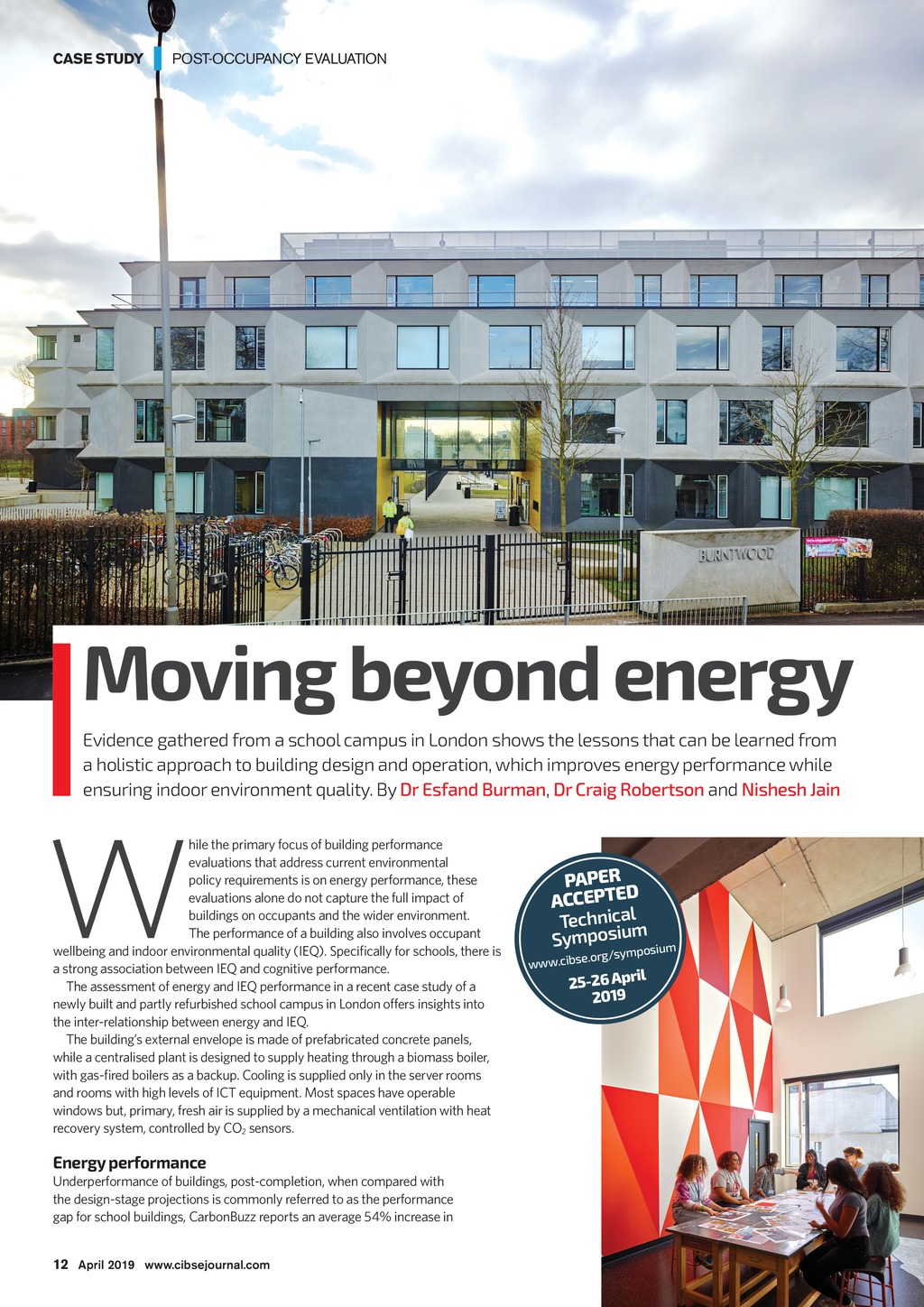


CASE STUDY | POST-OCCUPANCY EVALUATION Moving beyond energy Evidence gathered from a school campus in London shows the lessons that can be learned from a holistic approach to building design and operation, which improves energy performance while ensuring indoor environment quality. By Dr Esfand Burman, Dr Craig Robertson and Nishesh Jain W hile the primary focus of building performance evaluations that address current environmental policy requirements is on energy performance, these evaluations alone do not capture the full impact of buildings on occupants and the wider environment. The performance of a building also involves occupant wellbeing and indoor environmental quality (IEQ). Specifically for schools, there is a strong association between IEQ and cognitive performance. The assessment of energy and IEQ performance in a recent case study of a newly built and partly refurbished school campus in London offers insights into theinter-relationship between energy and IEQ. The buildings external envelope is made of prefabricated concrete panels, whilea centralised plant is designed to supply heating through a biomass boiler, with gas-fired boilers as a backup. Cooling is supplied only in the server rooms androoms with high levels of ICT equipment. Most spaces have operable windows but, primary, fresh air is supplied by a mechanical ventilation with heat recovery system, controlled by CO2 sensors. PAPER ACCEPTED Technicalm Symposiu sium o .org/symp www.cibse il 25-26 Apr 9 201 Energy performance Underperformance of buildings, post-completion, when compared with the design-stage projections is commonly referred to as the performance gapforschool buildings, CarbonBuzz reports an average 54% increase in 12 April 2019 www.cibsejournal.com CIBSE Apr19 pp12-14 School Supp POE.indd 12 22/03/2019 13:14