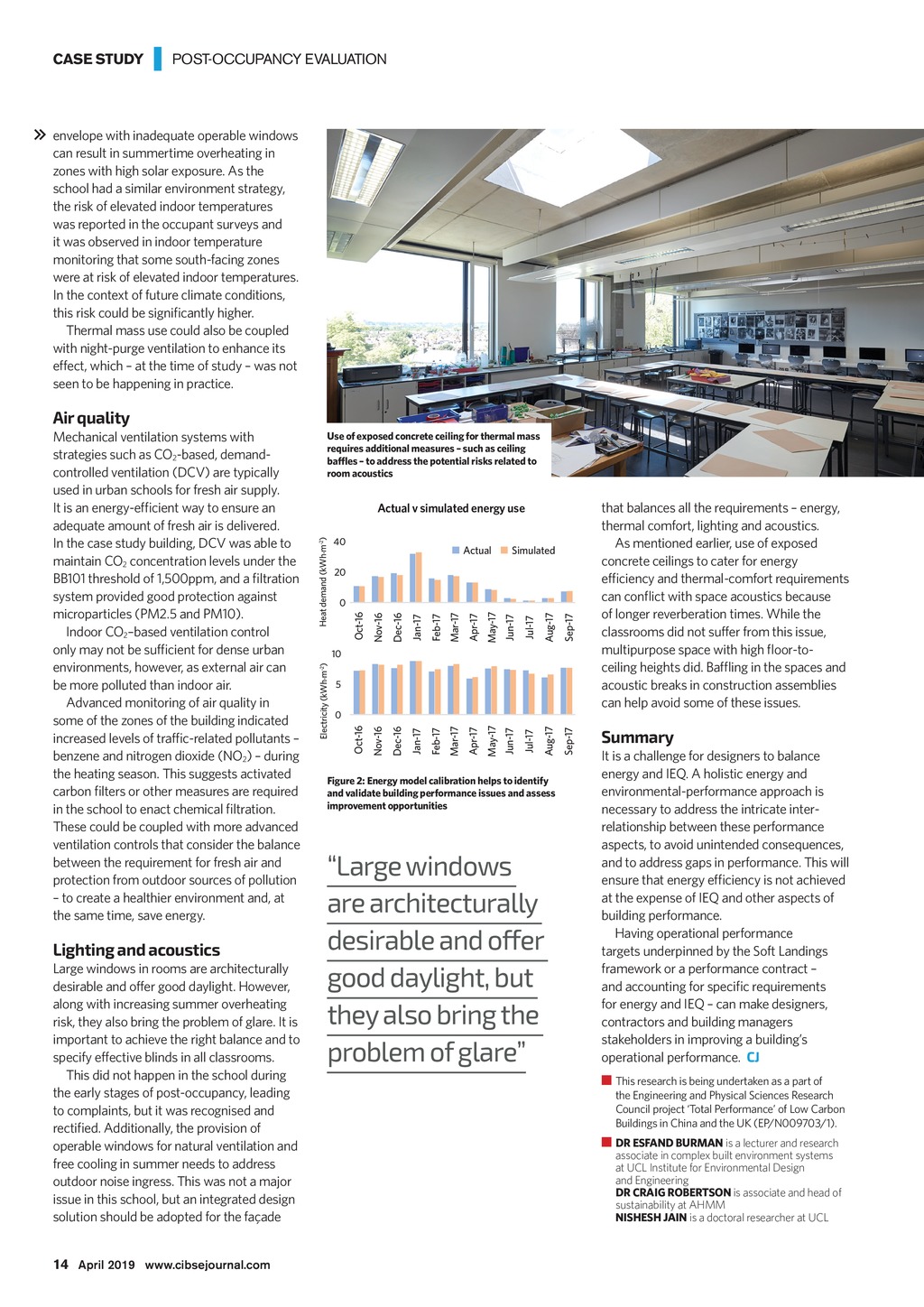


CASE STUDY | POST-OCCUPANCY EVALUATION envelope with inadequate operable windows can result in summertime overheating in zones with high solar exposure. As the school had a similar environment strategy, the risk of elevated indoor temperatures wasreported in the occupant surveys and it was observed in indoor temperature monitoring that some south-facing zones were at risk of elevated indoor temperatures. In the context of future climate conditions, this risk could be significantly higher. Thermal mass use could also be coupled with night-purge ventilation to enhance its effect, which at the time of study was not seen to be happening in practice. Air quality Lighting and acoustics Large windows in rooms are architecturally desirable and offer good daylight. However, along with increasing summer overheating risk, they also bring the problem of glare. It is important to achieve the right balance and to specify effective blinds in all classrooms. This did not happen in the school during the early stages of post-occupancy, leading to complaints, but it was recognised and rectified. Additionally, the provision of operable windows for natural ventilation and free cooling in summer needs to address outdoor noise ingress. This was not a major issue in this school, but an integrated design solution should be adopted for the faade Use of exposed concrete ceiling for thermal mass requires additional measures such as ceiling baffles to address the potential risks related to room acoustics 40 Actual Simulated 20 Sep-17 Jul-17 Aug-17 Aug-17 Jun-17 Jul-17 Apr-17 May-17 May-17 Mar-17 Apr-17 Mar-17 Jan-17 Feb-17 Dec-16 Dec-16 Feb-17 Oct-16 Nov-16 Oct-16 0 Nov-16 Heat demand (kWh.m-2) Actual v simulated energy use 10 5 Figure 2: Energy model calibration helps to identify and validate building performance issues and assess improvement opportunities Large windows are architecturally desirable and offer good daylight, but they also bring the problem of glare Sep-17 Jun-17 0 Jan-17 Electricity (kWh.m-2) Mechanical ventilation systems with strategies such as CO2-based, demandcontrolled ventilation (DCV) are typically used in urban schools for fresh air supply. It is an energy-efficient way to ensure an adequate amount of fresh air is delivered. In the case study building, DCV was able to maintain CO2 concentration levels under the BB101 threshold of 1,500ppm, and a filtration system provided good protection against microparticles (PM2.5 and PM10). Indoor CO2based ventilation control only may not be sufficient for dense urban environments, however, as external air can be more polluted than indoor air. Advanced monitoring of air quality in some of the zones of the building indicated increased levels of traffic-related pollutants benzene and nitrogen dioxide (NO2) during the heating season. This suggests activated carbon filters or other measures are required in the school to enact chemical filtration. These could be coupled with more advanced ventilation controls that consider the balance between the requirement for fresh air and protection from outdoor sources of pollution to create a healthier environment and, at the same time, save energy. that balances all the requirements energy, thermal comfort, lighting and acoustics. As mentioned earlier, use of exposed concrete ceilings to cater for energy efficiency and thermal-comfort requirements can conflict with space acoustics because of longer reverberation times. While the classrooms did not suffer from this issue, multipurpose space with high floor-toceiling heights did. Baffling in the spaces and acoustic breaks in construction assemblies can help avoid some of these issues. Summary It is a challenge for designers to balance energy and IEQ. A holistic energy and environmental-performance approach is necessary to address the intricate interrelationship between these performance aspects, to avoid unintended consequences, and to address gaps in performance. This will ensure that energy efficiency is not achieved at the expense of IEQ and other aspects of building performance. Having operational performance targets underpinned by the Soft Landings framework or a performance contract and accounting for specific requirements for energy and IEQ can make designers, contractors and building managers stakeholders in improving a buildings operational performance. CJ This research is being undertaken as a part of the Engineering and Physical Sciences Research Council project Total Performance of Low Carbon Buildings in China and the UK (EP/N009703/1). DR ESFAND BURMAN is a lecturer and research associate in complex built environment systems at UCL Institute for Environmental Design andEngineering DR CRAIG ROBERTSON is associate and head of sustainability at AHMM NISHESH JAIN is a doctoral researcher at UCL 14 April 2019 www.cibsejournal.com CIBSE Apr19 pp12-14 School Supp POE.indd 14 22/03/2019 13:14