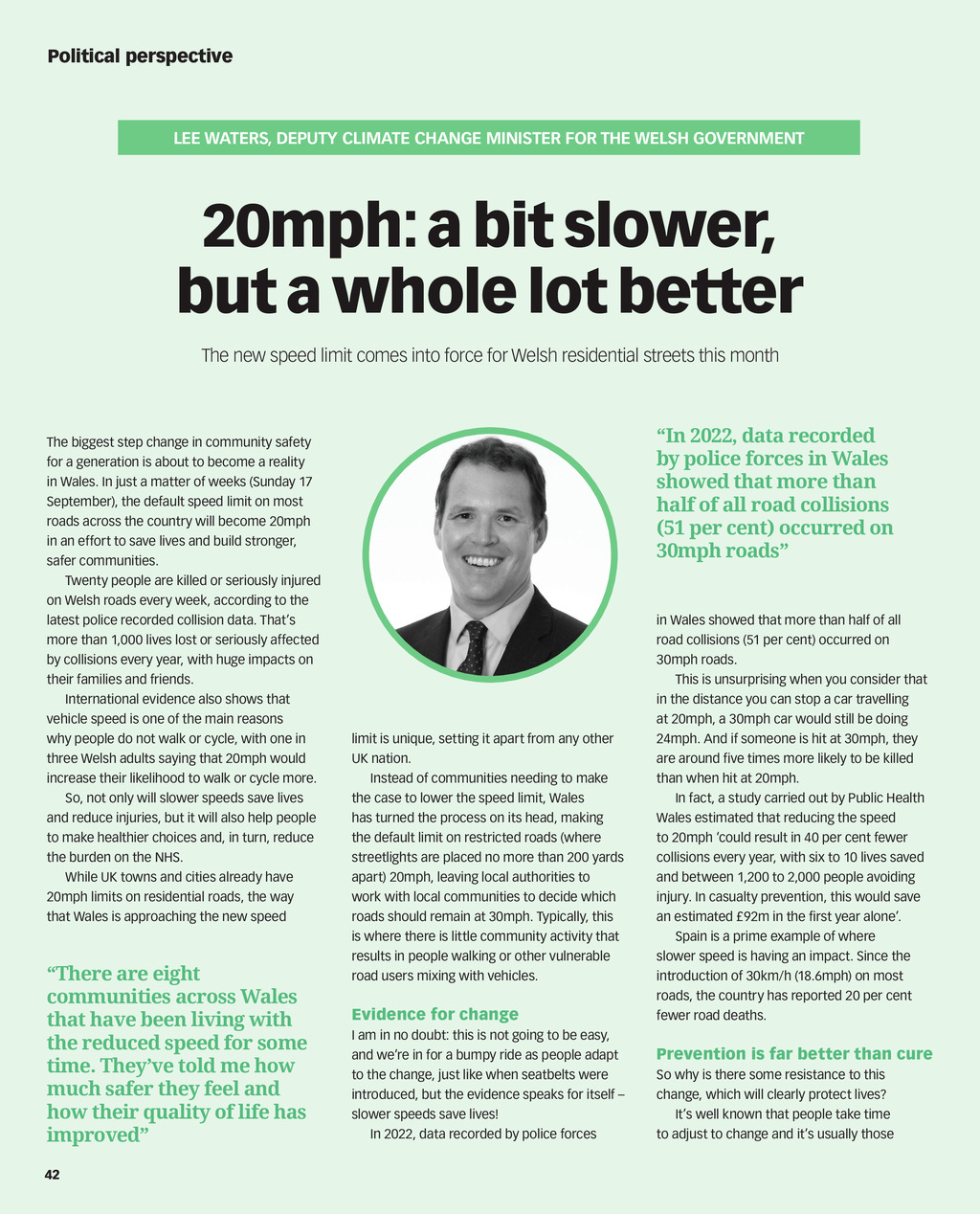
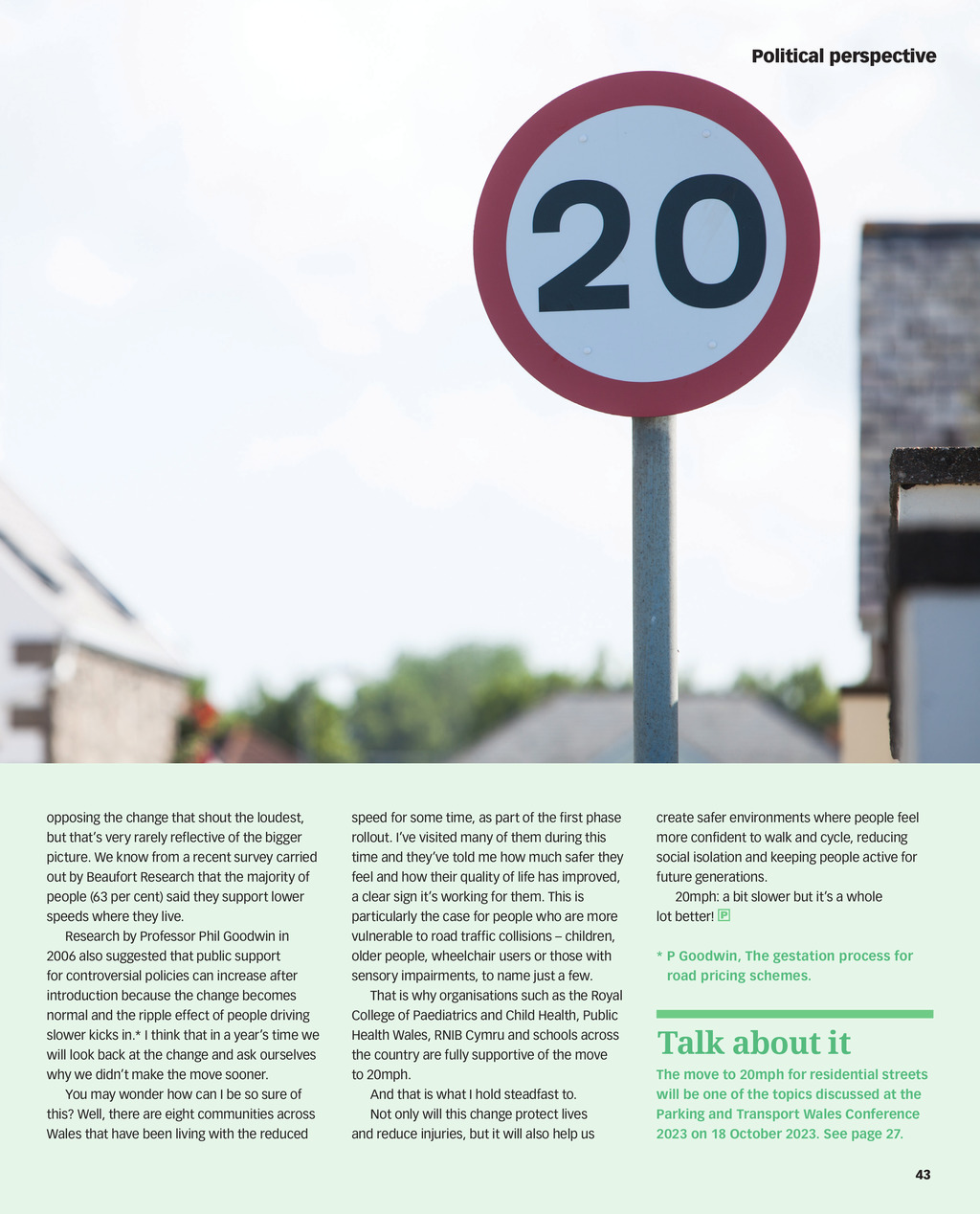

Political perspective LEE WATERS, DEPUTY CLIMATE CHANGE MINISTER FOR THE WELSH GOVERNMENT 20mph: a bit slower, but a whole lot better The new speed limit comes into force for Welsh residential streets this month The biggest step change in community safety for a generation is about to become a reality in Wales. In just a matter of weeks (Sunday 17 September), the default speed limit on most roads across the country will become 20mph in an effort to save lives and build stronger, safer communities. Twenty people are killed or seriously injured on Welsh roads every week, according to the latest police recorded collision data. Thats more than 1,000 lives lost or seriously affected by collisions every year, with huge impacts on their families and friends. International evidence also shows that vehicle speed is one of the main reasons why people do not walk or cycle, with one in three Welsh adults saying that 20mph would increase their likelihood to walk or cycle more. So, not only will slower speeds save lives and reduce injuries, but it will also help people to make healthier choices and, in turn, reduce the burden on the NHS. While UK towns and cities already have 20mph limits on residential roads, the way that Wales is approaching the new speed There are eight communities across Wales that have been living with the reduced speed for some time. Theyve told me how much safer they feel and how their quality of life has improved In 2022, data recorded by police forces in Wales showed that more than half of all road collisions (51 per cent) occurred on 30mph roads limit is unique, setting it apart from any other UK nation. Instead of communities needing to make the case to lower the speed limit, Wales has turned the process on its head, making the default limit on restricted roads (where streetlights are placed no more than 200 yards apart) 20mph, leaving local authorities to work with local communities to decide which roads should remain at 30mph. Typically, this is where there is little community activity that results in people walking or other vulnerable road users mixing with vehicles. Evidence for change I am in no doubt: this is not going to be easy, and were in for a bumpy ride as people adapt to the change, just like when seatbelts were introduced, but the evidence speaks for itself slower speeds save lives! In 2022, data recorded by police forces in Wales showed that more than half of all road collisions (51 per cent) occurred on 30mph roads. This is unsurprising when you consider that in the distance you can stop a car travelling at 20mph, a 30mph car would still be doing 24mph. And if someone is hit at 30mph, they are around five times more likely to be killed than when hit at 20mph. In fact, a study carried out by Public Health Wales estimated that reducing the speed to 20mph could result in 40 per cent fewer collisions every year, with six to 10 lives saved and between 1,200 to 2,000 people avoiding injury. In casualty prevention, this would save an estimated 92m in the first year alone. Spain is a prime example of where slower speed is having an impact. Since the introduction of 30km/h (18.6mph) on most roads, the country has reported 20 per cent fewer road deaths. Prevention is far better than cure So why is there some resistance to this change, which will clearly protect lives? Its well known that people take time to adjust to change and its usually those 42 PN Sept 2023 pp42-43 Political Perspective.indd 42 24/08/2023 11:11