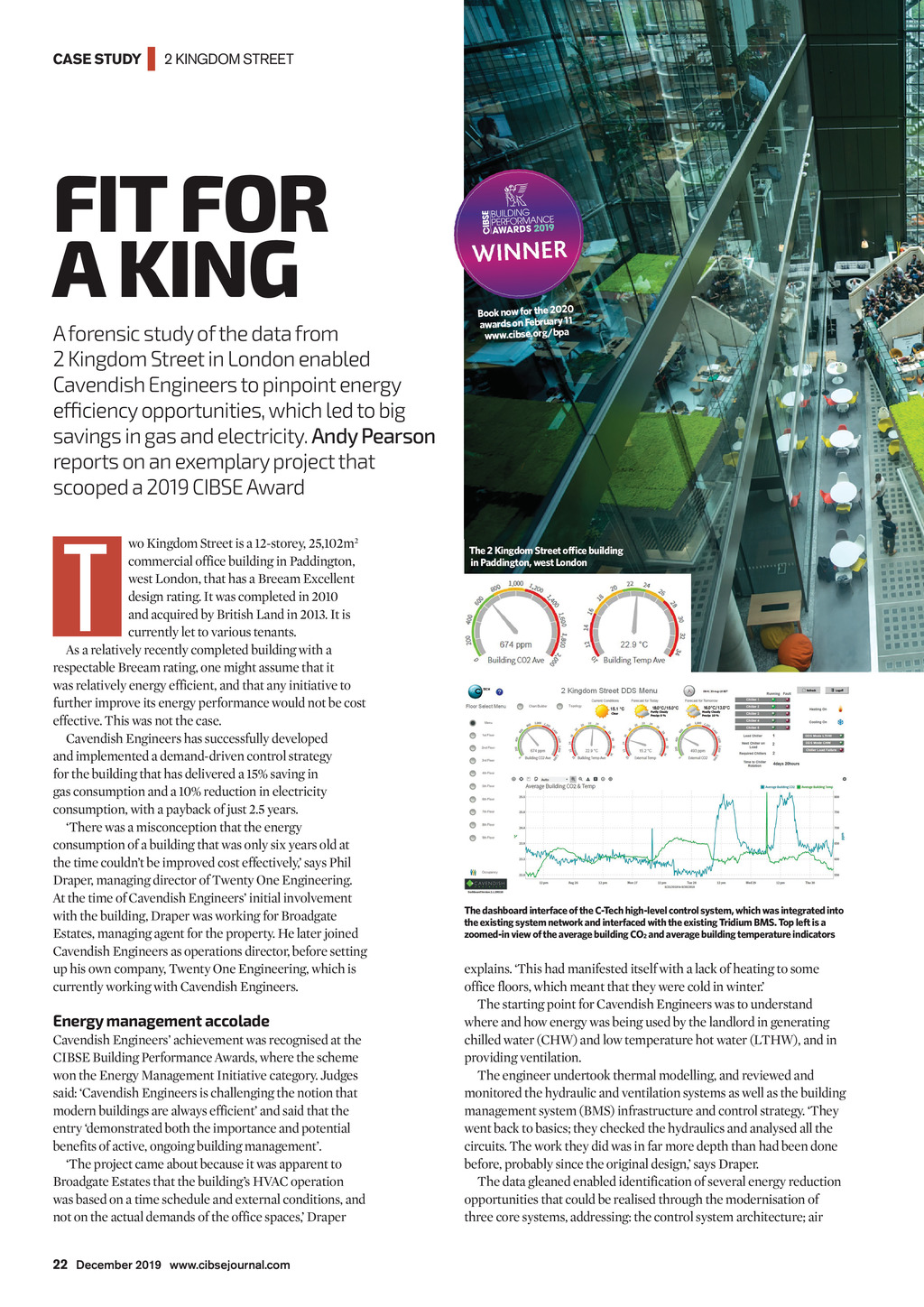
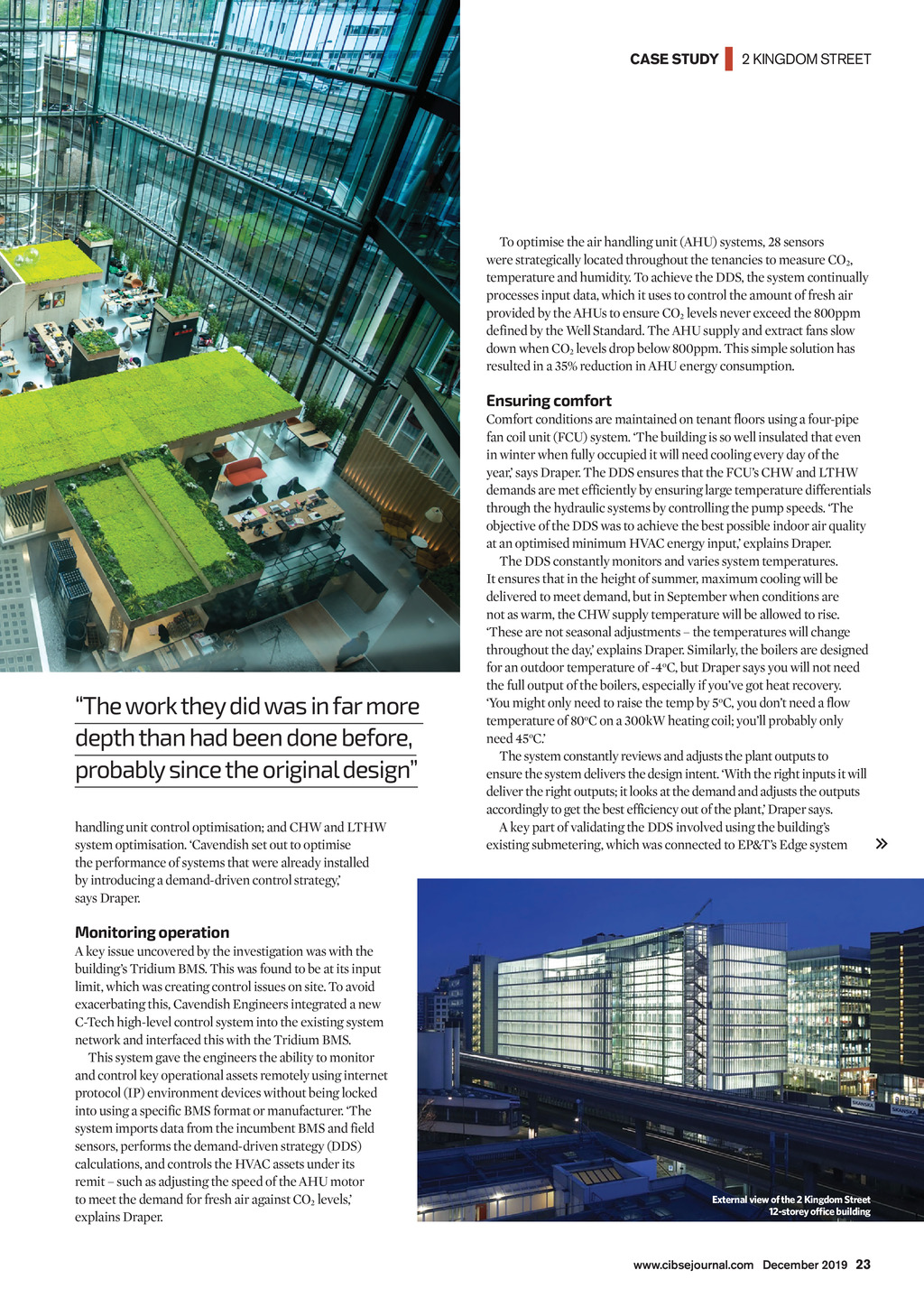

CASE STUDY | 2 KINGDOM STREET FIT FOR A KING A forensic study of the data from 2 Kingdom Street in London enabled Cavendish Engineers to pinpoint energy efficiency opportunities, which led to big savings in gas and electricity. Andy Pearson reports on an exemplary project that scooped a 2019 CIBSE Award T wo Kingdom Street is a 12-storey, 25,102m2 commercial office building in Paddington, west London, that has a Breeam Excellent design rating. It was completed in 2010 and acquired by British Land in 2013. It is currently let to various tenants. As a relatively recently completed building with a respectable Breeam rating, one might assume that it was relatively energy efficient, and that any initiative to further improve its energy performance would not be cost effective. This was not the case. Cavendish Engineers has successfully developed and implemented a demand-driven control strategy for the building that has delivered a 15% saving in gas consumption and a 10% reduction in electricity consumption, with a payback of just 2.5 years. There was a misconception that the energy consumption of a building that was only six years old at the time couldnt be improved cost effectively, says Phil Draper, managing director of Twenty One Engineering. At the time of Cavendish Engineers initial involvement with the building, Draper was working for Broadgate Estates, managing agent for the property. He later joined Cavendish Engineers as operations director, before setting up his own company, Twenty One Engineering, which is currently working with Cavendish Engineers. Energy management accolade Cavendish Engineers achievement was recognised at the CIBSE Building Performance Awards, where the scheme won the Energy Management Initiative category. Judges said: Cavendish Engineers is challenging the notion that modern buildings are always efficient and said that the entry demonstrated both the importance and potential benefits of active, ongoing building management. The project came about because it was apparent to Broadgate Estates that the buildings HVAC operation was based on a time schedule and external conditions, and not on the actual demands of the office spaces, Draper Book now for the 2020 awards on February 11 www.cibse.org/bpa The 2 Kingdom Street ofce building in Paddington, west London The dashboard interface of the C-Tech high-level control system, which was integrated into the existing system network and interfaced with the existing Tridium BMS. Top left is a zoomed-in view of the average building CO2 and average building temperature indicators explains. This had manifested itself with a lack of heating to some office floors, which meant that they were cold in winter. The starting point for Cavendish Engineers was to understand where and how energy was being used by the landlord in generating chilled water (CHW) and low temperature hot water (LTHW), and in providing ventilation. The engineer undertook thermal modelling, and reviewed and monitored the hydraulic and ventilation systems as well as the building management system (BMS) infrastructure and control strategy. They went back to basics; they checked the hydraulics and analysed all the circuits. The work they did was in far more depth than had been done before, probably since the original design, says Draper. The data gleaned enabled identification of several energy reduction opportunities that could be realised through the modernisation of three core systems, addressing: the control system architecture; air 22 December 2019 www.cibsejournal.com CIBSE Dec19 pp22-24 Two Kingdom St.indd 22 22/11/2019 15:17