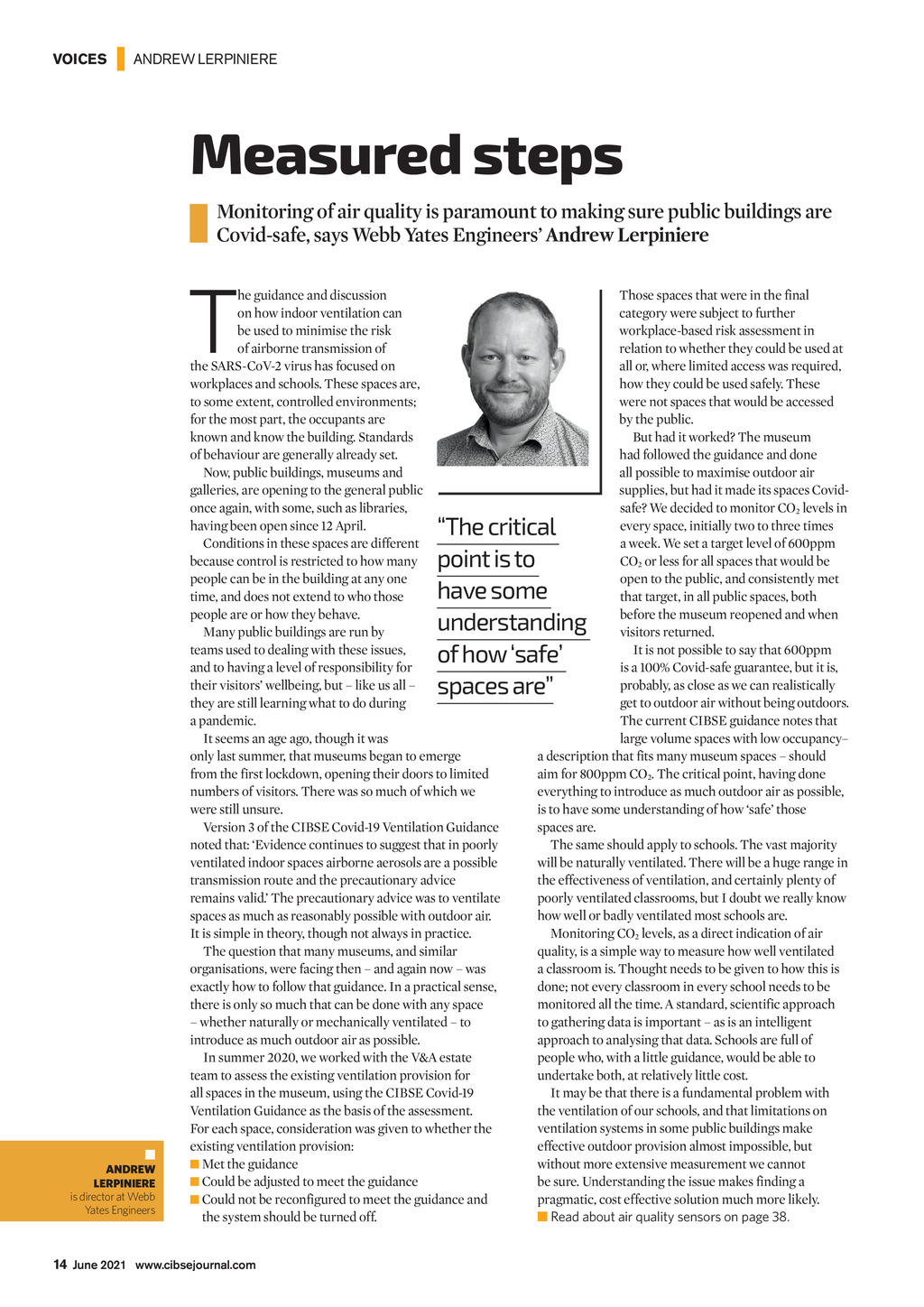


VOICES | ANDREW LERPINIERE Measured steps Monitoring of air quality is paramount to making sure public buildings are Covid-safe, says Webb Yates Engineers Andrew Lerpiniere T he guidance and discussion on how indoor ventilation can be used to minimise the risk of airborne transmission of the SARS-CoV-2 virus has focused on workplaces and schools. These spaces are, to some extent, controlled environments; for the most part, the occupants are known and know the building. Standards of behaviour are generally already set. Now, public buildings, museums and galleries, are opening to the general public once again, with some, such as libraries, having been open since 12 April. Conditions in these spaces are different because control is restricted to how many people can be in the building at any one time, and does not extend to who those people are or how they behave. Many public buildings are run by teams used to dealing with these issues, and to having a level of responsibility for their visitors wellbeing, but like us all they are still learning what to do during a pandemic. It seems an age ago, though it was only last summer, that museums began to emerge from the first lockdown, opening their doors to limited numbers of visitors. There was so much of which we were still unsure. Version 3 of the CIBSE Covid-19 Ventilation Guidance noted that: Evidence continues to suggest that in poorly ventilated indoor spaces airborne aerosols are a possible transmission route and the precautionary advice remains valid. The precautionary advice was to ventilate spaces as much as reasonably possible with outdoor air. It is simple in theory, though not always in practice. The question that many museums, and similar organisations, were facing then and again now was exactly how to follow that guidance. In a practical sense, there is only so much that can be done with any space whether naturally or mechanically ventilated to introduce as much outdoor air as possible. In summer 2020, we worked with the V&A estate team to assess the existing ventilation provision for all spaces in the museum, using the CIBSE Covid-19 Ventilation Guidance as the basis of the assessment. For each space, consideration was given to whether the existing ventilation provision: Met the guidance Could be adjusted to meet the guidance Could not be reconfigured to meet the guidance and the system should be turned off. Those spaces that were in the final category were subject to further workplace-based risk assessment in relation to whether they could be used at all or, where limited access was required, how they could be used safely. These were not spaces that would be accessed by the public. But had it worked? The museum had followed the guidance and done all possible to maximise outdoor air supplies, but had it made its spaces Covidsafe? We decided to monitor CO2 levels in every space, initially two to three times a week. We set a target level of 600ppm CO2 or less for all spaces that would be open to the public, and consistently met that target, in all public spaces, both before the museum reopened and when visitors returned. It is not possible to say that 600ppm is a 100% Covid-safe guarantee, but it is, probably, as close as we can realistically get to outdoor air without being outdoors. The current CIBSE guidance notes that large volume spaces with low occupancy a description that fits many museum spaces should aim for 800ppm CO2. The critical point, having done everything to introduce as much outdoor air as possible, is to have some understanding of how safe those spaces are. The same should apply to schools. The vast majority will be naturally ventilated. There will be a huge range in the effectiveness of ventilation, and certainly plenty of poorly ventilated classrooms, but I doubt we really know how well or badly ventilated most schools are. Monitoring CO2 levels, as a direct indication of air quality, is a simple way to measure how well ventilated a classroom is. Thought needs to be given to how this is done; not every classroom in every school needs to be monitored all the time. A standard, scientific approach to gathering data is important as is an intelligent approach to analysing that data. Schools are full of people who, with a little guidance, would be able to undertake both, at relatively little cost. It may be that there is a fundamental problem with the ventilation of our schools, and that limitations on ventilation systems in some public buildings make effective outdoor provision almost impossible, but without more extensive measurement we cannot be sure. Understanding the issue makes finding a pragmatic, cost effective solution much more likely. Read about air quality sensors on page 38. The critical point is to have some understanding of how safe spaces are ANDREW LERPINIERE is director at Webb Yates Engineers 14 June 2021 www.cibsejournal.com CIBSE June 21 pp14 Opinion.indd 14 21/05/2021 17:50