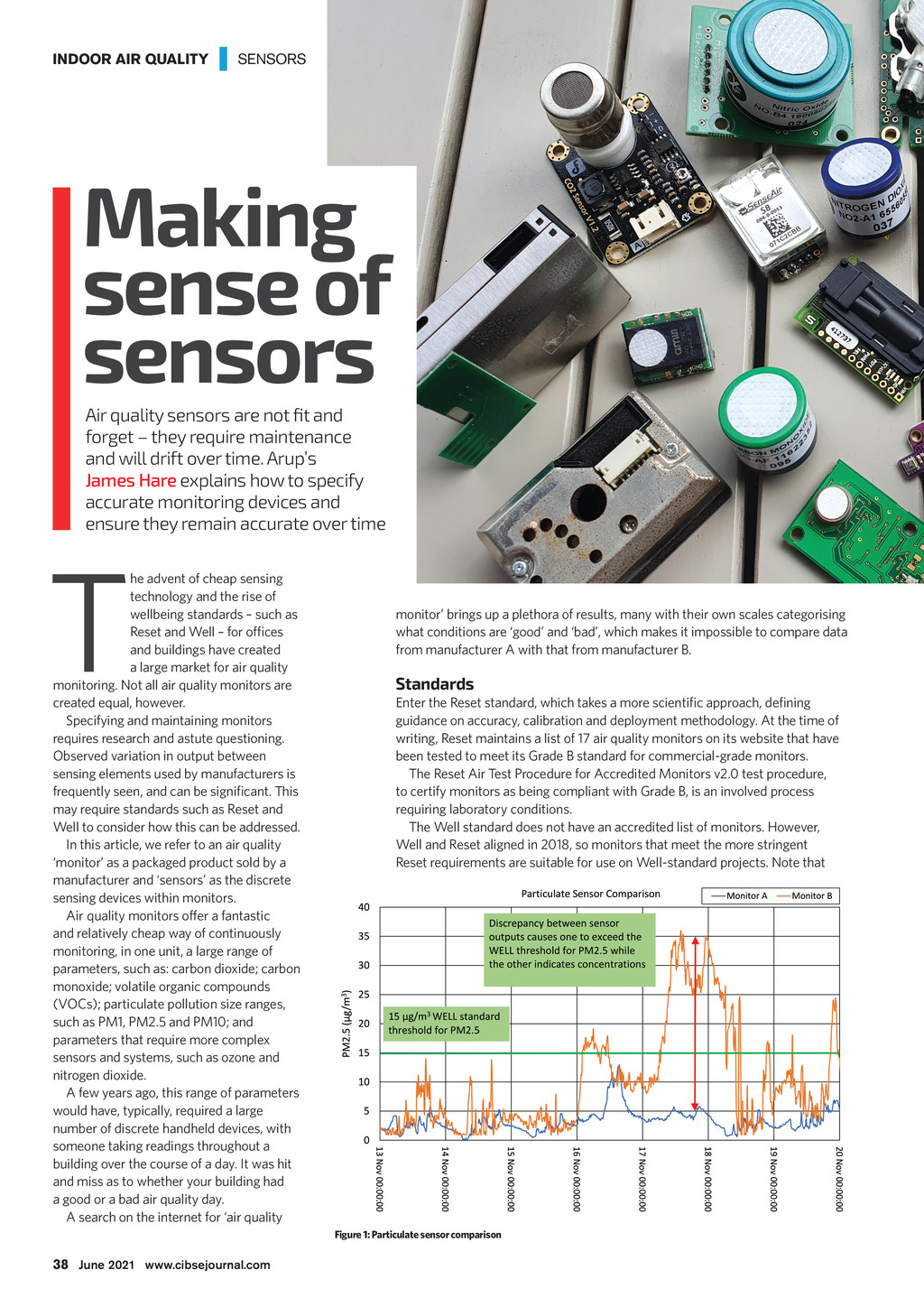


INDOOR AIR QUALITY | SENSORS Making sense of sensors Air quality sensors are not fit and forget they require maintenance and will drift over time. Arups James Hare explains how to specify accurate monitoring devices and ensure they remain accurate over time T he advent of cheap sensing technology and the rise of wellbeing standards such as and buildings have created a large market for air quality monitoring. Not all air quality monitors are created equal, however. Specifying and maintaining monitors requires research and astute questioning. Observed variation in output between sensing elements used by manufacturers is may require standards such as Reset and Well to consider how this can be addressed. In this article, we refer to an air quality monitor as a packaged product sold by a manufacturer and sensors as the discrete sensing devices within monitors. Air quality monitors offer a fantastic and relatively cheap way of continuously monitoring, in one unit, a large range of parameters, such as: carbon dioxide; carbon monoxide; volatile organic compounds (VOCs); particulate pollution size ranges, such as PM1, PM2.5 and PM10; and parameters that require more complex sensors and systems, such as ozone and nitrogen dioxide. A few years ago, this range of parameters would have, typically, required a large number of discrete handheld devices, with someone taking readings throughout a building over the course of a day. It was hit and miss as to whether your building had a good or a bad air quality day. A search on the internet for air quality monitor brings up a plethora of results, many with their own scales categorising what conditions are good and bad, which makes it impossible to compare data from manufacturer A with that from manufacturer B. Standards guidance on accuracy, calibration and deployment methodology. At the time of writing, Reset maintains a list of 17 air quality monitors on its website that have been tested to meet its Grade B standard for commercial-grade monitors. The Reset Air Test Procedure for Accredited Monitors v2.0 test procedure, to certify monitors as being compliant with Grade B, is an involved process requiring laboratory conditions. The Well standard does not have an accredited list of monitors. However, Well and Reset aligned in 2018, so monitors that meet the more stringent Reset requirements are suitable for use on Well-standard projects. Note that Figure 1: Particulate sensor comparison 38 June 2021 www.cibsejournal.com CIBSE June 21 pp38-40 Air quality sensors Supp.indd 38 21/05/2021 16:24