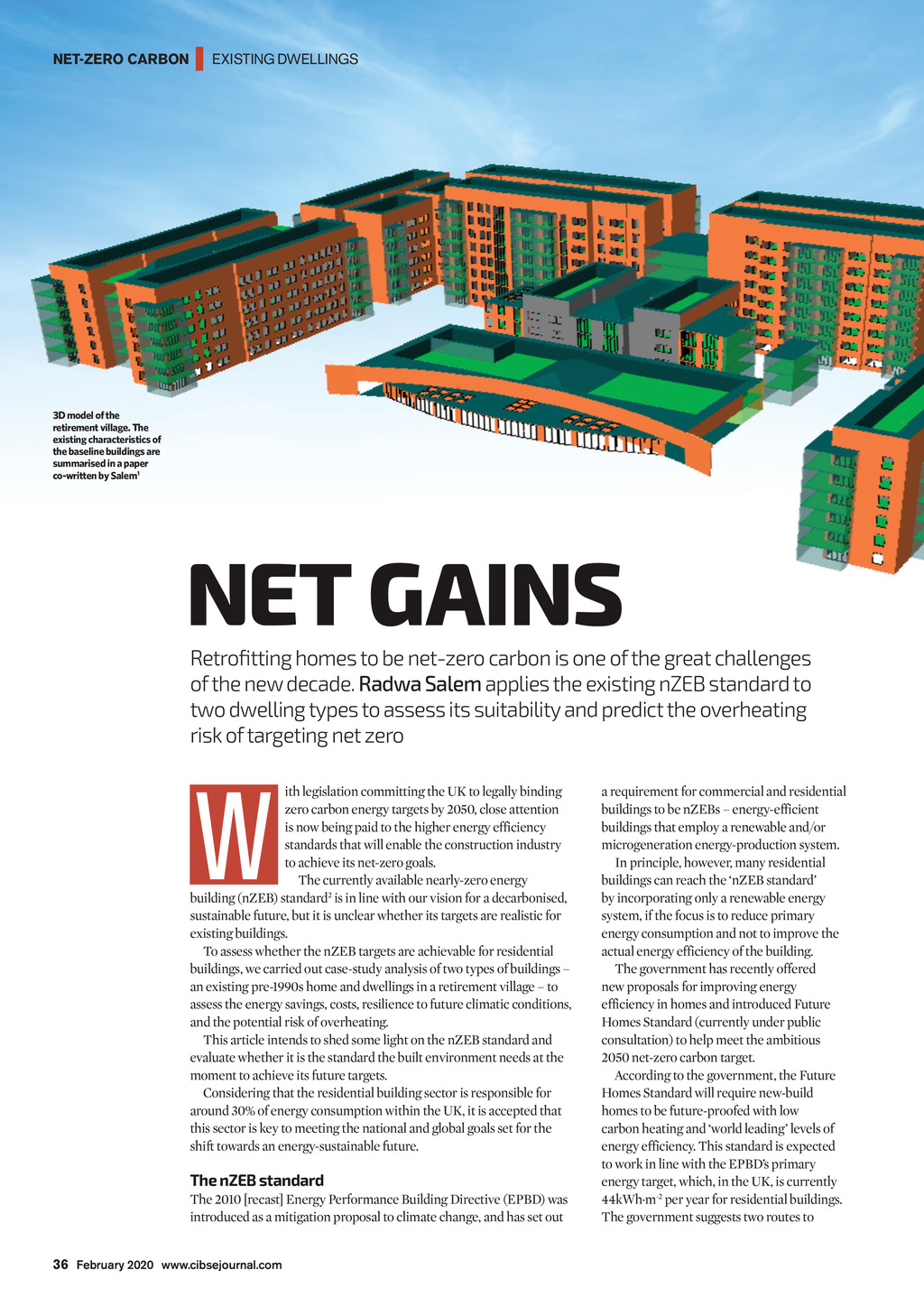


NET-ZERO CARBON | EXISTING DWELLINGS 3D model of the retirement village. The existing characteristics of the baseline buildings are summarised in a paper co-written by Salem1 NET GAINS Retrofitting homes to be net-zero carbon is one of the great challenges of the new decade. Radwa Salem applies the existing nZEB standard to two dwelling types to assess its suitability and predict the overheating risk of targeting net zero W ith legislation committing the UK to legally binding zero carbon energy targets by 2050, close attention is now being paid to the higher energy efficiency standards that will enable the construction industry to achieve its net-zero goals. The currently available nearly-zero energy building (nZEB) standard2 is in line with our vision for a decarbonised, sustainable future, but it is unclear whether its targets are realistic for existing buildings. To assess whether the nZEB targets are achievable for residential buildings, we carried out case-study analysis of two types of buildings an existing pre-1990s home and dwellings in a retirement village to assess the energy savings, costs, resilience to future climatic conditions, and the potential risk of overheating. This article intends to shed some light on the nZEB standard and evaluate whether it is the standard the built environment needs at the moment to achieve its future targets. Considering that the residential building sector is responsible for around 30% of energy consumption within the UK, it is accepted that this sector is key to meeting the national and global goals set for the shift towards an energy-sustainable future. The nZEB standard The 2010 [recast] Energy Performance Building Directive (EPBD) was introduced as a mitigation proposal to climate change, and has set out a requirement for commercial and residential buildings to be nZEBs energy-efficient buildings that employ a renewable and/or microgeneration energy-production system. In principle, however, many residential buildings can reach the nZEB standard by incorporating only a renewable energy system, if the focus is to reduce primary energy consumption and not to improve the actual energy efficiency of the building. The government has recently offered new proposals for improving energy efficiency in homes and introduced Future Homes Standard (currently under public consultation) to help meet the ambitious 2050 net-zero carbon target. According to the government, the Future Homes Standard will require new-build homes to be future-proofed with low carbon heating and world leading levels of energy efficiency. This standard is expected to work in line with the EPBDs primary energy target, which, in the UK, is currently 44kWh.m-2 per year for residential buildings. The government suggests two routes to 36 February 2020 www.cibsejournal.com CIBSE Feb20 pp36-39 Zero carbon.indd 36 24/01/2020 17:18