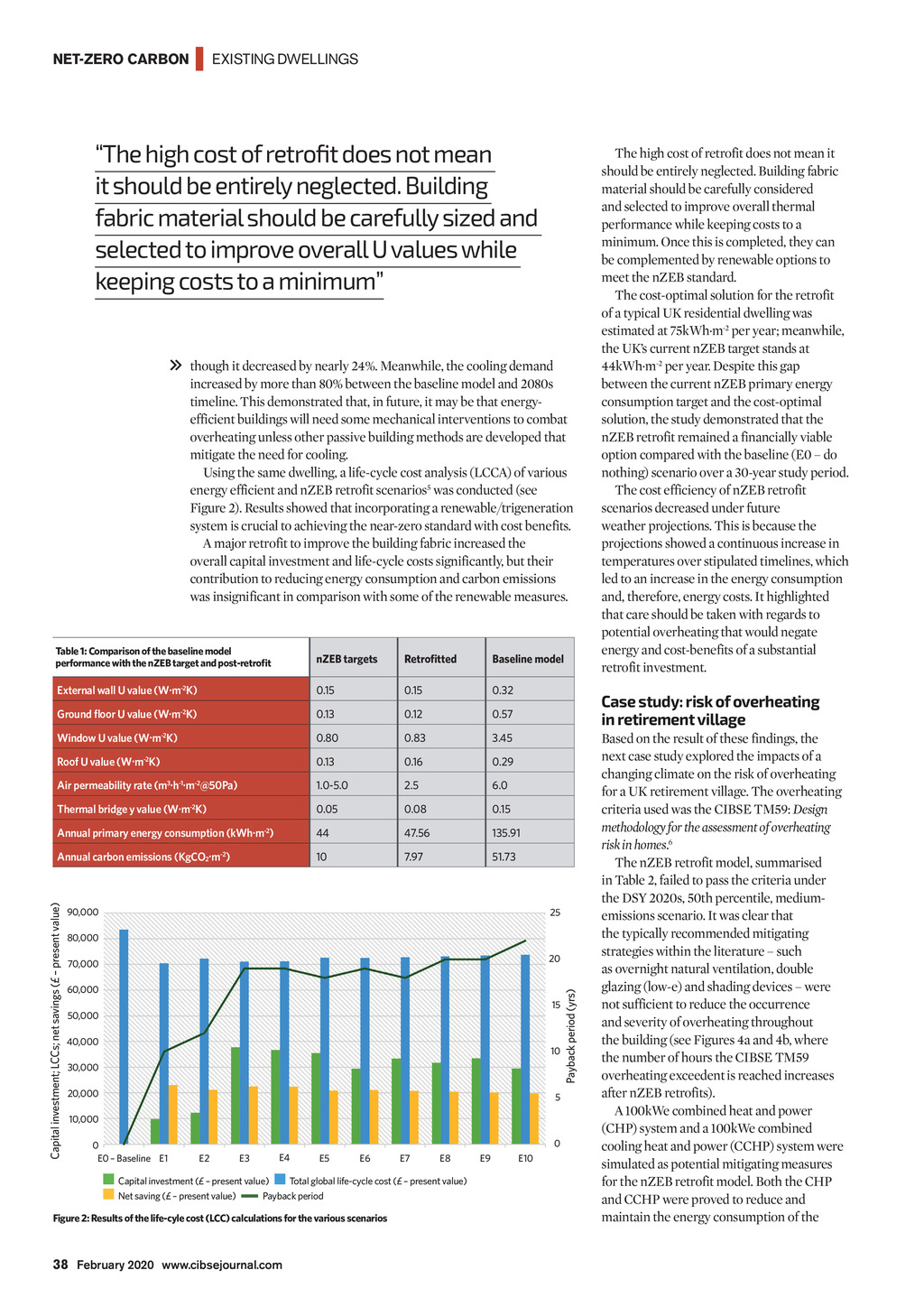


NET-ZERO CARBON | EXISTING DWELLINGS The high cost of retrofit does not mean it should be entirely neglected. Building fabric material should be carefully sized and selected to improve overall U values while keeping costs to a minimum though it decreased by nearly 24%. Meanwhile, the cooling demand increased by more than 80% between the baseline model and 2080s timeline. This demonstrated that, in future, it may be that energyefficient buildings will need some mechanical interventions to combat overheating unless other passive building methods are developed that mitigate the need for cooling. Using the same dwelling, a life-cycle cost analysis (LCCA) of various energy efficient and nZEB retrofit scenarios5 was conducted (see Figure 2). Results showed that incorporating a renewable/trigeneration system is crucial to achieving the near-zero standard with cost benefits. A major retrofit to improve the building fabric increased the overall capital investment and life-cycle costs significantly, but their contribution to reducing energy consumption and carbon emissions was insignificant in comparison with some of the renewable measures. Table 1: Comparison of the baseline model performance with the nZEB target and post-retrofit nZEB targets Retrofitted Baseline model External wall U value (W.m-2K) 0.15 0.15 0.32 Ground floor U value (W.m-2K) 0.13 0.12 0.57 Window U value (W.m-2K) 0.80 0.83 3.45 Roof U value (W.m-2K) 0.13 0.16 0.29 Air permeability rate (m3.h-1.m-2@50Pa) 1.0-5.0 2.5 6.0 0.05 0.08 0.15 Annual primary energy consumption (kWh.m ) 44 47.56 135.91 Annual carbon emissions (KgCO2.m-2) 10 7.97 51.73 Thermal bridge y value (W.m-2K) Case study: risk of overheating in retirement village 90,000 25 80,000 20 70,000 60,000 15 50,000 40,000 10 30,000 20,000 5 10,000 0 E0 Baseline E1 0 E2 E3 E4 E5 E6 E7 E8 Capital investment ( present value) Total global life-cycle cost ( present value) Net saving ( present value) Payback period Figure 2: Results of the life-cyle cost (LCC) calculations for the various scenarios E9 E10 Payback period (yrs) Capital investment; LCCs; net savings ( present value) -2 The high cost of retrofit does not mean it should be entirely neglected. Building fabric material should be carefully considered and selected to improve overall thermal performance while keeping costs to a minimum. Once this is completed, they can be complemented by renewable options to meet the nZEB standard. The cost-optimal solution for the retrofit of a typical UK residential dwelling was estimated at 75kWh.m-2 per year; meanwhile, the UKs current nZEB target stands at 44kWh.m-2 per year. Despite this gap between the current nZEB primary energy consumption target and the cost-optimal solution, the study demonstrated that the nZEB retrofit remained a financially viable option compared with the baseline (E0 do nothing) scenario over a 30-year study period. The cost efficiency of nZEB retrofit scenarios decreased under future weather projections. This is because the projections showed a continuous increase in temperatures over stipulated timelines, which led to an increase in the energy consumption and, therefore, energy costs. It highlighted that care should be taken with regards to potential overheating that would negate energy and cost-benefits of a substantial retrofit investment. Based on the result of these findings, the next case study explored the impacts of a changing climate on the risk of overheating for a UK retirement village. The overheating criteria used was the CIBSE TM59: Design methodology for the assessment of overheating risk in homes.6 The nZEB retrofit model, summarised in Table 2, failed to pass the criteria under the DSY 2020s, 50th percentile, mediumemissions scenario. It was clear that the typically recommended mitigating strategies within the literature such as overnight natural ventilation, double glazing (low-e) and shading devices were not sufficient to reduce the occurrence and severity of overheating throughout the building (see Figures 4a and 4b, where the number of hours the CIBSE TM59 overheating exceedent is reached increases after nZEB retrofits). A 100kWe combined heat and power (CHP) system and a 100kWe combined cooling heat and power (CCHP) system were simulated as potential mitigating measures for the nZEB retrofit model. Both the CHP and CCHP were proved to reduce and maintain the energy consumption of the 38 February 2020 www.cibsejournal.com CIBSE Feb20 pp36-39 Zero carbon.indd 38 24/01/2020 15:06