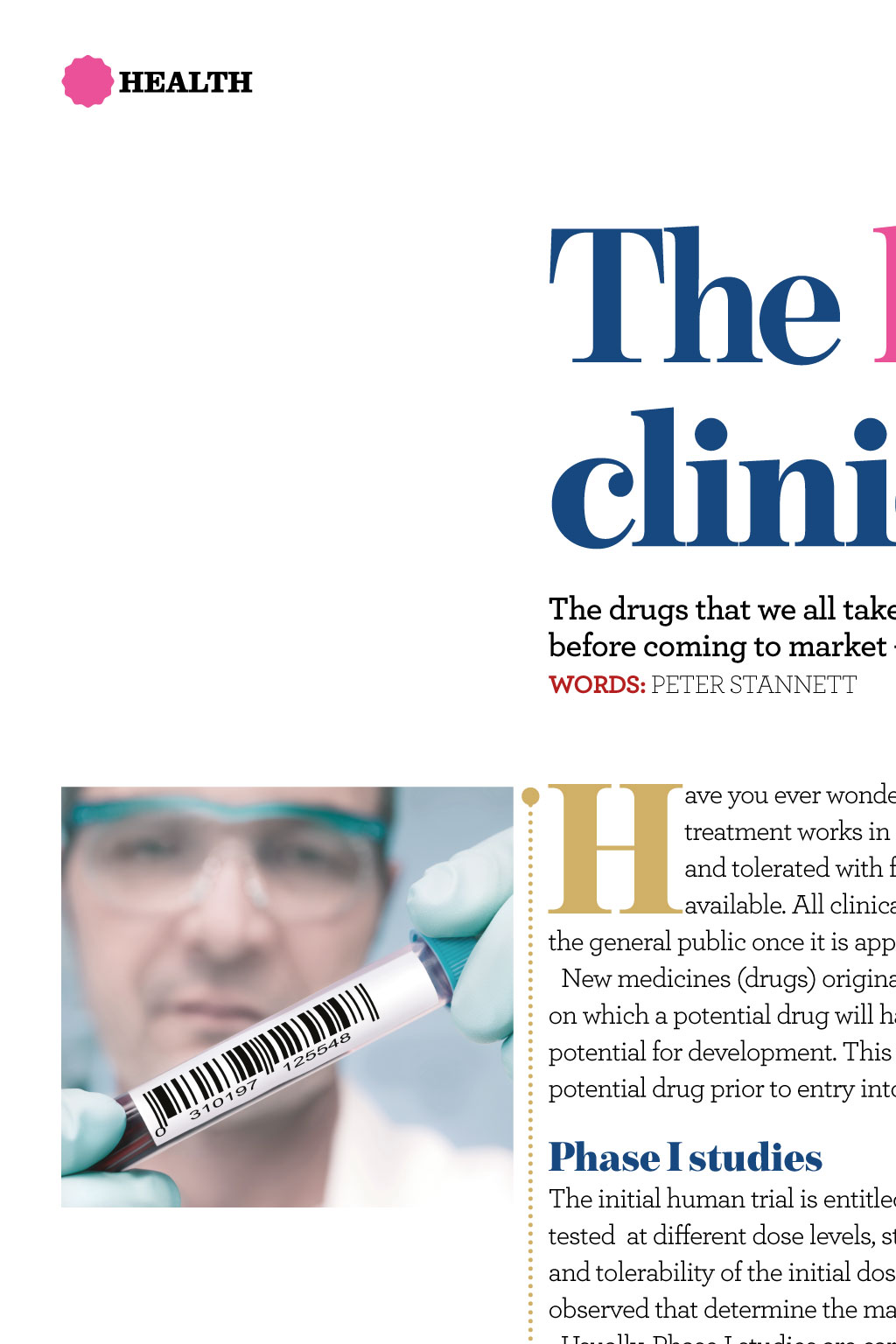

health The lowdown on clinical trials The drugs that we all take for granted have gone through years of tests and trials before coming to market but what really goes into developing them? Words: peter Stannett h ave you ever wondered how new medicines are developed? Clinical trials explore how a treatment works in the human body, and are designed to ensure that a drug is both effective and tolerated with few side effects before it is approved by the regulatory authorities and made available. All clinical trials conform to a strict set of criteria to protect the people involved and the general public once it is approved and launched. New medicines (drugs) originate in the laboratory, where researchers often identify a target in the body on which a potential drug will have a beneficial effect. The next stage is to find the drug with therapeutic potential for development. This goes through a number of tests to assess its safety and efficacy as a potential drug prior to entry into clinical trials. Phase I studies The initial human trial is entitled Phase I and its focus is to evaluate the safety of the drug. The drug is tested at different dose levels, starting with the smallest dose, to see how well tolerated it is. After the safety and tolerability of the initial dose has been determined, the doses are increased until mild side-effects are observed that determine the maximum dose. Work is then concentrated on lower doses. Usually, Phase I studies are carried out in a double-blind randomised way, which means that the group of volunteers are separated into two sets with one set receiving the drug and the other a placebo. A placebo is a dummy pill that does not contain an active drug. Neither the volunteers nor the drug developer know who is in which group, but this would not happen in life-threatening disease settings, such as cancer, as it would be unethical. Phase II studies When the Phase I study has been successfully completed, Phase II trials start. These can take two years or longer, depending on the number of people involved and the speed at which they are recruited into the trial. The trials are carried out to test how effective the drug is, and are done by reviewing the data against the therapeutic claim that the drug developer is proposing. Other parameters are also tested at the same time, along with evaluating the drugs safety and any potential side-effects. This phase is sometimes divided into two. Phase IIa involves a limited number of patients to assess the therapeutic value and obvious side-effects. Phase IIb involves larger numbers of patients and is usually carried out as double-blind placebo-controlled studies. Different dosing regimens are again used, and most trials have between 20-80 patients. The drug developer is likely to propose a main claim for the therapeutic benefit and sub-claims (also known as endpoints). These are measured to determine whether the outcome of the trial is successful. Any parameter that is relevant, sensitive, measurable and ethically acceptable can be used. For example, this could be a reduction in blood pressure and levels of pain or joint stiffness. the process can start with identifying a drug target a receptor, nucleic acid or enzyme Phase III studies in the body Prior to approval, and following a successful Phase II study, a Phase III study starts. This includes a far larger patient population, which will be determined from a review of how many people have the disease. The drug is tested in the same way as in Phase II using double-blind procedures, but on a larger sample of patients. Assessments of clinical benefit are as before. If the same result is observed, then the drug developer will submit the drug candidate to the relevant regulatory authority for approval in a specific territory. For Europe, this is the EMA (European Medical Agency) and for the US it is the FDA (Food and Drug Administration). Phase Iv studies If approval is received, the drug will be launched onto the market but it will still be monitored for rare/ unexpected side-effects. This is because, while Phase III studies are far larger than Phase II, the studies may not pick up certain side-effects in the far larger general population. For example, Rofecoxib for arthritis was withdrawn in 2004 after several years on the market because it was associated with heart attacks and strokes. Typically, it can take 12 years to develop a drug, but the time varies according to the type of drug. The success rate from Phase I to approval across all therapeutic areas is 11 per cent. Studies can be aborted because side-effects are shown or the clinical benefit is insufficient. Sometimes approval is not given because a regulatory authority considers that the developer has not provided sufficient data to demonstrate that the drug will have a clinical benefit, or that it will not have an adverse effect. n Peter Stannett is information officer at Arthritis Care; visit www.arthritiscare.org.uk For more info on drug trials, contact Peter at peters@arthritiscare.org.uk