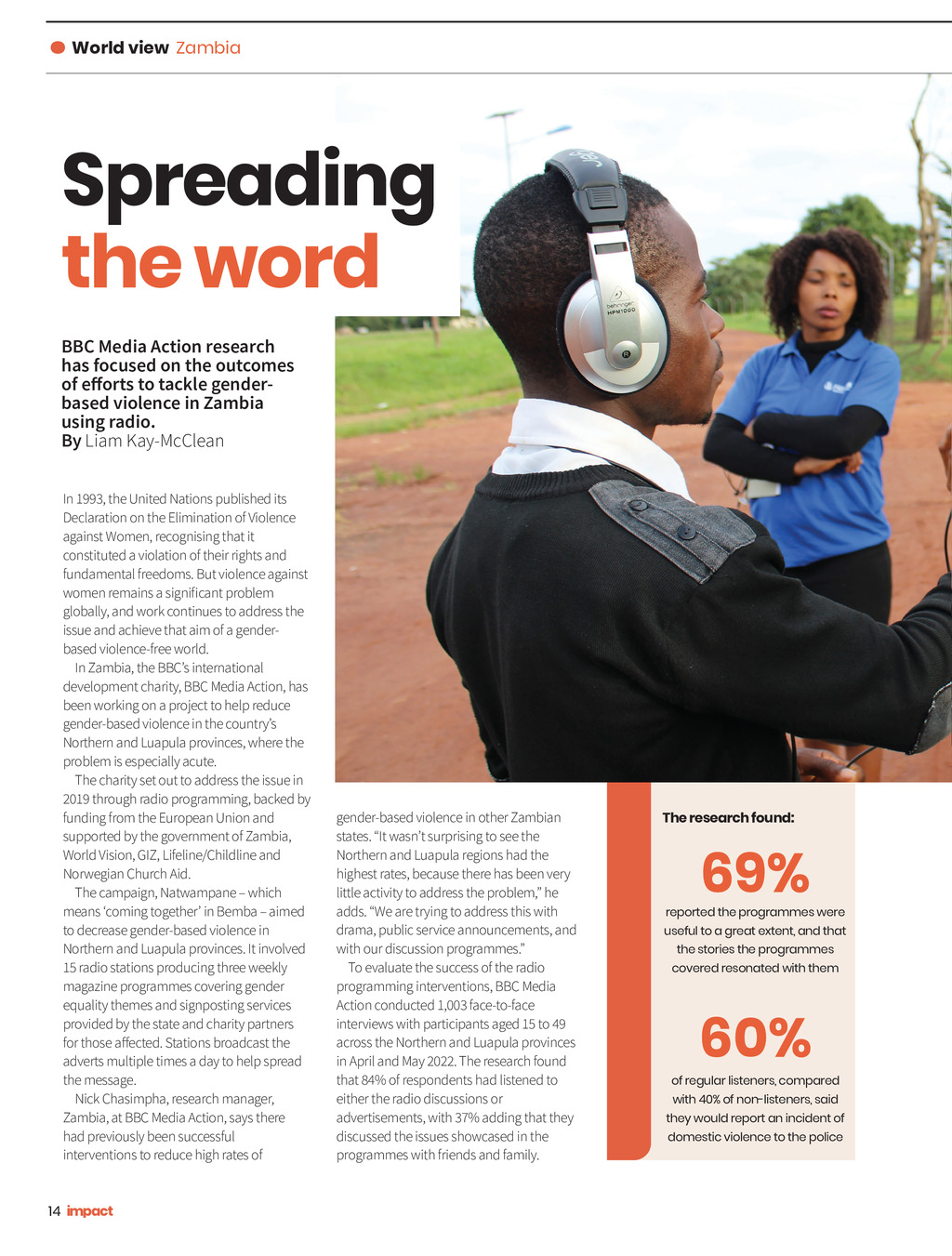


World view Zambia Spreading the word BBC Media Action research has focused on the outcomes of efforts to tackle genderbased violence in Zambia using radio. By Liam Kay-McClean In 1993, the United Nations published its Declaration on the Elimination of Violence against Women, recognising that it constituted a violation of their rights and fundamental freedoms. But violence against women remains a significant problem globally, and work continues to address the issue and achieve that aim of a genderbased violence-free world. In Zambia, the BBCs international development charity, BBC Media Action, has been working on a project to help reduce gender-based violence in the countrys Northern and Luapula provinces, where the problem is especially acute. The charity set out to address the issue in 2019 through radio programming, backed by funding from the European Union and supported by the government of Zambia, World Vision, GIZ, Lifeline/Childline and Norwegian Church Aid. The campaign, Natwampane which means coming together in Bemba aimed to decrease gender-based violence in Northern and Luapula provinces. It involved 15 radio stations producing three weekly magazine programmes covering gender equality themes and signposting services provided by the state and charity partners for those affected. Stations broadcast the adverts multiple times a day to help spread the message. Nick Chasimpha, research manager, Zambia, at BBC Media Action, says there had previously been successful interventions to reduce high rates of gender-based violence in other Zambian states. It wasnt surprising to see the Northern and Luapula regions had the highest rates, because there has been very little activity to address the problem, he adds. We are trying to address this with drama, public service announcements, and with our discussion programmes. To evaluate the success of the radio programming interventions, BBC Media Action conducted 1,003 face-to-face interviews with participants aged 15 to 49 across the Northern and Luapula provinces in April and May 2022. The research found that 84% of respondents had listened to either the radio discussions or advertisements, with 37% adding that they discussed the issues showcased in the programmes with friends and family. The research found: 69% reported the programmes were useful to a great extent, and that the stories the programmes covered resonated with them 60% of regular listeners, compared with 40% of non-listeners, said they would report an incident of domestic violence to the police 14 Impact ISSUE 43 2023_pp14-15 WV Zambia.indd 14 18/09/2023 11:55