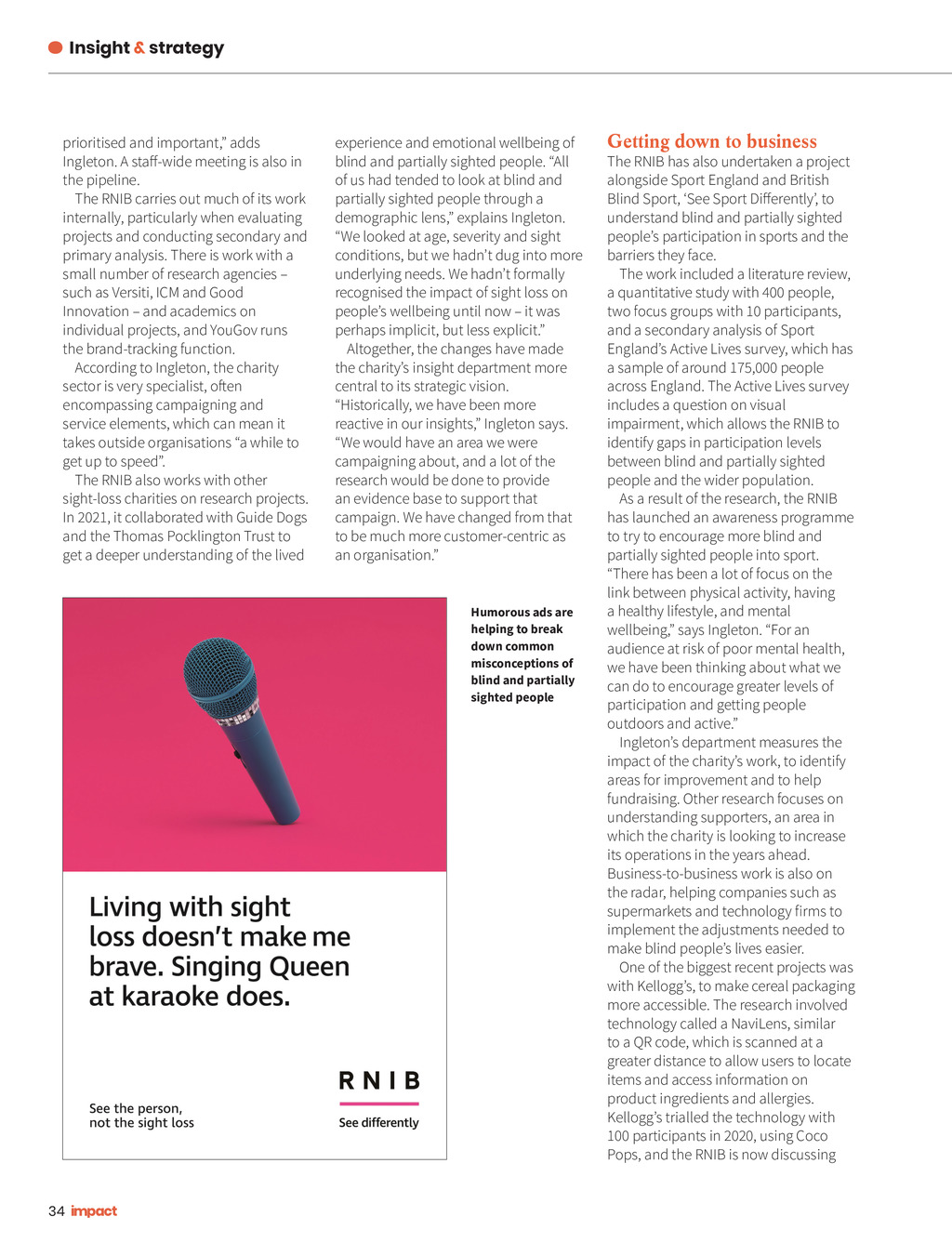


Insight & strategy prioritised and important, adds Ingleton. A staff-wide meeting is also in the pipeline. The RNIB carries out much of its work internally, particularly when evaluating projects and conducting secondary and primary analysis. There is work with a small number of research agencies such as Versiti, ICM and Good Innovation and academics on individual projects, and YouGov runs the brand-tracking function. According to Ingleton, the charity sector is very specialist, often encompassing campaigning and service elements, which can mean it takes outside organisations a while to get up to speed. The RNIB also works with other sight-loss charities on research projects. In 2021, it collaborated with Guide Dogs and the Thomas Pocklington Trust to get a deeper understanding of the lived experience and emotional wellbeing of blind and partially sighted people. All of us had tended to look at blind and partially sighted people through a demographic lens, explains Ingleton. We looked at age, severity and sight conditions, but we hadnt dug into more underlying needs. We hadnt formally recognised the impact of sight loss on peoples wellbeing until now it was perhaps implicit, but less explicit. Altogether, the changes have made the charitys insight department more central to its strategic vision. Historically, we have been more reactive in our insights, Ingleton says. We would have an area we were campaigning about, and a lot of the research would be done to provide an evidence base to support that campaign. We have changed from that to be much more customer-centric as an organisation. Humorous ads are helping to break down common misconceptions of blind and partially sighted people Getting down to business The RNIB has also undertaken a project alongside Sport England and British Blind Sport, See Sport Differently, to understand blind and partially sighted peoples participation in sports and the barriers they face. The work included a literature review, a quantitative study with 400 people, two focus groups with 10 participants, and a secondary analysis of Sport Englands Active Lives survey, which has a sample of around 175,000 people across England. The Active Lives survey includes a question on visual impairment, which allows the RNIB to identify gaps in participation levels between blind and partially sighted people and the wider population. As a result of the research, the RNIB has launched an awareness programme to try to encourage more blind and partially sighted people into sport. There has been a lot of focus on the link between physical activity, having a healthy lifestyle, and mental wellbeing, says Ingleton. For an audience at risk of poor mental health, we have been thinking about what we can do to encourage greater levels of participation and getting people outdoors and active. Ingletons department measures the impact of the charitys work, to identify areas for improvement and to help fundraising. Other research focuses on understanding supporters, an area in which the charity is looking to increase its operations in the years ahead. Business-to-business work is also on the radar, helping companies such as supermarkets and technology firms to implement the adjustments needed to make blind peoples lives easier. One of the biggest recent projects was with Kelloggs, to make cereal packaging more accessible. The research involved technology called a NaviLens, similar to a QR code, which is scanned at a greater distance to allow users to locate items and access information on product ingredients and allergies. Kelloggs trialled the technology with 100 participants in 2020, using Coco Pops, and the RNIB is now discussing 34 Impact ISSUE 36 2022_pp32-35 I&S RNIB.indd 34 08/12/2021 10:07