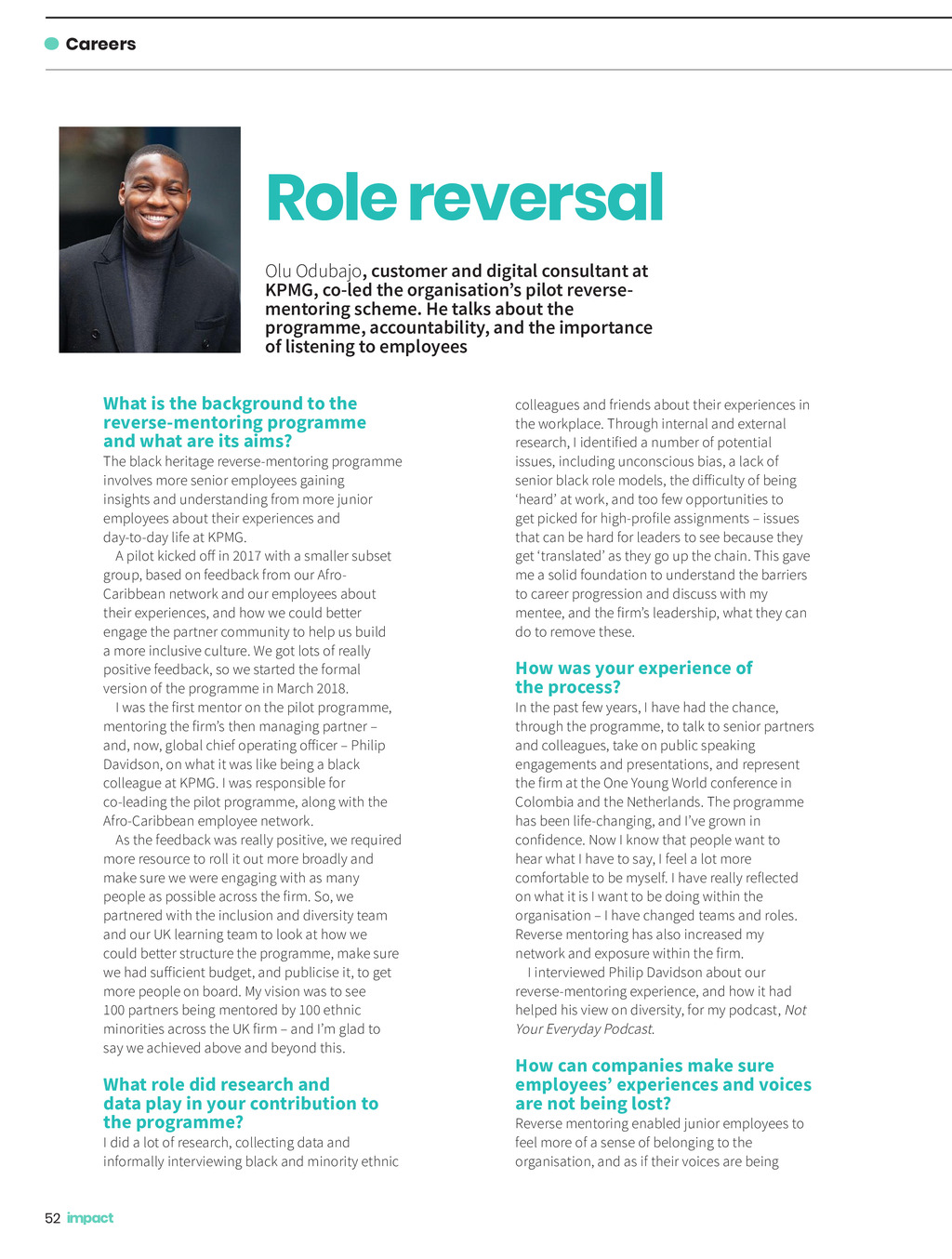


Careers Role reversal Olu Odubajo, customer and digital consultant at KPMG, co-led the organisations pilot reversementoring scheme. He talks about the programme, accountability, and the importance of listening to employees What is the background to the reverse-mentoring programme and what are its aims? The black heritage reverse-mentoring programme involves more senior employees gaining insights and understanding from more junior employees about their experiences and day-to-day life at KPMG. pilot kicked off in with a smaller subset group, based on feedback from our Afroaribbean network and our employees about their experiences, and how we could better engage the partner community to help us build a more inclusive culture. We got lots of really positive feedback, so we started the formal version of the programme in arch . was the first mentor on the pilot programme, mentoring the firms then managing partner and, now, global chief operating officer Philip avidson, on what it was like being a black colleague at P . was responsible for co leading the pilot programme, along with the fro aribbean employee network. s the feedback was really positive, we re uired more resource to roll it out more broadly and make sure we were engaging with as many people as possible across the firm. o, we partnered with the inclusion and diversity team and our learning team to look at how we could better structure the programme, make sure we had sufficient budget, and publicise it, to get more people on board. y vision was to see partners being mentored by ethnic minorities across the firm and m glad to say we achieved above and beyond this. What role did research and data play in your contribution to the programme? I did a lot of research, collecting data and informally interviewing black and minority ethnic colleagues and friends about their experiences in the workplace. Through internal and external research, identified a number of potential issues, including unconscious bias, a lack of senior black role models, the difficulty of being heard at work, and too few opportunities to get picked for high profile assignments issues that can be hard for leaders to see because they get translated as they go up the chain. This gave me a solid foundation to understand the barriers to career progression and discuss with my mentee, and the firms leadership, what they can do to remove these. How was your experience of the process? n the past few years, have had the chance, through the programme, to talk to senior partners and colleagues, take on public speaking engagements and presentations, and represent the firm at the ne oung orld conference in Colombia and the Netherlands. The programme has been life changing, and ve grown in confidence. ow know that people want to hear what have to say, feel a lot more comfortable to be myself. have really reflected on what it is want to be doing within the organisation have changed teams and roles. Reverse mentoring has also increased my network and exposure within the firm. interviewed Philip avidson about our reverse mentoring experience, and how it had helped his view on diversity, for my podcast, Not our veryday Podcast. How can companies make sure employees experiences and voices are not being lost? Reverse mentoring enabled junior employees to feel more of a sense of belonging to the organisation, and as if their voices are being 52 Impact ISSUE 31 20_pp52-53_Careers.indd 52 18/09/2020 11:59