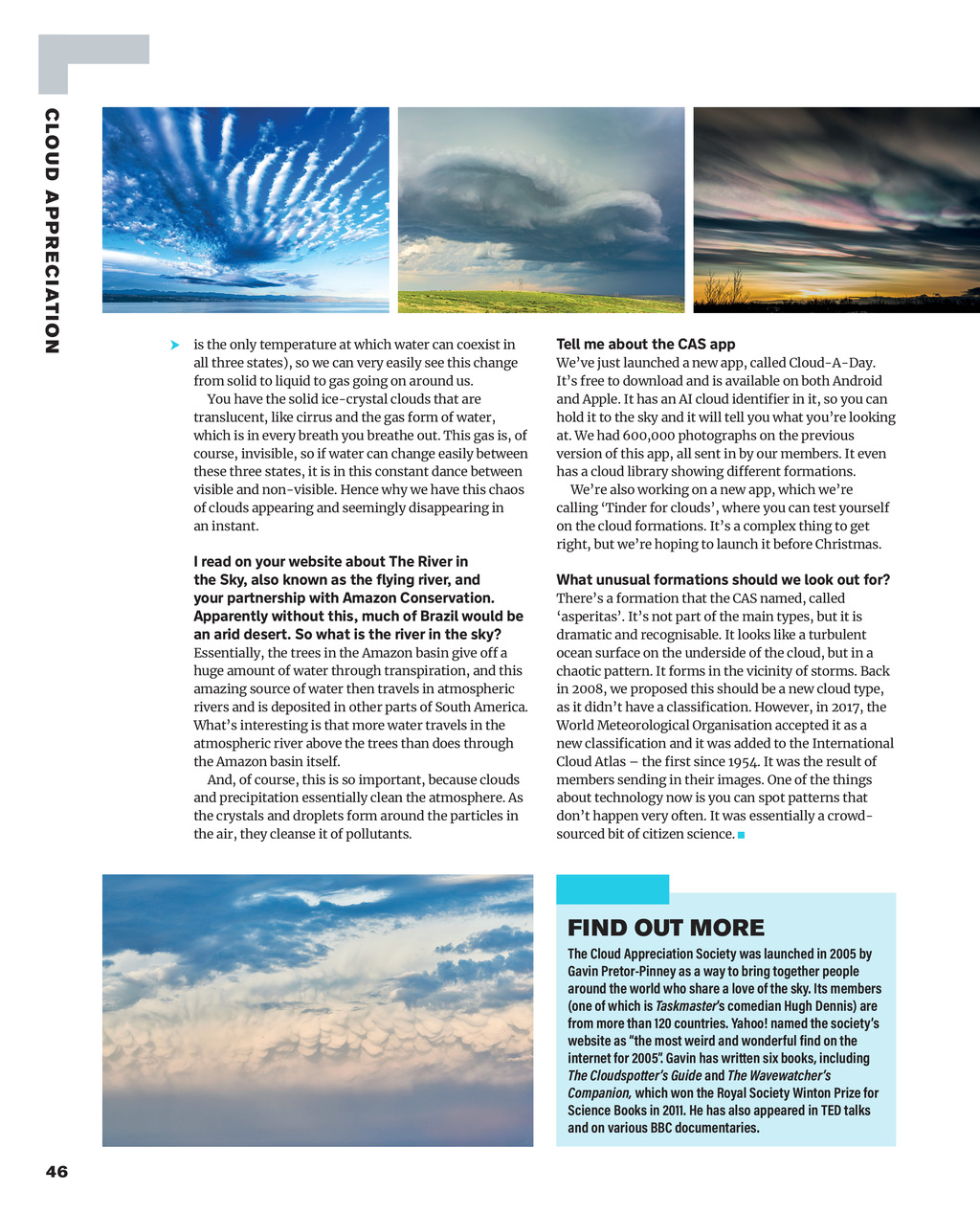

C L O U D A P P R E C I AT I O N is the only temperature at which water can coexist in all three states), so we can very easily see this change from solid to liquid to gas going on around us. You have the solid ice-crystal clouds that are translucent, like cirrus and the gas form of water, which is in every breath you breathe out. This gas is, of course, invisible, so if water can change easily between these three states, it is in this constant dance between visible and non-visible. Hence why we have this chaos of clouds appearing and seemingly disappearing in an instant. I read on your website about The River in the Sky, also known as the flying river, and your partnership with Amazon Conservation. Apparently without this, much of Brazil would be an arid desert. So what is the river in the sky? Essentially, the trees in the Amazon basin give off a huge amount of water through transpiration, and this amazing source of water then travels in atmospheric rivers and is deposited in other parts of South America. Whats interesting is that more water travels in the atmospheric river above the trees than does through the Amazon basin itself. And, of course, this is so important, because clouds and precipitation essentially clean the atmosphere. As the crystals and droplets form around the particles in the air, they cleanse it of pollutants. Tell me about the CAS app Weve just launched a new app, called Cloud-A-Day. Its free to download and is available on both Android and Apple. It has an AI cloud identifier in it, so you can hold it to the sky and it will tell you what youre looking at. We had 600,000 photographs on the previous version of this app, all sent in by our members. It even has a cloud library showing different formations. Were also working on a new app, which were calling Tinder for clouds, where you can test yourself on the cloud formations. Its a complex thing to get right, but were hoping to launch it before Christmas. What unusual formations should we look out for? Theres a formation that the CAS named, called asperitas. Its not part of the main types, but it is dramatic and recognisable. It looks like a turbulent ocean surface on the underside of the cloud, but in a chaotic pattern. It forms in the vicinity of storms. Back in 2008, we proposed this should be a new cloud type, as it didnt have a classification. However, in 2017, the World Meteorological Organisation accepted it as a new classification and it was added to the International Cloud Atlas the first since 1954. It was the result of members sending in their images. One of the things about technology now is you can spot patterns that dont happen very often. It was essentially a crowdsourced bit of citizen science. FIND OUT MORE The Cloud Appreciation Society was launched in 2005 by Gavin Pretor-Pinney as a way to bring together people around the world who share a love of the sky. Its members (one of which is Taskmasters comedian Hugh Dennis) are from more than 120 countries. Yahoo! named the societys website as the most weird and wonderful find on the internet for 2005. Gavin has written six books, including The Cloudspotters Guide and The Wavewatchers Companion, which won the Royal Society Winton Prize for Science Books in 2011. He has also appeared in TED talks and on various BBC documentaries. 46 THE LOG Win 24 pp43-46 Clouds.indd 46 01/12/2023 14:56