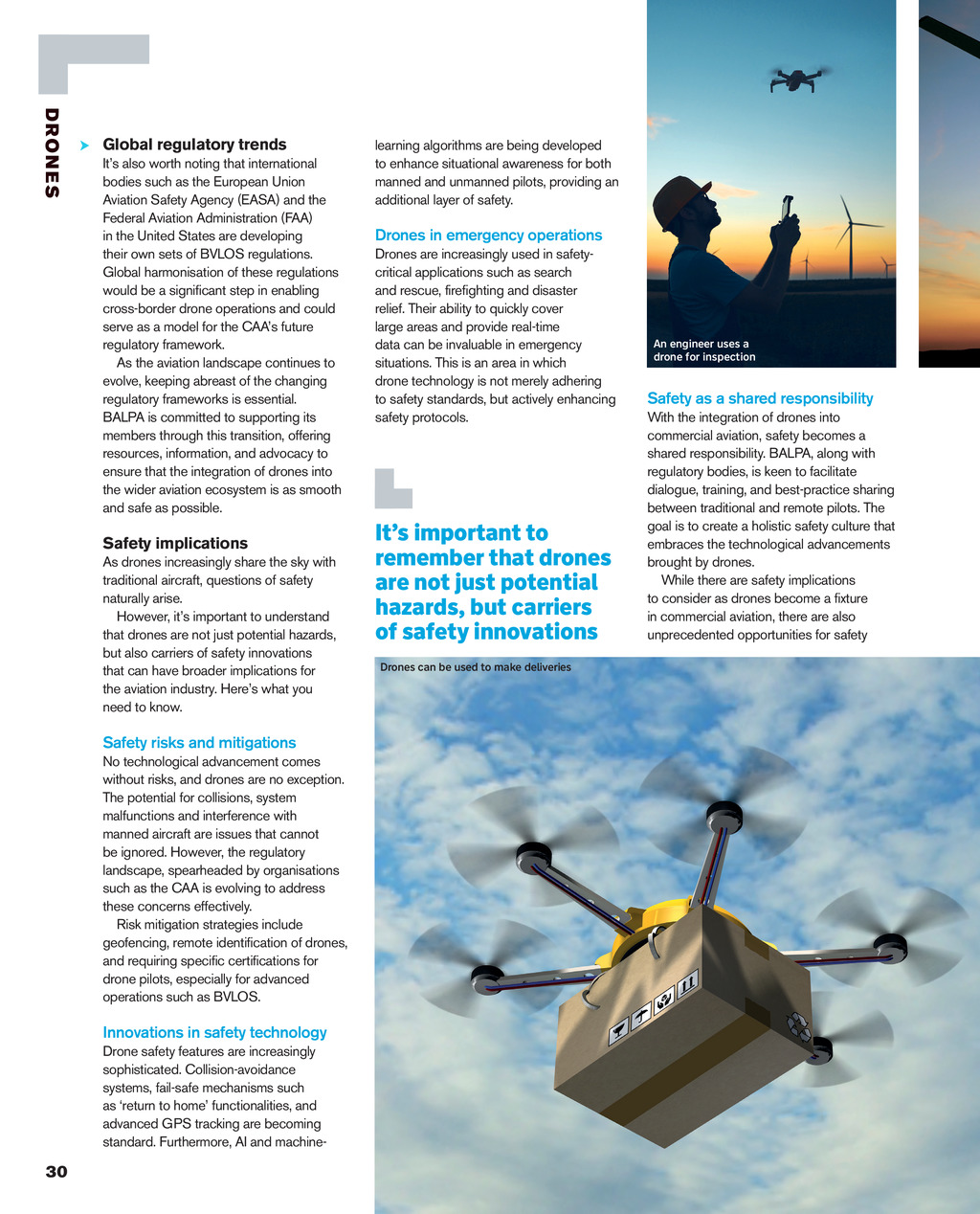


DRONES Global regulatory trends Its also worth noting that international bodies such as the European Union Aviation Safety Agency (EASA) and the Federal Aviation Administration (FAA) in the United States are developing their own sets of BVLOS regulations. Global harmonisation of these regulations would be a significant step in enabling cross-border drone operations and could serve as a model for the CAAs future regulatory framework. As the aviation landscape continues to evolve, keeping abreast of the changing regulatory frameworks is essential. BALPA is committed to supporting its members through this transition, offering resources, information, and advocacy to ensure that the integration of drones into the wider aviation ecosystem is as smooth and safe as possible. Safety implications As drones increasingly share the sky with traditional aircraft, questions of safety naturally arise. However, its important to understand that drones are not just potential hazards, but also carriers of safety innovations that can have broader implications for the aviation industry. Heres what you need to know. learning algorithms are being developed to enhance situational awareness for both manned and unmanned pilots, providing an additional layer of safety. Drones in emergency operations Drones are increasingly used in safetycritical applications such as search and rescue, firefighting and disaster relief. Their ability to quickly cover large areas and provide real-time data can be invaluable in emergency situations. This is an area in which drone technology is not merely adhering to safety standards, but actively enhancing safety protocols. Its important to remember that drones are not just potential hazards, but carriers of safety innovations An engineer uses a drone for inspection Safety as a shared responsibility With the integration of drones into commercial aviation, safety becomes a shared responsibility. BALPA, along with regulatory bodies, is keen to facilitate dialogue, training, and best-practice sharing between traditional and remote pilots. The goal is to create a holistic safety culture that embraces the technological advancements brought by drones. While there are safety implications to consider as drones become a fixture in commercial aviation, there are also unprecedented opportunities for safety Drones can be used to make deliveries Safety risks and mitigations No technological advancement comes without risks, and drones are no exception. The potential for collisions, system malfunctions and interference with manned aircraft are issues that cannot be ignored. However, the regulatory landscape, spearheaded by organisations such as the CAA is evolving to address these concerns effectively. Risk mitigation strategies include geofencing, remote identification of drones, and requiring specific certifications for drone pilots, especially for advanced operations such as BVLOS. Innovations in safety technology Drone safety features are increasingly sophisticated. Collision-avoidance systems, fail-safe mechanisms such as return to home functionalities, and advanced GPS tracking are becoming standard. Furthermore, AI and machine- 30 THE LOG Win 24 pp26-32 Drones.indd 30 01/12/2023 14:49