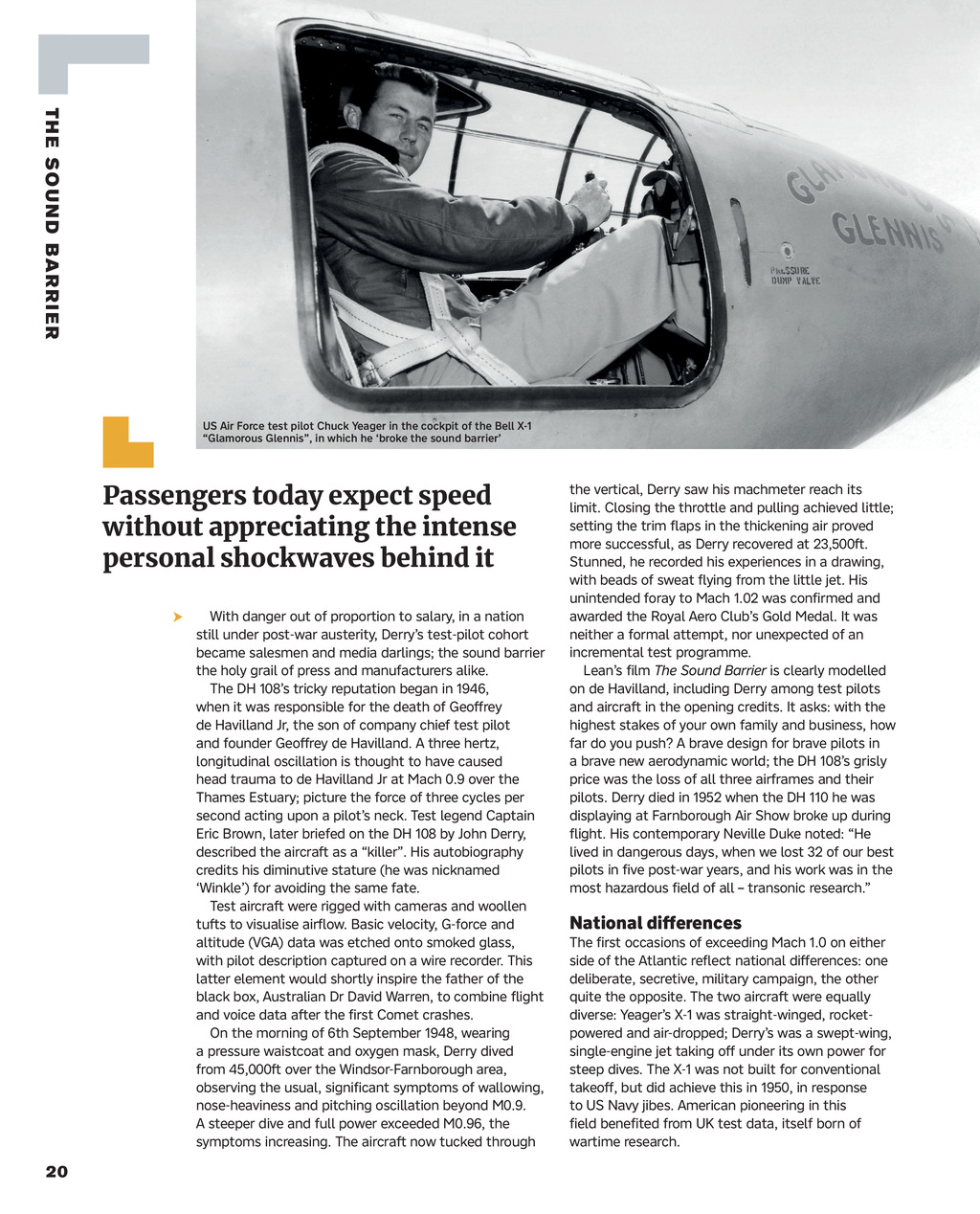


T H E SO U N D BA R R I E R US Air Force test pilot Chuck Yeager in the cockpit of the Bell X-1 Glamorous Glennis, in which he broke the sound barrier Passengers today expect speed without appreciating the intense personal shockwaves behind it With danger out of proportion to salary, in a nation still under post-war austerity, Derrys test-pilot cohort became salesmen and media darlings; the sound barrier the holy grail of press and manufacturers alike. The DH 108s tricky reputation began in 1946, when it was responsible for the death of Geoffrey de Havilland Jr, the son of company chief test pilot and founder Geoffrey de Havilland. A three hertz, longitudinal oscillation is thought to have caused head trauma to de Havilland Jr at Mach 0.9 over the Thames Estuary; picture the force of three cycles per second acting upon a pilots neck. Test legend Captain Eric Brown, later briefed on the DH 108 by John Derry, described the aircraft as a killer. His autobiography credits his diminutive stature (he was nicknamed Winkle) for avoiding the same fate. Test aircraft were rigged with cameras and woollen tufts to visualise airflow. Basic velocity, G-force and altitude (VGA) data was etched onto smoked glass, with pilot description captured on a wire recorder. This latter element would shortly inspire the father of the black box, Australian Dr David Warren, to combine flight and voice data after the first Comet crashes. On the morning of 6th September 1948, wearing a pressure waistcoat and oxygen mask, Derry dived from 45,000ft over the Windsor-Farnborough area, observing the usual, significant symptoms of wallowing, nose-heaviness and pitching oscillation beyond M0.9. A steeper dive and full power exceeded M0.96, the symptoms increasing. The aircraft now tucked through the vertical, Derry saw his machmeter reach its limit. Closing the throttle and pulling achieved little; setting the trim flaps in the thickening air proved more successful, as Derry recovered at 23,500ft. Stunned, he recorded his experiences in a drawing, with beads of sweat flying from the little jet. His unintended foray to Mach 1.02 was confirmed and awarded the Royal Aero Clubs Gold Medal. It was neither a formal attempt, nor unexpected of an incremental test programme. Leans film The Sound Barrier is clearly modelled on de Havilland, including Derry among test pilots and aircraft in the opening credits. It asks: with the highest stakes of your own family and business, how far do you push? A brave design for brave pilots in a brave new aerodynamic world; the DH 108s grisly price was the loss of all three airframes and their pilots. Derry died in 1952 when the DH 110 he was displaying at Farnborough Air Show broke up during flight. His contemporary Neville Duke noted: He lived in dangerous days, when we lost 32 of our best pilots in five post-war years, and his work was in the most hazardous field of all transonic research. National differences The first occasions of exceeding Mach 1.0 on either side of the Atlantic reflect national differences: one deliberate, secretive, military campaign, the other quite the opposite. The two aircraft were equally diverse: Yeagers X-1 was straight-winged, rocketpowered and air-dropped; Derrys was a swept-wing, single-engine jet taking off under its own power for steep dives. The X-1 was not built for conventional takeoff, but did achieve this in 1950, in response to US Navy jibes. American pioneering in this field benefited from UK test data, itself born of wartime research. 20 THE LOG Win 24 pp18-21 Sound barrier.indd 20 01/12/2023 15:37