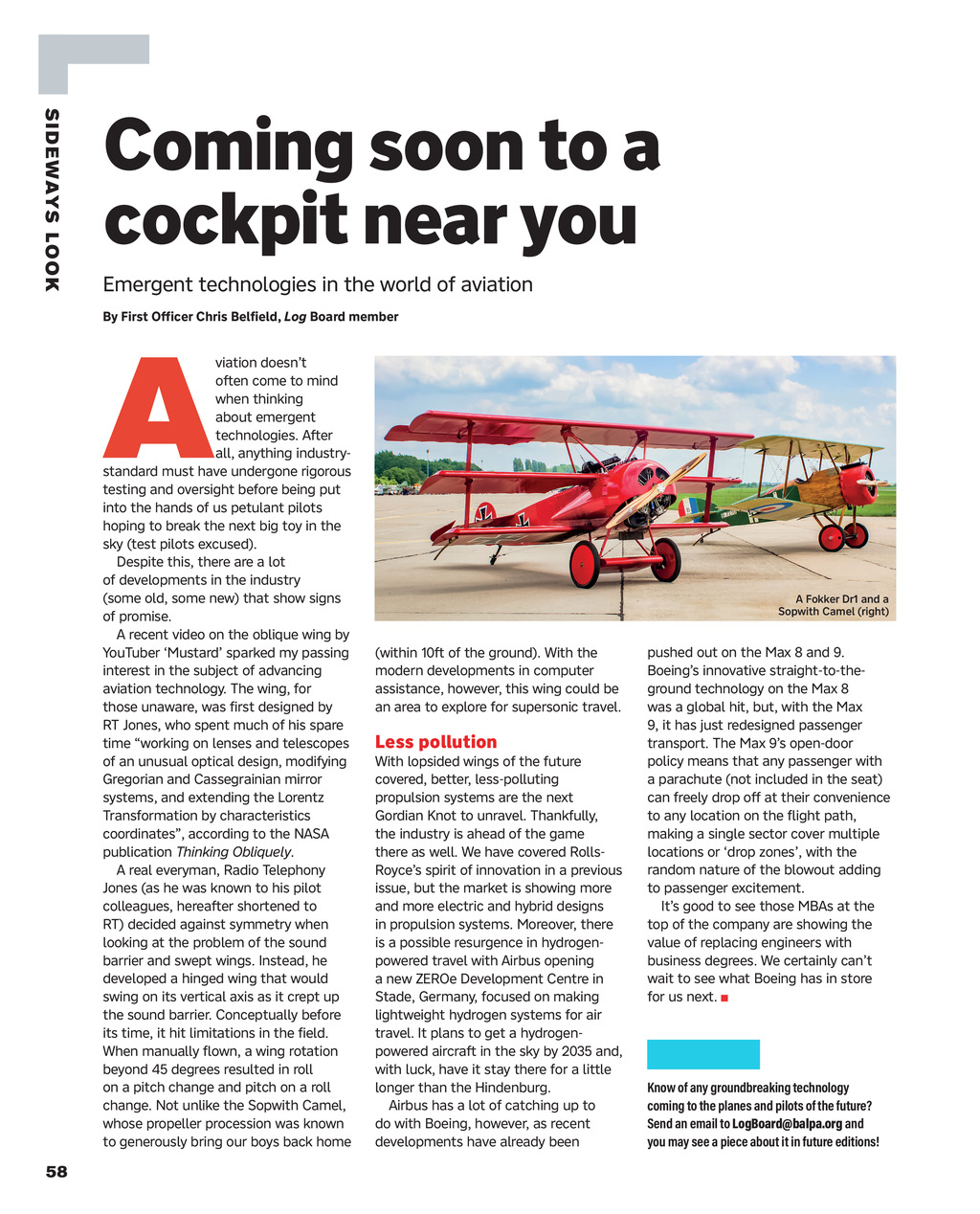


S I D E WAYS L O O K Coming soon to a cockpit near you Emergent technologies in the world of aviation By First Officer Chris Belfield, Log Board member A viation doesnt often come to mind when thinking about emergent technologies. After all, anything industrystandard must have undergone rigorous testing and oversight before being put into the hands of us petulant pilots hoping to break the next big toy in the sky (test pilots excused). Despite this, there are a lot of developments in the industry (some old, some new) that show signs of promise. A recent video on the oblique wing by YouTuber Mustard sparked my passing interest in the subject of advancing aviation technology. The wing, for those unaware, was first designed by RT Jones, who spent much of his spare time working on lenses and telescopes of an unusual optical design, modifying Gregorian and Cassegrainian mirror systems, and extending the Lorentz Transformation by characteristics coordinates, according to the NASA publication Thinking Obliquely. A real everyman, Radio Telephony Jones (as he was known to his pilot colleagues, hereafter shortened to RT) decided against symmetry when looking at the problem of the sound barrier and swept wings. Instead, he developed a hinged wing that would swing on its vertical axis as it crept up the sound barrier. Conceptually before its time, it hit limitations in the field. When manually flown, a wing rotation beyond 45 degrees resulted in roll on a pitch change and pitch on a roll change. Not unlike the Sopwith Camel, whose propeller procession was known to generously bring our boys back home A Fokker Dr1 and a Sopwith Camel (right) (within 10ft of the ground). With the modern developments in computer assistance, however, this wing could be an area to explore for supersonic travel. Less pollution With lopsided wings of the future covered, better, less-polluting propulsion systems are the next Gordian Knot to unravel. Thankfully, the industry is ahead of the game there as well. We have covered RollsRoyces spirit of innovation in a previous issue, but the market is showing more and more electric and hybrid designs in propulsion systems. Moreover, there is a possible resurgence in hydrogenpowered travel with Airbus opening a new ZEROe Development Centre in Stade, Germany, focused on making lightweight hydrogen systems for air travel. It plans to get a hydrogenpowered aircraft in the sky by 2035 and, with luck, have it stay there for a little longer than the Hindenburg. Airbus has a lot of catching up to do with Boeing, however, as recent developments have already been pushed out on the Max 8 and 9. Boeings innovative straight-to-theground technology on the Max 8 was a global hit, but, with the Max 9, it has just redesigned passenger transport. The Max 9s open-door policy means that any passenger with a parachute (not included in the seat) can freely drop off at their convenience to any location on the flight path, making a single sector cover multiple locations or drop zones, with the random nature of the blowout adding to passenger excitement. Its good to see those MBAs at the top of the company are showing the value of replacing engineers with business degrees. We certainly cant wait to see what Boeing has in store for us next. Know of any groundbreaking technology coming to the planes and pilots of the future? Send an email to LogBoard@balpa.org and you may see a piece about it in future editions! 58 THE LOG Spr 24 pp58-60 Sideways look.indd 58 16/02/2024 11:17