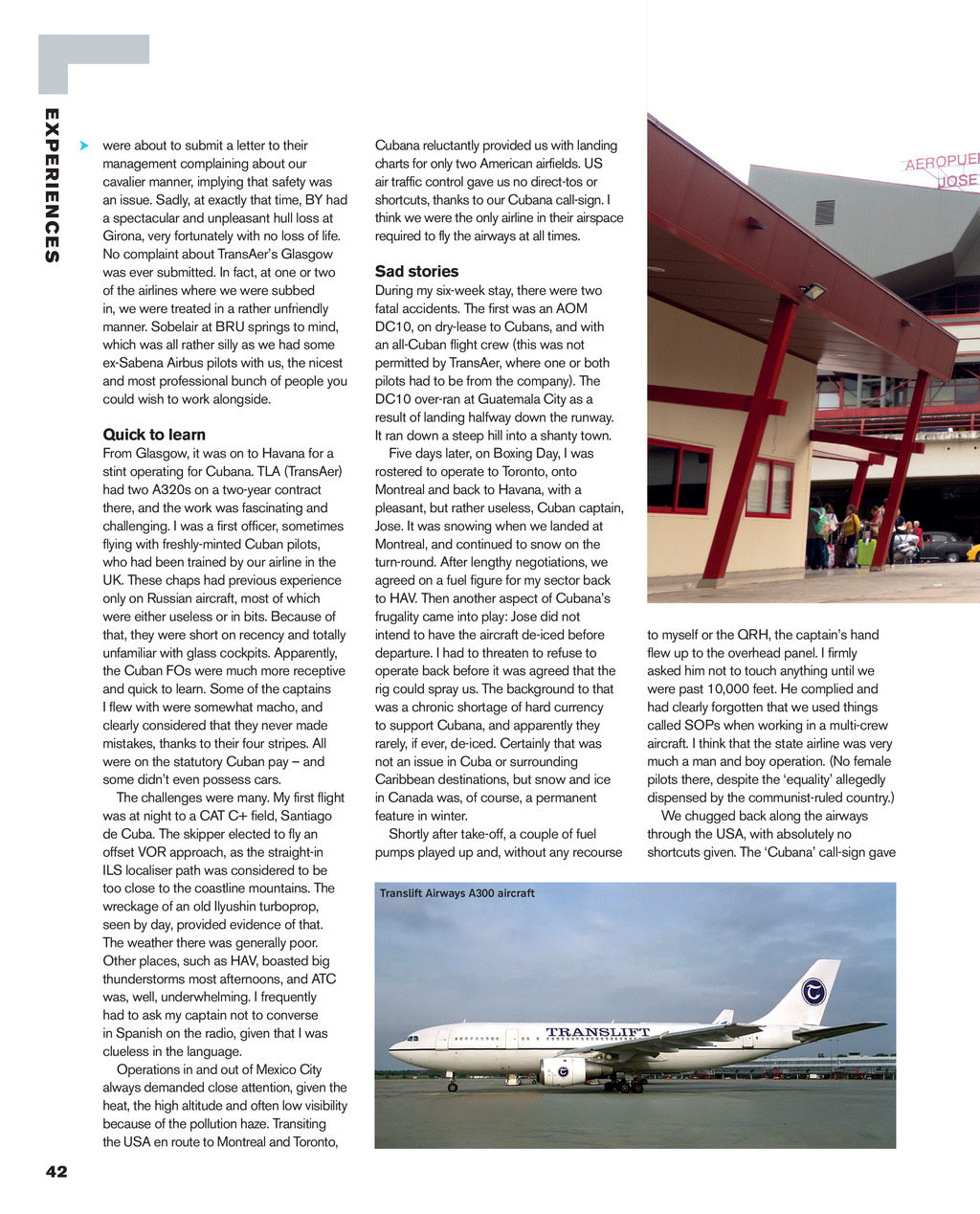


EXPERIENCES were about to submit a letter to their management complaining about our cavalier manner, implying that safety was an issue. Sadly, at exactly that time, BY had a spectacular and unpleasant hull loss at Girona, very fortunately with no loss of life. No complaint about TransAers Glasgow was ever submitted. In fact, at one or two of the airlines where we were subbed in, we were treated in a rather unfriendly manner. Sobelair at BRU springs to mind, which was all rather silly as we had some ex-Sabena Airbus pilots with us, the nicest and most professional bunch of people you could wish to work alongside. Quick to learn From Glasgow, it was on to Havana for a stint operating for Cubana. TLA (TransAer) had two A320s on a two-year contract there, and the work was fascinating and challenging. I was a first officer, sometimes flying with freshly-minted Cuban pilots, who had been trained by our airline in the UK. These chaps had previous experience only on Russian aircraft, most of which were either useless or in bits. Because of that, they were short on recency and totally unfamiliar with glass cockpits. Apparently, the Cuban FOs were much more receptive and quick to learn. Some of the captains I flew with were somewhat macho, and clearly considered that they never made mistakes, thanks to their four stripes. All were on the statutory Cuban pay and some didnt even possess cars. The challenges were many. My first flight was at night to a CAT C+ field, Santiago de Cuba. The skipper elected to fly an offset VOR approach, as the straight-in ILS localiser path was considered to be too close to the coastline mountains. The wreckage of an old Ilyushin turboprop, seen by day, provided evidence of that. The weather there was generally poor. Other places, such as HAV, boasted big thunderstorms most afternoons, and ATC was, well, underwhelming. I frequently had to ask my captain not to converse in Spanish on the radio, given that I was clueless in the language. Operations in and out of Mexico City always demanded close attention, given the heat, the high altitude and often low visibility because of the pollution haze. Transiting the USA en route to Montreal and Toronto, Cubana reluctantly provided us with landing charts for only two American airfields. US air traffic control gave us no direct-tos or shortcuts, thanks to our Cubana call-sign. I think we were the only airline in their airspace required to fly the airways at all times. Sad stories During my six-week stay, there were two fatal accidents. The first was an AOM DC10, on dry-lease to Cubans, and with an all-Cuban flight crew (this was not permitted by TransAer, where one or both pilots had to be from the company). The DC10 over-ran at Guatemala City as a result of landing halfway down the runway. It ran down a steep hill into a shanty town. Five days later, on Boxing Day, I was rostered to operate to Toronto, onto Montreal and back to Havana, with a pleasant, but rather useless, Cuban captain, Jose. It was snowing when we landed at Montreal, and continued to snow on the turn-round. After lengthy negotiations, we agreed on a fuel figure for my sector back to HAV. Then another aspect of Cubanas frugality came into play: Jose did not intend to have the aircraft de-iced before departure. I had to threaten to refuse to operate back before it was agreed that the rig could spray us. The background to that was a chronic shortage of hard currency to support Cubana, and apparently they rarely, if ever, de-iced. Certainly that was not an issue in Cuba or surrounding Caribbean destinations, but snow and ice in Canada was, of course, a permanent feature in winter. Shortly after take-off, a couple of fuel pumps played up and, without any recourse to myself or the QRH, the captains hand flew up to the overhead panel. I firmly asked him not to touch anything until we were past 10,000 feet. He complied and had clearly forgotten that we used things called SOPs when working in a multi-crew aircraft. I think that the state airline was very much a man and boy operation. (No female pilots there, despite the equality allegedly dispensed by the communist-ruled country.) We chugged back along the airways through the USA, with absolutely no shortcuts given. The Cubana call-sign gave Translift Airways A300 aircraft 42 THE LOG Spr 24 pp40-46 Highs and lows.indd 42 16/02/2024 11:14