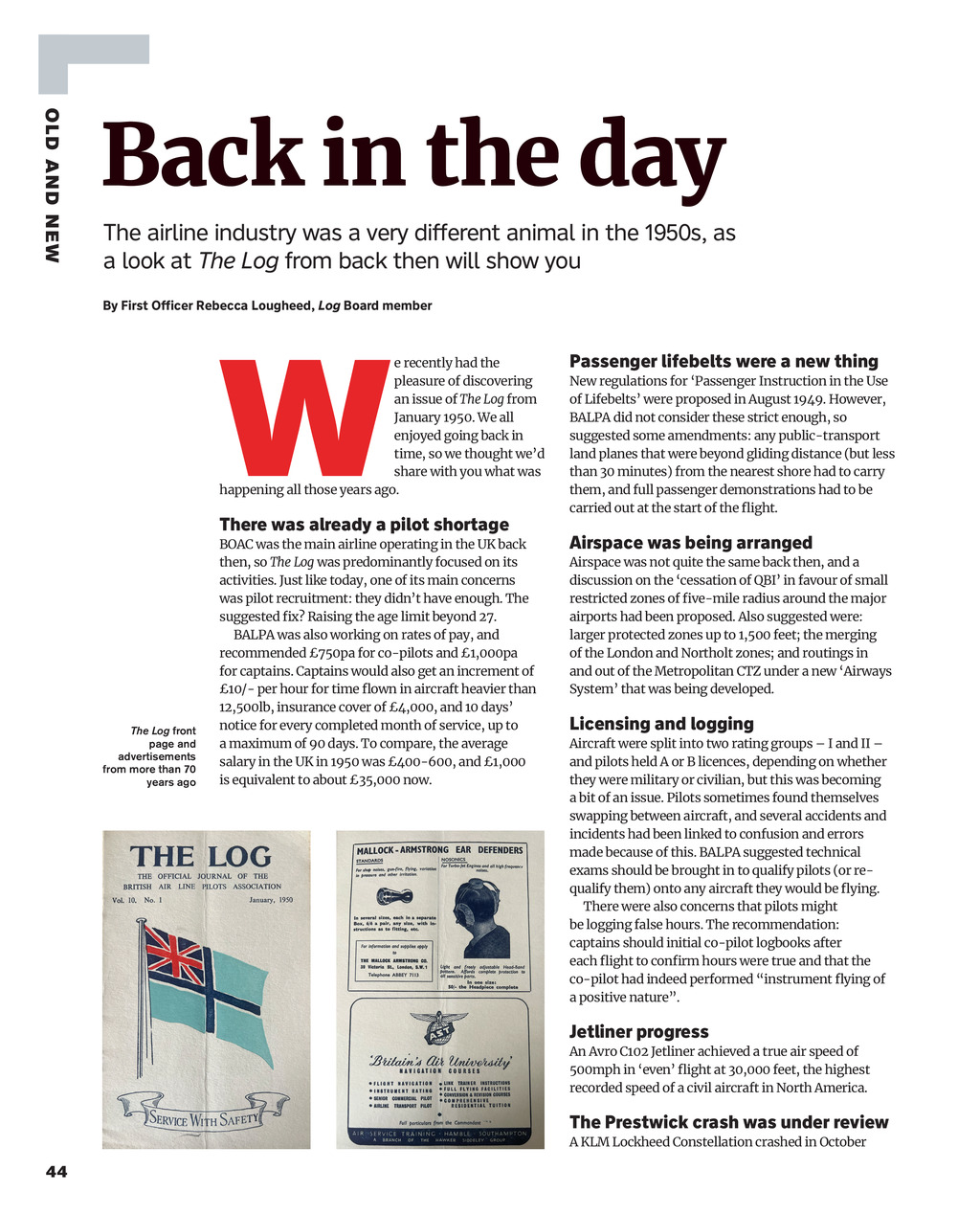


OLD AND NEW Back in the day The airline industry was a very different animal in the 1950s, as a look at The Log from back then will show you By First Officer Rebecca Lougheed, Log Board member W e recently had the pleasure of discovering an issue of The Log from January 1950. We all enjoyed going back in time, so we thought wed share with you what was happening all those years ago. There was already a pilot shortage The Log front page and advertisements from more than 70 years ago BOAC was the main airline operating in the UK back then, so The Log was predominantly focused on its activities. Just like today, one of its main concerns was pilot recruitment: they didnt have enough. The suggested fix? Raising the age limit beyond 27. BALPA was also working on rates of pay, and recommended 750pa for co-pilots and 1,000pa for captains. Captains would also get an increment of 10/- per hour for time flown in aircraft heavier than 12,500lb, insurance cover of 4,000, and 10 days notice for every completed month of service, up to a maximum of 90 days. To compare, the average salary in the UK in 1950 was 400-600, and 1,000 is equivalent to about 35,000 now. Passenger lifebelts were a new thing New regulations for Passenger Instruction in the Use of Lifebelts were proposed in August 1949. However, BALPA did not consider these strict enough, so suggested some amendments: any public-transport land planes that were beyond gliding distance (but less than 30 minutes) from the nearest shore had to carry them, and full passenger demonstrations had to be carried out at the start of the flight. Airspace was being arranged Airspace was not quite the same back then, and a discussion on the cessation of QBI in favour of small restricted zones of five-mile radius around the major airports had been proposed. Also suggested were: larger protected zones up to 1,500 feet; the merging of the London and Northolt zones; and routings in and out of the Metropolitan CTZ under a new Airways System that was being developed. Licensing and logging Aircraft were split into two rating groups I and II and pilots held A or B licences, depending on whether they were military or civilian, but this was becoming a bit of an issue. Pilots sometimes found themselves swapping between aircraft, and several accidents and incidents had been linked to confusion and errors made because of this. BALPA suggested technical exams should be brought in to qualify pilots (or requalify them) onto any aircraft they would be flying. There were also concerns that pilots might be logging false hours. The recommendation: captains should initial co-pilot logbooks after each flight to confirm hours were true and that the co-pilot had indeed performed instrument flying of a positive nature. Jetliner progress An Avro C102 Jetliner achieved a true air speed of 500mph in even flight at 30,000 feet, the highest recorded speed of a civil aircraft in North America. The Prestwick crash was under review A KLM Lockheed Constellation crashed in October 44 THE LOG Autumn 24 pp44-45 Old and New.indd 44 13/11/2024 19:01