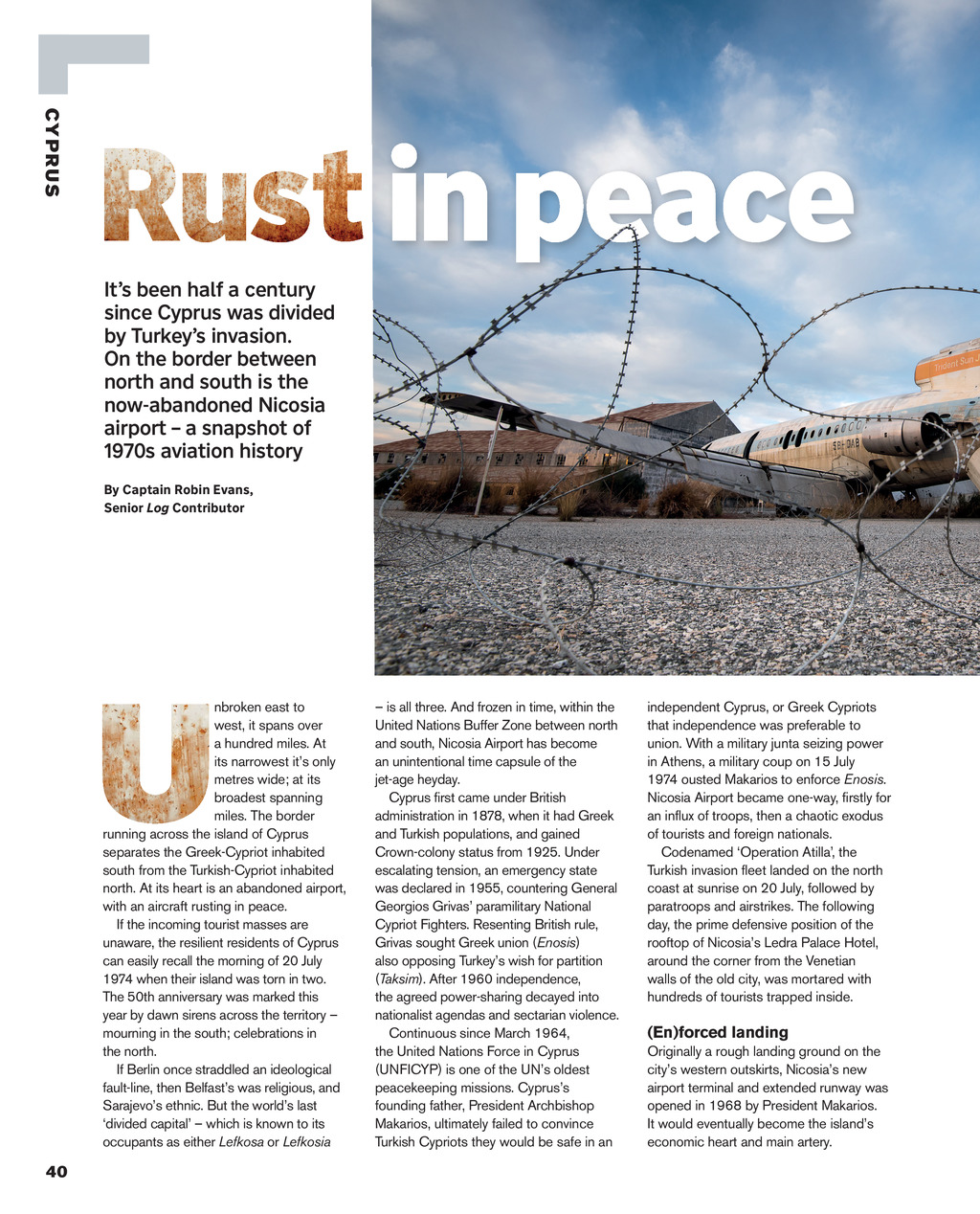


CY P R US Its been half a century since Cyprus was divided by Turkeys invasion. On the border between north and south is the now-abandoned Nicosia airport a snapshot of 1970s aviation history By Captain Robin Evans, Senior Log Contributor U nbroken east to west, it spans over a hundred miles. At its narrowest its only metres wide; at its broadest spanning miles. The border running across the island of Cyprus separates the Greek-Cypriot inhabited south from the Turkish-Cypriot inhabited north. At its heart is an abandoned airport, with an aircraft rusting in peace. If the incoming tourist masses are unaware, the resilient residents of Cyprus can easily recall the morning of 20 July 1974 when their island was torn in two. The 50th anniversary was marked this year by dawn sirens across the territory mourning in the south; celebrations in the north. If Berlin once straddled an ideological fault-line, then Belfasts was religious, and Sarajevos ethnic. But the worlds last divided capital which is known to its occupants as either Lefkosa or Lefkosia is all three. And frozen in time, within the United Nations Buffer Zone between north and south, Nicosia Airport has become an unintentional time capsule of the jet-age heyday. Cyprus first came under British administration in 1878, when it had Greek and Turkish populations, and gained Crown-colony status from 1925. Under escalating tension, an emergency state was declared in 1955, countering General Georgios Grivas paramilitary National Cypriot Fighters. Resenting British rule, Grivas sought Greek union (Enosis) also opposing Turkeys wish for partition (Taksim). After 1960 independence, the agreed power-sharing decayed into nationalist agendas and sectarian violence. Continuous since March 1964, the United Nations Force in Cyprus (UNFICYP) is one of the UNs oldest peacekeeping missions. Cypruss founding father, President Archbishop Makarios, ultimately failed to convince Turkish Cypriots they would be safe in an independent Cyprus, or Greek Cypriots that independence was preferable to union. With a military junta seizing power in Athens, a military coup on 15 July 1974 ousted Makarios to enforce Enosis. Nicosia Airport became one-way, firstly for an influx of troops, then a chaotic exodus of tourists and foreign nationals. Codenamed Operation Atilla, the Turkish invasion fleet landed on the north coast at sunrise on 20 July, followed by paratroops and airstrikes. The following day, the prime defensive position of the rooftop of Nicosias Ledra Palace Hotel, around the corner from the Venetian walls of the old city, was mortared with hundreds of tourists trapped inside. (En)forced landing Originally a rough landing ground on the citys western outskirts, Nicosias new airport terminal and extended runway was opened in 1968 by President Makarios. It would eventually become the islands economic heart and main artery. 40 THE LOG Autumn 24 pp40-43 Nicosia.indd 40 13/11/2024 14:39