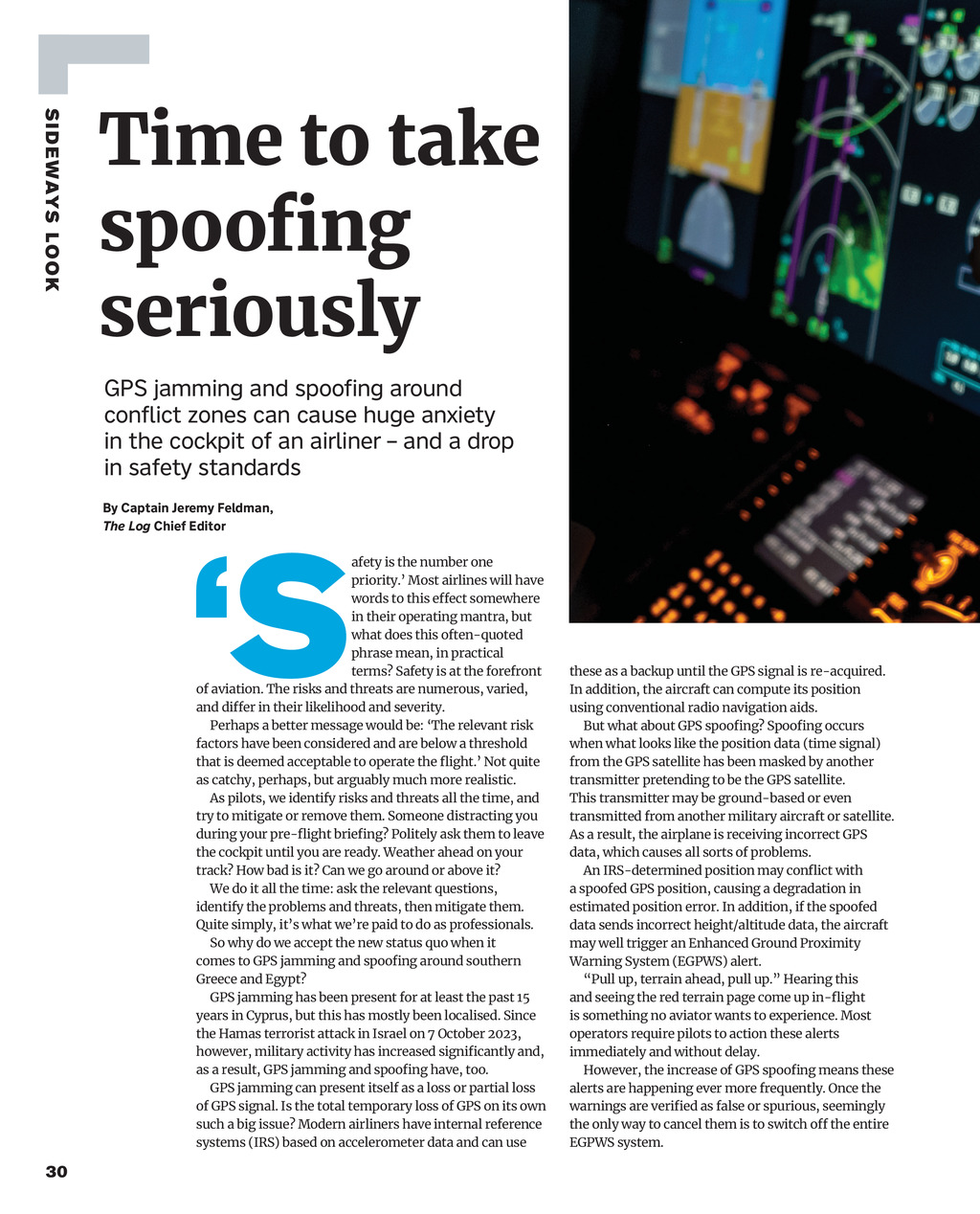


S I D E WAYS L O O K Time to take spoofing seriously GPS jamming and spoofing around conflict zones can cause huge anxiety in the cockpit of an airliner and a drop in safety standards By Captain Jeremy Feldman, The Log Chief Editor S afety is the number one priority. Most airlines will have words to this effect somewhere in their operating mantra, but what does this often-quoted phrase mean, in practical terms? Safety is at the forefront of aviation. The risks and threats are numerous, varied, and differ in their likelihood and severity. Perhaps a better message would be: The relevant risk factors have been considered and are below a threshold that is deemed acceptable to operate the flight. Not quite as catchy, perhaps, but arguably much more realistic. As pilots, we identify risks and threats all the time, and try to mitigate or remove them. Someone distracting you during your pre-flight briefing? Politely ask them to leave the cockpit until you are ready. Weather ahead on your track? How bad is it? Can we go around or above it? We do it all the time: ask the relevant questions, identify the problems and threats, then mitigate them. Quite simply, its what were paid to do as professionals. So why do we accept the new status quo when it comes to GPS jamming and spoofing around southern Greece and Egypt? GPS jamming has been present for at least the past 15 years in Cyprus, but this has mostly been localised. Since the Hamas terrorist attack in Israel on 7 October 2023, however, military activity has increased significantly and, as a result, GPS jamming and spoofing have, too. GPS jamming can present itself as a loss or partial loss of GPS signal. Is the total temporary loss of GPS on its own such a big issue? Modern airliners have internal reference systems (IRS) based on accelerometer data and can use these as a backup until the GPS signal is re-acquired. In addition, the aircraft can compute its position using conventional radio navigation aids. But what about GPS spoofing? Spoofing occurs when what looks like the position data (time signal) from the GPS satellite has been masked by another transmitter pretending to be the GPS satellite. This transmitter may be ground-based or even transmitted from another military aircraft or satellite. As a result, the airplane is receiving incorrect GPS data, which causes all sorts of problems. An IRS-determined position may conflict with a spoofed GPS position, causing a degradation in estimated position error. In addition, if the spoofed data sends incorrect height/altitude data, the aircraft may well trigger an Enhanced Ground Proximity Warning System (EGPWS) alert. Pull up, terrain ahead, pull up. Hearing this and seeing the red terrain page come up in-flight is something no aviator wants to experience. Most operators require pilots to action these alerts immediately and without delay. However, the increase of GPS spoofing means these alerts are happening ever more frequently. Once the warnings are verified as false or spurious, seemingly the only way to cancel them is to switch off the entire EGPWS system. 30 THE LOG Autumn 24 pp30-31 GPS Jamming.indd 30 13/11/2024 14:23