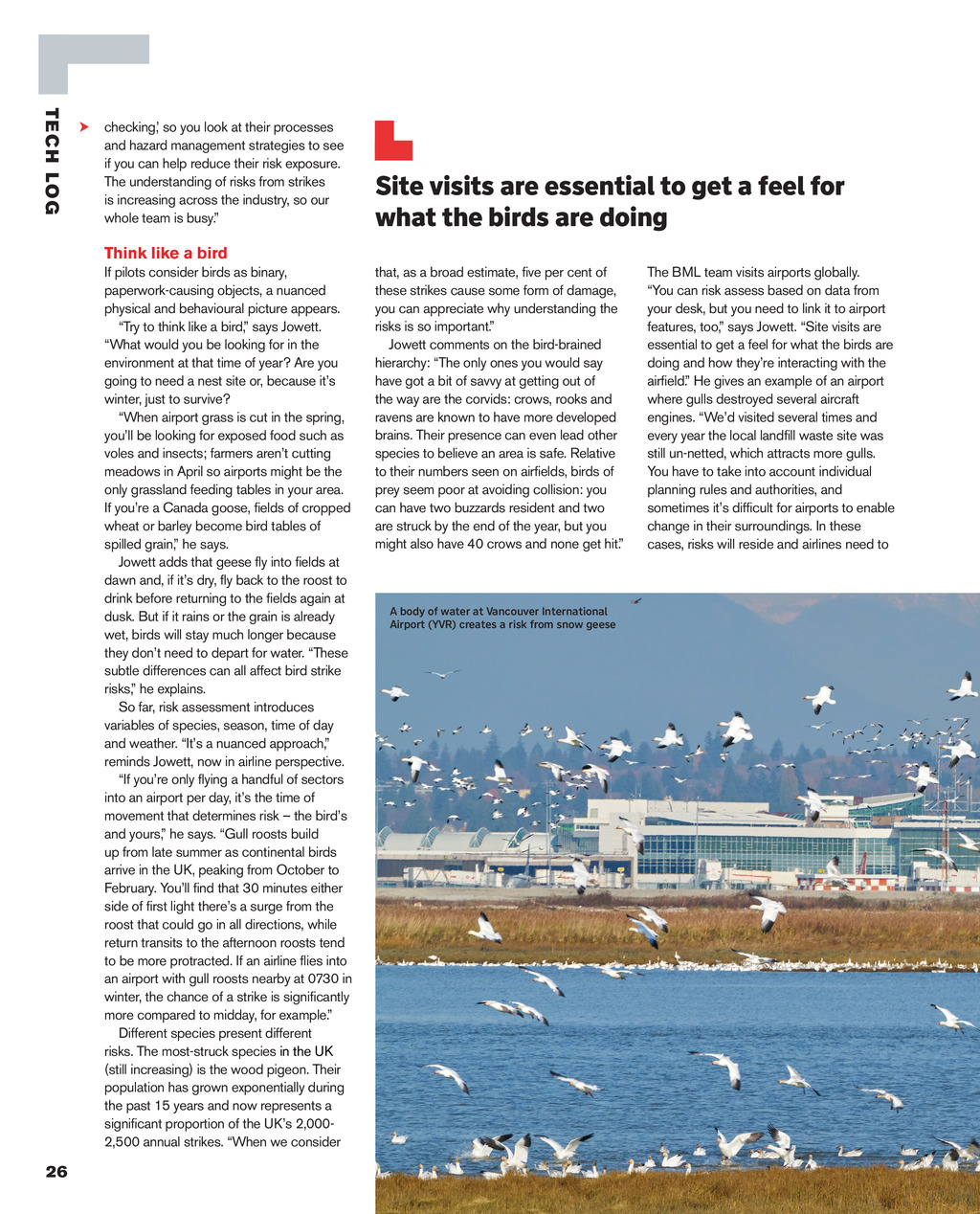


TECH LOG checking, so you look at their processes and hazard management strategies to see if you can help reduce their risk exposure. The understanding of risks from strikes is increasing across the industry, so our whole team is busy. Site visits are essential to get a feel for what the birds are doing Think like a bird If pilots consider birds as binary, paperwork-causing objects, a nuanced physical and behavioural picture appears. Try to think like a bird, says Jowett. What would you be looking for in the environment at that time of year? Are you going to need a nest site or, because its winter, just to survive? When airport grass is cut in the spring, youll be looking for exposed food such as voles and insects; farmers arent cutting meadows in April so airports might be the only grassland feeding tables in your area. If youre a Canada goose, fields of cropped wheat or barley become bird tables of spilled grain, he says. Jowett adds that geese fly into fields at dawn and, if its dry, fly back to the roost to drink before returning to the fields again at dusk. But if it rains or the grain is already wet, birds will stay much longer because they dont need to depart for water. These subtle differences can all affect bird strike risks, he explains. So far, risk assessment introduces variables of species, season, time of day and weather. Its a nuanced approach, reminds Jowett, now in airline perspective. If youre only flying a handful of sectors into an airport per day, its the time of movement that determines risk the birds and yours, he says. Gull roosts build up from late summer as continental birds arrive in the UK, peaking from October to February. Youll find that 30 minutes either side of first light theres a surge from the roost that could go in all directions, while return transits to the afternoon roosts tend to be more protracted. If an airline flies into an airport with gull roosts nearby at 0730 in winter, the chance of a strike is significantly more compared to midday, for example. Different species present different risks. The most-struck species in the UK (still increasing) is the wood pigeon. Their population has grown exponentially during the past 15 years and now represents a significant proportion of the UKs 2,0002,500 annual strikes. When we consider that, as a broad estimate, five per cent of these strikes cause some form of damage, you can appreciate why understanding the risks is so important. Jowett comments on the bird-brained hierarchy: The only ones you would say have got a bit of savvy at getting out of the way are the corvids: crows, rooks and ravens are known to have more developed brains. Their presence can even lead other species to believe an area is safe. Relative to their numbers seen on airfields, birds of prey seem poor at avoiding collision: you can have two buzzards resident and two are struck by the end of the year, but you might also have 40 crows and none get hit. The BML team visits airports globally. You can risk assess based on data from your desk, but you need to link it to airport features, too, says Jowett. Site visits are essential to get a feel for what the birds are doing and how theyre interacting with the airfield. He gives an example of an airport where gulls destroyed several aircraft engines. Wed visited several times and every year the local landfill waste site was still un-netted, which attracts more gulls. You have to take into account individual planning rules and authorities, and sometimes its difficult for airports to enable change in their surroundings. In these cases, risks will reside and airlines need to A body of water at Vancouver International Airport (YVR) creates a risk from snow geese 26 THE LOG Autumn 24 pp25-29 Birdstrikes.indd 26 13/11/2024 14:22