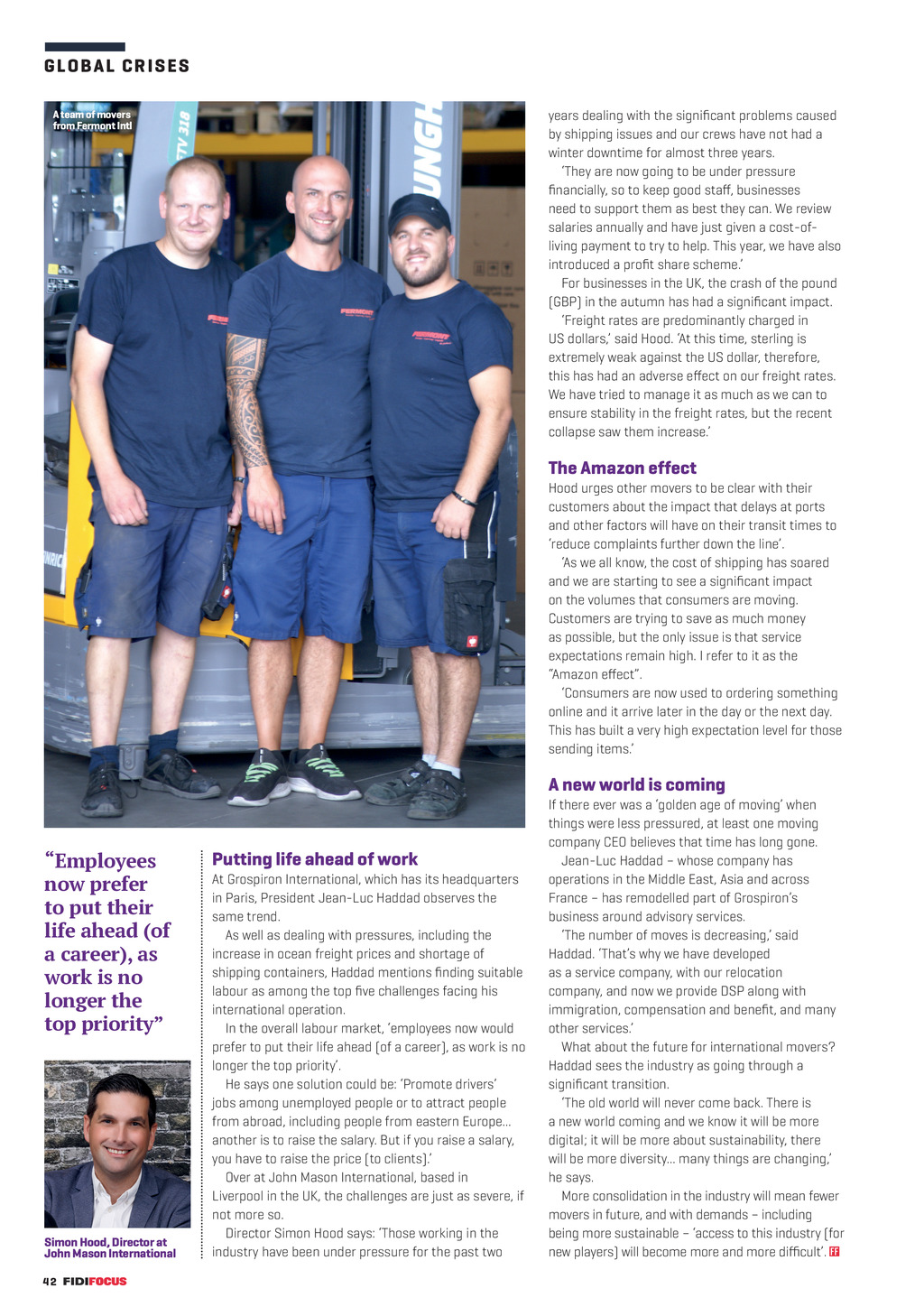


G LO BA L C R I SES years dealing with the significant problems caused by shipping issues and our crews have not had a winter downtime for almost three years. They are now going to be under pressure financially, so to keep good staff, businesses need to support them as best they can. We review salaries annually and have just given a cost-ofliving payment to try to help. This year, we have also introduced a profit share scheme. For businesses in the UK, the crash of the pound (GBP) in the autumn has had a significant impact. Freight rates are predominantly charged in US dollars, said Hood. At this time, sterling is extremely weak against the US dollar, therefore, this has had an adverse effect on our freight rates. We have tried to manage it as much as we can to ensure stability in the freight rates, but the recent collapse saw them increase. A team of movers from Fermont Intl The Amazon effect Hood urges other movers to be clear with their customers about the impact that delays at ports and other factors will have on their transit times to reduce complaints further down the line. As we all know, the cost of shipping has soared and we are starting to see a significant impact on the volumes that consumers are moving. Customers are trying to save as much money as possible, but the only issue is that service expectations remain high. I refer to it as the Amazon effect. Consumers are now used to ordering something online and it arrive later in the day or the next day. This has built a very high expectation level for those sending items. A new world is coming Employees now prefer to put their life ahead (of a career), as work is no longer the top priority Simon Hood, Director at John Mason International Putting life ahead of work At Grospiron International, which has its headquarters in Paris, President Jean-Luc Haddad observes the same trend. As well as dealing with pressures, including the increase in ocean freight prices and shortage of shipping containers, Haddad mentions finding suitable labour as among the top five challenges facing his international operation. In the overall labour market, employees now would prefer to put their life ahead (of a career), as work is no longer the top priority. He says one solution could be: Promote drivers jobs among unemployed people or to attract people from abroad, including people from eastern Europe... another is to raise the salary. But if you raise a salary, you have to raise the price (to clients). Over at John Mason International, based in Liverpool in the UK, the challenges are just as severe, if not more so. Director Simon Hood says: Those working in the industry have been under pressure for the past two If there ever was a golden age of moving when things were less pressured, at least one moving company CEO believes that time has long gone. Jean-Luc Haddad whose company has operations in the Middle East, Asia and across France has remodelled part of Grospirons business around advisory services. The number of moves is decreasing, said Haddad. Thats why we have developed as a service company, with our relocation company, and now we provide DSP along with immigration, compensation and benefit, and many other services. What about the future for international movers? Haddad sees the industry as going through a significant transition. The old world will never come back. There is a new world coming and we know it will be more digital; it will be more about sustainability, there will be more diversity... many things are changing, he says. More consolidation in the industry will mean fewer movers in future, and with demands including being more sustainable access to this industry (for new players) will become more and more difficult. 42 FF308 Dec-Jan 23 pp36-43 Regional Focus Global Crises.indd 42 05/12/2022 17:00