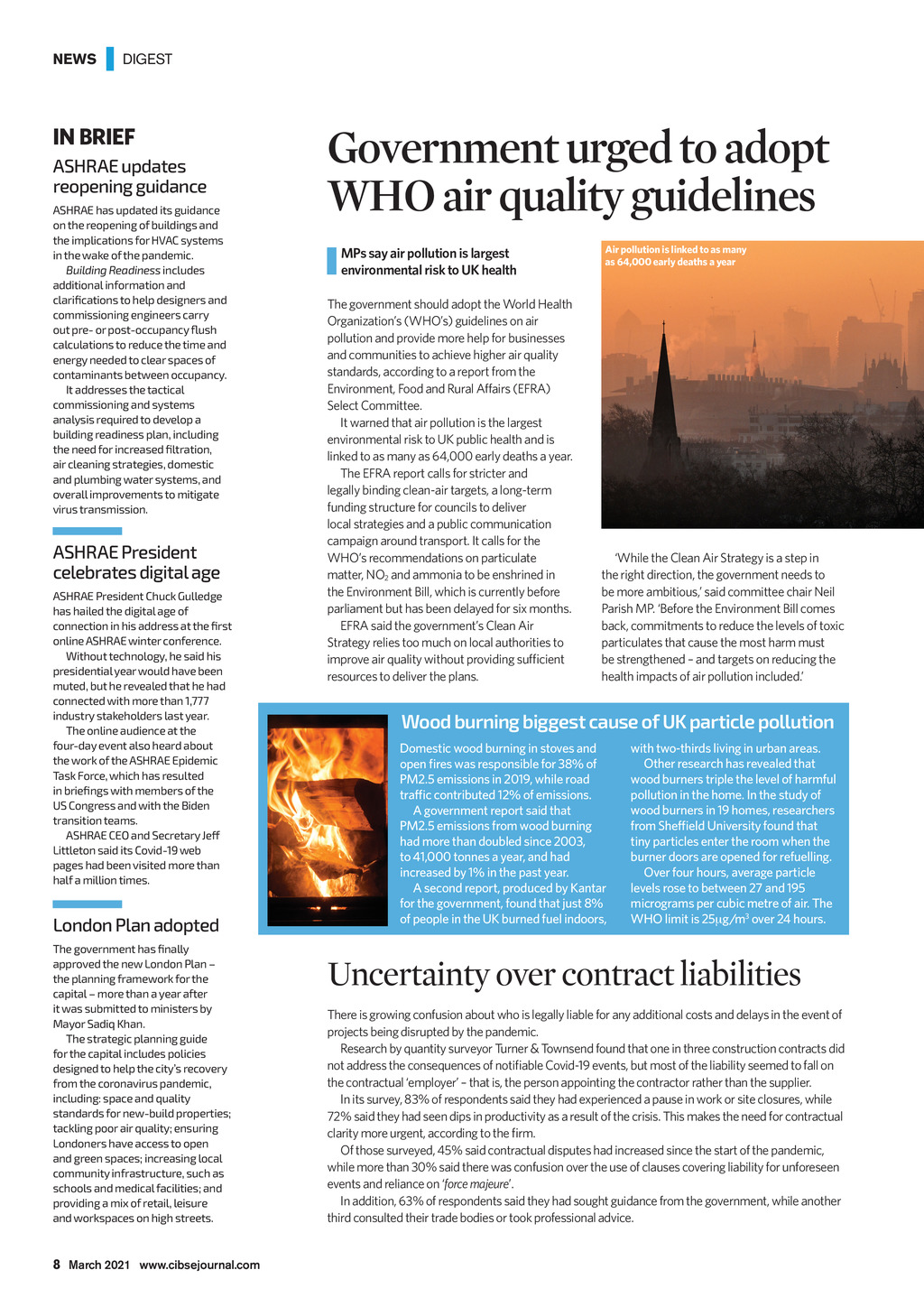


EWS | DIGEST IN BRIEF ASHRAE updates reopening guidance ASHRAE has updated its guidance on the reopening of buildings and the implications for HVAC systems in the wake of the pandemic. Building Readiness includes additional information and clarifications to help designers and commissioning engineers carry out pre- or post-occupancy flush calculations to reduce the time and energy needed to clear spaces of contaminants between occupancy. It addresses the tactical commissioning and systems analysis required to develop a building readiness plan, including the need for increased filtration, air cleaning strategies, domestic and plumbing water systems, and overall improvements to mitigate virus transmission. ASHRAE President celebrates digital age ASHRAE President Chuck Gulledge has hailed the digital age of connection in his address at the first online ASHRAE winter conference. Without technology, he said his presidential year would have been muted, but he revealed that he had connected with more than 1,777 industry stakeholders last year. The online audience at the four-day event also heard about the work of the ASHRAE Epidemic Task Force, which has resulted in briefings with members of the US Congress and with the Biden transition teams. ASHRAE CEO and Secretary Jeff Littleton said its Covid-19 web pages had been visited more than half a million times. London Plan adopted The government has finally approved the new London Plan the planning framework for the capital more than a year after it was submitted to ministers by Mayor Sadiq Khan. The strategic planning guide for the capital includes policies designed to help the citys recovery from the coronavirus pandemic, including: space and quality standards for new-build properties; tackling poor air quality; ensuring Londoners have access to open and green spaces; increasing local community infrastructure, such as schools and medical facilities; and providing a mix of retail, leisure and workspaces on high streets. Government urged to adopt WHO air quality guidelines MPs say air pollution is largest environmental risk to UK health The government should adopt the World Health Organizations (WHOs) guidelines on air pollution and provide more help for businesses and communities to achieve higher air quality standards, according to a report from the Environment, Food and Rural Affairs (EFRA) Select Committee. It warned that air pollution is the largest environmental risk to UK public health and is linked to as many as 64,000 early deaths a year. The EFRA report calls for stricter and legally binding clean-air targets, a long-term funding structure for councils to deliver local strategies and a public communication campaign around transport. It calls for the WHOs recommendations on particulate matter, NO2 and ammonia to be enshrined in the Environment Bill, which is currently before parliament but has been delayed for six months. EFRA said the governments Clean Air Strategy relies too much on local authorities to improve air quality without providing sufficient resources to deliver the plans. Air pollution is linked to as many as 64,000 early deaths a year While the Clean Air Strategy is a step in the right direction, the government needs to be more ambitious, said committee chair Neil Parish MP. Before the Environment Bill comes back, commitments to reduce the levels of toxic particulates that cause the most harm must be strengthened and targets on reducing the health impacts of air pollution included. Wood burning biggest cause of UK particle pollution Domestic wood burning in stoves and open fires was responsible for 38% of PM2.5 emissions in 2019, while road traffic contributed 12% of emissions. A government report said that PM2.5 emissions from wood burning had more than doubled since 2003, to 41,000 tonnes a year, and had increased by 1% in the past year. A second report, produced by Kantar for the government, found that just 8% of people in the UK burned fuel indoors, with two-thirds living in urban areas. Other research has revealed that wood burners triple the level of harmful pollution in the home. In the study of wood burners in 19 homes, researchers from Sheffield University found that tiny particles enter the room when the burner doors are opened for refuelling. Over four hours, average particle levels rose to between 27 and 195 micrograms per cubic metre of air. The WHO limit is 25g/m3 over 24 hours. Uncertainty over contract liabilities There is growing confusion about who is legally liable for any additional costs and delays in the event of projects being disrupted by the pandemic. Research by quantity surveyor Turner & Townsend found that one in three construction contracts did not address the consequences of notifiable Covid-19 events, but most of the liability seemed to fall on the contractual employer that is, the person appointing the contractor rather than the supplier. In its survey, 83% of respondents said they had experienced a pause in work or site closures, while 72% said they had seen dips in productivity as a result of the crisis. This makes the need for contractual clarity more urgent, according to the firm. Of those surveyed, 45% said contractual disputes had increased since the start of the pandemic, while more than 30% said there was confusion over the use of clauses covering liability for unforeseen events and reliance on force majeure. In addition, 63% of respondents said they had sought guidance from the government, while another third consulted their trade bodies or took professional advice. 8 March 2021 www.cibsejournal.com CIBSE March 21 pp08 News.indd 8 19/02/2021 17:29