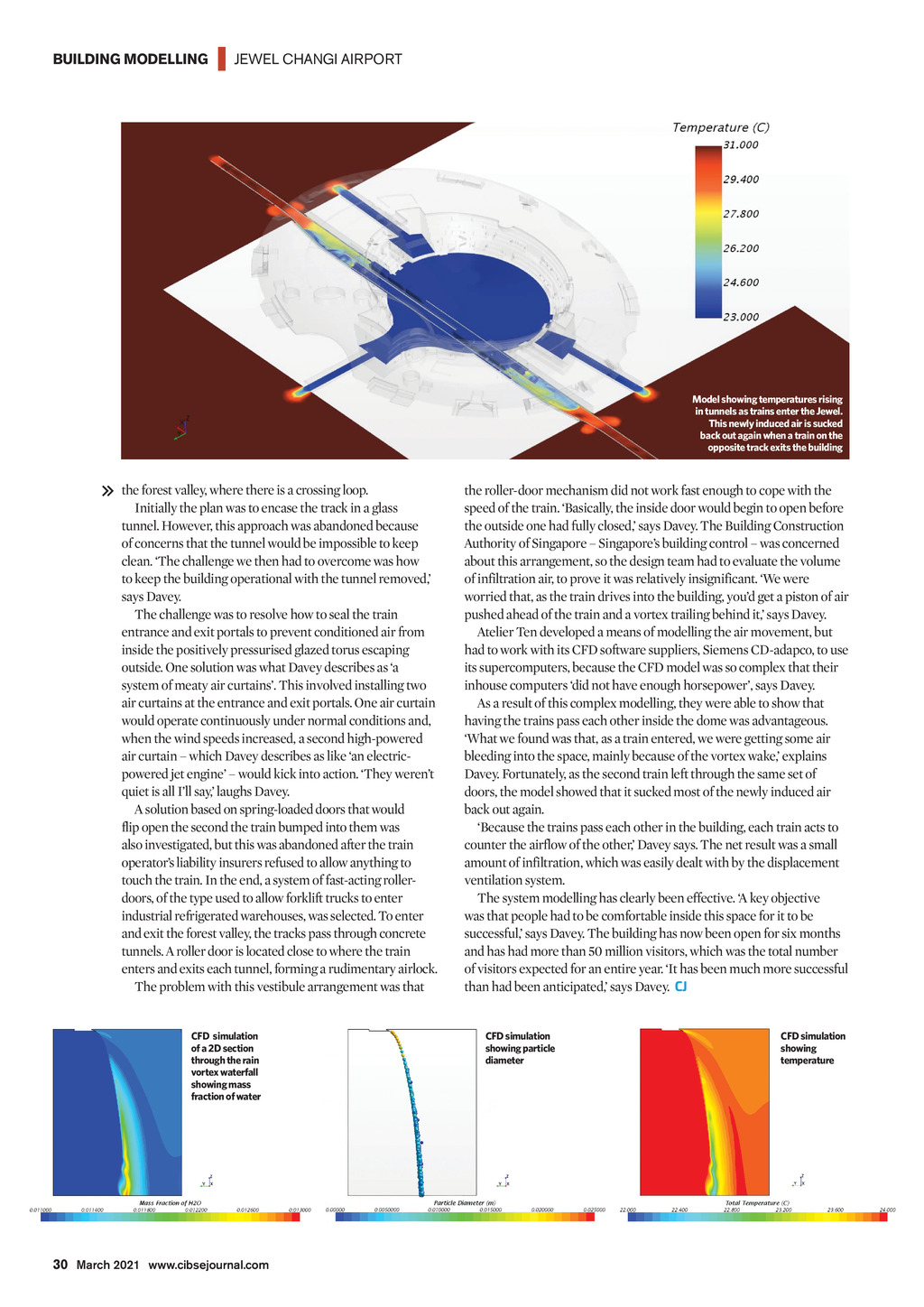


BUILDING MODELLING | JEWEL CHANGI AIRPORT Model showing temperatures rising in tunnels as trains enter the Jewel. This newly induced air is sucked back out again when a train on the opposite track exits the building the forest valley, where there is a crossing loop. Initially the plan was to encase the track in a glass tunnel. However, this approach was abandoned because of concerns that the tunnel would be impossible to keep clean. The challenge we then had to overcome was how to keep the building operational with the tunnel removed, says Davey. The challenge was to resolve how to seal the train entrance and exit portals to prevent conditioned air from inside the positively pressurised glazed torus escaping outside. One solution was what Davey describes as a system of meaty air curtains. This involved installing two air curtains at the entrance and exit portals. One air curtain would operate continuously under normal conditions and, when the wind speeds increased, a second high-powered air curtain which Davey describes as like an electricpowered jet engine would kick into action. They werent quiet is all Ill say, laughs Davey. A solution based on spring-loaded doors that would flip open the second the train bumped into them was also investigated, but this was abandoned after the train operators liability insurers refused to allow anything to touch the train. In the end, a system of fast-acting rollerdoors, of the type used to allow forklift trucks to enter industrial refrigerated warehouses, was selected. To enter and exit the forest valley, the tracks pass through concrete tunnels. A roller door is located close to where the train enters and exits each tunnel, forming a rudimentary airlock. The problem with this vestibule arrangement was that CFD simulation of a 2D section through the rain vortex waterfall showing mass fraction of water the roller-door mechanism did not work fast enough to cope with the speed of the train. Basically, the inside door would begin to open before the outside one had fully closed, says Davey. The Building Construction Authority of Singapore Singapores building control was concerned about this arrangement, so the design team had to evaluate the volume of infiltration air, to prove it was relatively insignificant. We were worried that, as the train drives into the building, youd get a piston of air pushed ahead of the train and a vortex trailing behind it, says Davey. Atelier Ten developed a means of modelling the air movement, but had to work with its CFD software suppliers, Siemens CD-adapco, to use its supercomputers, because the CFD model was so complex that their inhouse computers did not have enough horsepower, says Davey. As a result of this complex modelling, they were able to show that having the trains pass each other inside the dome was advantageous. What we found was that, as a train entered, we were getting some air bleeding into the space, mainly because of the vortex wake, explains Davey. Fortunately, as the second train left through the same set of doors, the model showed that it sucked most of the newly induced air back out again. Because the trains pass each other in the building, each train acts to counter the airflow of the other, Davey says. The net result was a small amount of infiltration, which was easily dealt with by the displacement ventilation system. The system modelling has clearly been effective. A key objective was that people had to be comfortable inside this space for it to be successful, says Davey. The building has now been open for six months and has had more than 50 million visitors, which was the total number of visitors expected for an entire year. It has been much more successful than had been anticipated, says Davey. CJ CFD simulation showing particle diameter CFD simulation showing temperature 30 March 2021 www.cibsejournal.com CIBSE March 21 pp26-30 Jewel Changi.indd 30 19/02/2021 17:44