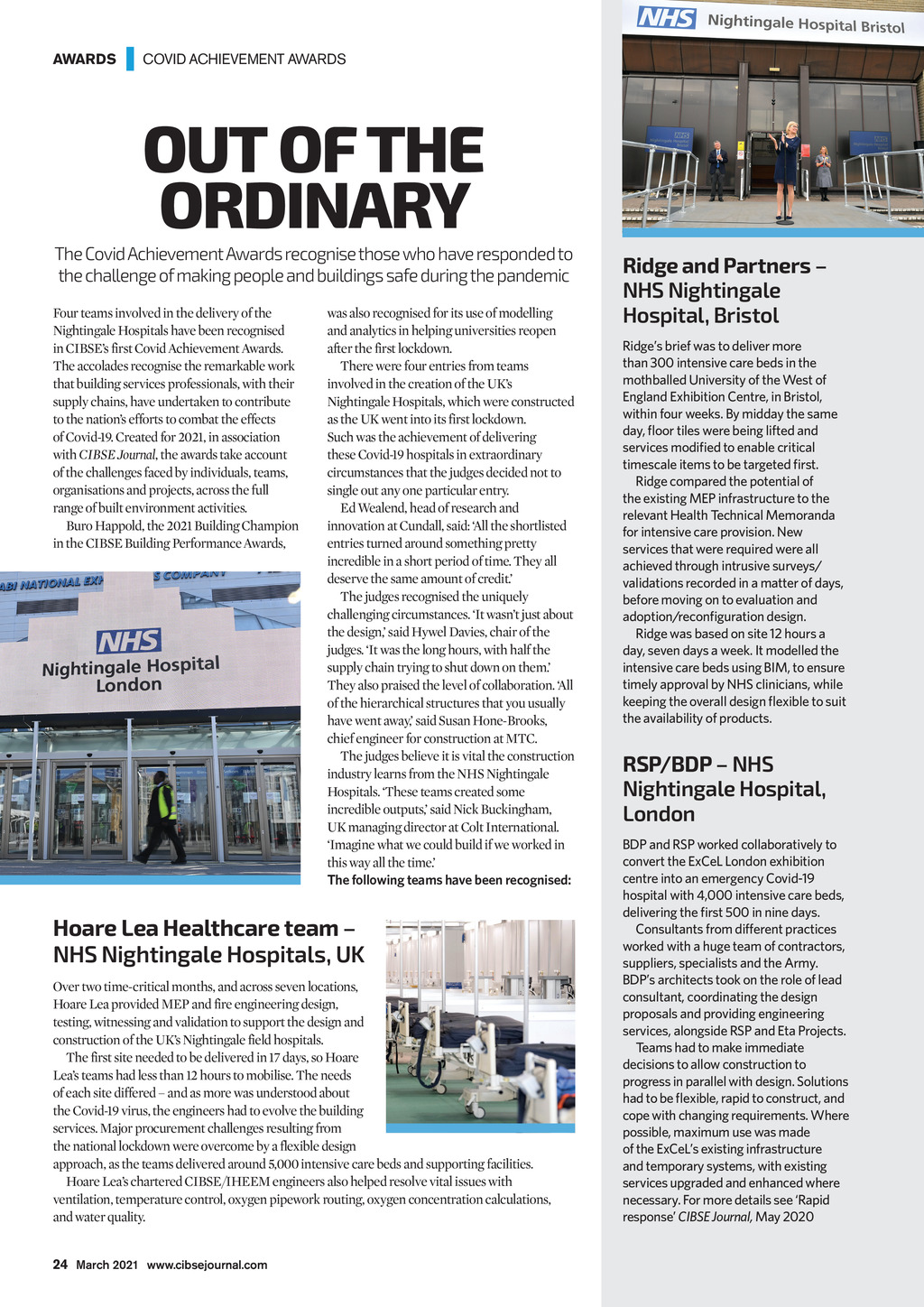


AWARDS | COVID ACHIEVEMENT AWARDS OUT OF THE ORDINARY The Covid Achievement Awards recognise those who have responded to the challenge of making people and buildings safe during the pandemic Four teams involved in the delivery of the Nightingale Hospitals have been recognised in CIBSEs first Covid Achievement Awards. The accolades recognise the remarkable work that building services professionals, with their supply chains, have undertaken to contribute to the nations efforts to combat the effects of Covid-19. Created for 2021, in association with CIBSE Journal, the awards take account of the challenges faced by individuals, teams, organisations and projects, across the full range of built environment activities. Buro Happold, the 2021 Building Champion in the CIBSE Building Performance Awards, was also recognised for its use of modelling and analytics in helping universities reopen after the first lockdown. There were four entries from teams involved in the creation of the UKs Nightingale Hospitals, which were constructed as the UK went into its first lockdown. Such was the achievement of delivering these Covid-19 hospitals in extraordinary circumstances that the judges decided not to single out any one particular entry. Ed Wealend, head of research and innovation at Cundall, said: All the shortlisted entries turned around something pretty incredible in a short period of time. They all deserve the same amount of credit. The judges recognised the uniquely challenging circumstances. It wasnt just about the design, said Hywel Davies, chair of the judges. It was the long hours, with half the supply chain trying to shut down on them. They also praised the level of collaboration. All of the hierarchical structures that you usually have went away, said Susan Hone-Brooks, chief engineer for construction at MTC. The judges believe it is vital the construction industry learns from the NHS Nightingale Hospitals. These teams created some incredible outputs, said Nick Buckingham, UK managing director at Colt International. Imagine what we could build if we worked in this way all the time. The following teams have been recognised: Hoare Lea Healthcare team NHS Nightingale Hospitals, UK Over two time-critical months, and across seven locations, Hoare Lea provided MEP and fire engineering design, testing, witnessing and validation to support the design and construction of the UKs Nightingale field hospitals. The first site needed to be delivered in 17 days, so Hoare Leas teams had less than 12 hours to mobilise. The needs of each site differed and as more was understood about the Covid-19 virus, the engineers had to evolve the building services. Major procurement challenges resulting from the national lockdown were overcome by a flexible design approach, as the teams delivered around 5,000 intensive care beds and supporting facilities. Hoare Leas chartered CIBSE/IHEEM engineers also helped resolve vital issues with ventilation, temperature control, oxygen pipework routing, oxygen concentration calculations, and water quality. Ridge and Partners NHS Nightingale Hospital, Bristol Ridges brief was to deliver more than 300 intensive care beds in the mothballed University of the West of England Exhibition Centre, in Bristol, within four weeks. By midday the same day, floor tiles were being lifted and services modified to enable critical timescale items to be targeted first. Ridge compared the potential of the existing MEP infrastructure to the relevant Health Technical Memoranda for intensive care provision. New services that were required were all achieved through intrusive surveys/ validations recorded in a matter of days, before moving on to evaluation and adoption/reconfiguration design. Ridge was based on site 12 hours a day, seven days a week. It modelled the intensive care beds using BIM, to ensure timely approval by NHS clinicians, while keeping the overall design flexible to suit the availability of products. RSP/BDP NHS Nightingale Hospital, London BDP and RSP worked collaboratively to convert the ExCeL London exhibition centre into an emergency Covid-19 hospital with 4,000 intensive care beds, delivering the first 500 in nine days. Consultants from different practices worked with a huge team of contractors, suppliers, specialists and the Army. BDPs architects took on the role of lead consultant, coordinating the design proposals and providing engineering services, alongside RSP and Eta Projects. Teams had to make immediate decisions to allow construction to progress in parallel with design. Solutions had to be flexible, rapid to construct, and cope with changing requirements. Where possible, maximum use was made of the ExCeLs existing infrastructure and temporary systems, with existing services upgraded and enhanced where necessary. For more details see Rapid response CIBSE Journal, May 2020 24 March 2021 www.cibsejournal.com CIBSE March 21 pp24-25 Covid Achievement Awards.indd 24 19/02/2021 16:19