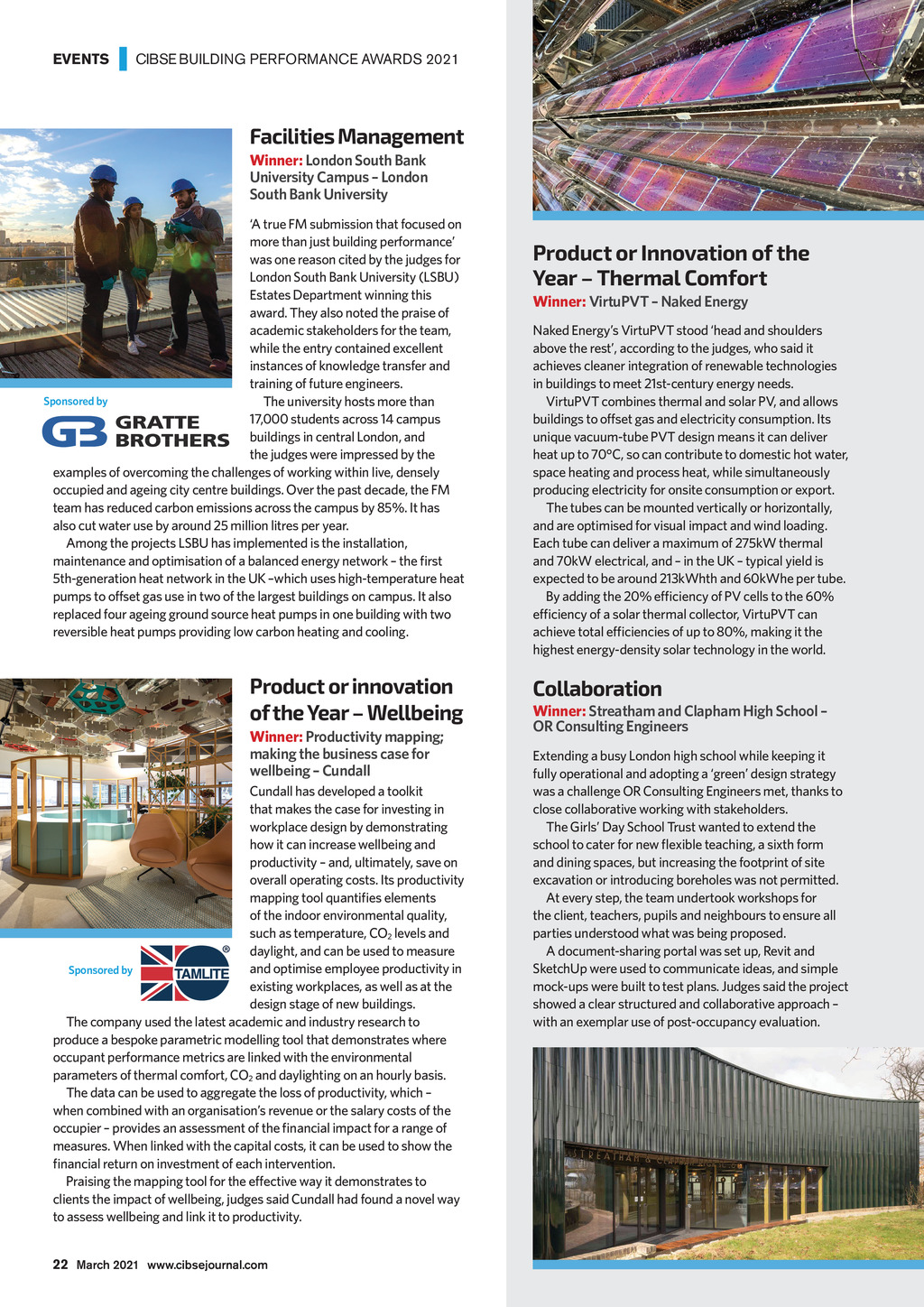


EVENTS | CIBSE BUILDING PERFORMANCE AWARDS 2021 Facilities Management Winner: London South Bank University Campus London South Bank University A true FM submission that focused on more than just building performance was one reason cited by the judges for London South Bank University (LSBU) Estates Department winning this award. They also noted the praise of academic stakeholders for the team, while the entry contained excellent instances of knowledge transfer and training of future engineers. Sponsored by The university hosts more than 17,000 students across 14 campus buildings in central London, and the judges were impressed by the examples of overcoming the challenges of working within live, densely occupied and ageing city centre buildings. Over the past decade, the FM team has reduced carbon emissions across the campus by 85%. It has also cut water use by around 25 million litres per year. Among the projects LSBU has implemented is the installation, maintenance and optimisation of a balanced energy network the first 5th-generation heat network in the UK which uses high-temperature heat pumps to offset gas use in two of the largest buildings on campus. It also replaced four ageing ground source heat pumps in one building with two reversible heat pumps providing low carbon heating and cooling. Product or innovation of the Year Wellbeing Winner: Productivity mapping; making the business case for wellbeing Cundall Cundall has developed a toolkit that makes the case for investing in workplace design by demonstrating how it can increase wellbeing and productivity and, ultimately, save on overall operating costs. Its productivity mapping tool quantifies elements of the indoor environmental quality, such as temperature, CO2 levels and daylight, and can be used to measure and optimise employee productivity in Sponsored by existing workplaces, as well as at the design stage of new buildings. The company used the latest academic and industry research to produce a bespoke parametric modelling tool that demonstrates where occupant performance metrics are linked with the environmental parameters of thermal comfort, CO2 and daylighting on an hourly basis. The data can be used to aggregate the loss of productivity, which when combined with an organisations revenue or the salary costs of the occupier provides an assessment of the financial impact for a range of measures. When linked with the capital costs, it can be used to show the financial return on investment of each intervention. Praising the mapping tool for the effective way it demonstrates to clients the impact of wellbeing, judges said Cundall had found a novel way to assess wellbeing and link it to productivity. Product or Innovation of the Year Thermal Comfort Winner: VirtuPVT Naked Energy Naked Energys VirtuPVT stood head and shoulders above the rest, according to the judges, who said it achieves cleaner integration of renewable technologies in buildings to meet 21st-century energy needs. VirtuPVT combines thermal and solar PV, and allows buildings to offset gas and electricity consumption. Its unique vacuum-tube PVT design means it can deliver heat up to 70C, so can contribute to domestic hot water, space heating and process heat, while simultaneously producing electricity for onsite consumption or export. The tubes can be mounted vertically or horizontally, and are optimised for visual impact and wind loading. Each tube can deliver a maximum of 275kW thermal and 70kW electrical, and in the UK typical yield is expected to be around 213kWhth and 60kWhe per tube. By adding the 20% efficiency of PV cells to the 60% efficiency of a solar thermal collector, VirtuPVT can achieve total efficiencies of up to 80%, making it the highest energy-density solar technology in the world. Collaboration Winner: Streatham and Clapham High School OR Consulting Engineers Extending a busy London high school while keeping it fully operational and adopting a green design strategy was a challenge OR Consulting Engineers met, thanks to close collaborative working with stakeholders. The Girls Day School Trust wanted to extend the school to cater for new flexible teaching, a sixth form and dining spaces, but increasing the footprint of site excavation or introducing boreholes was not permitted. At every step, the team undertook workshops for the client, teachers, pupils and neighbours to ensure all parties understood what was being proposed. A document-sharing portal was set up, Revit and SketchUp were used to communicate ideas, and simple mock-ups were built to test plans. Judges said the project showed a clear structured and collaborative approach with an exemplar use of post-occupancy evaluation. 22 March 2021 www.cibsejournal.com CIBSE March 21 pp18-22 Awards.indd 22 19/02/2021 17:41