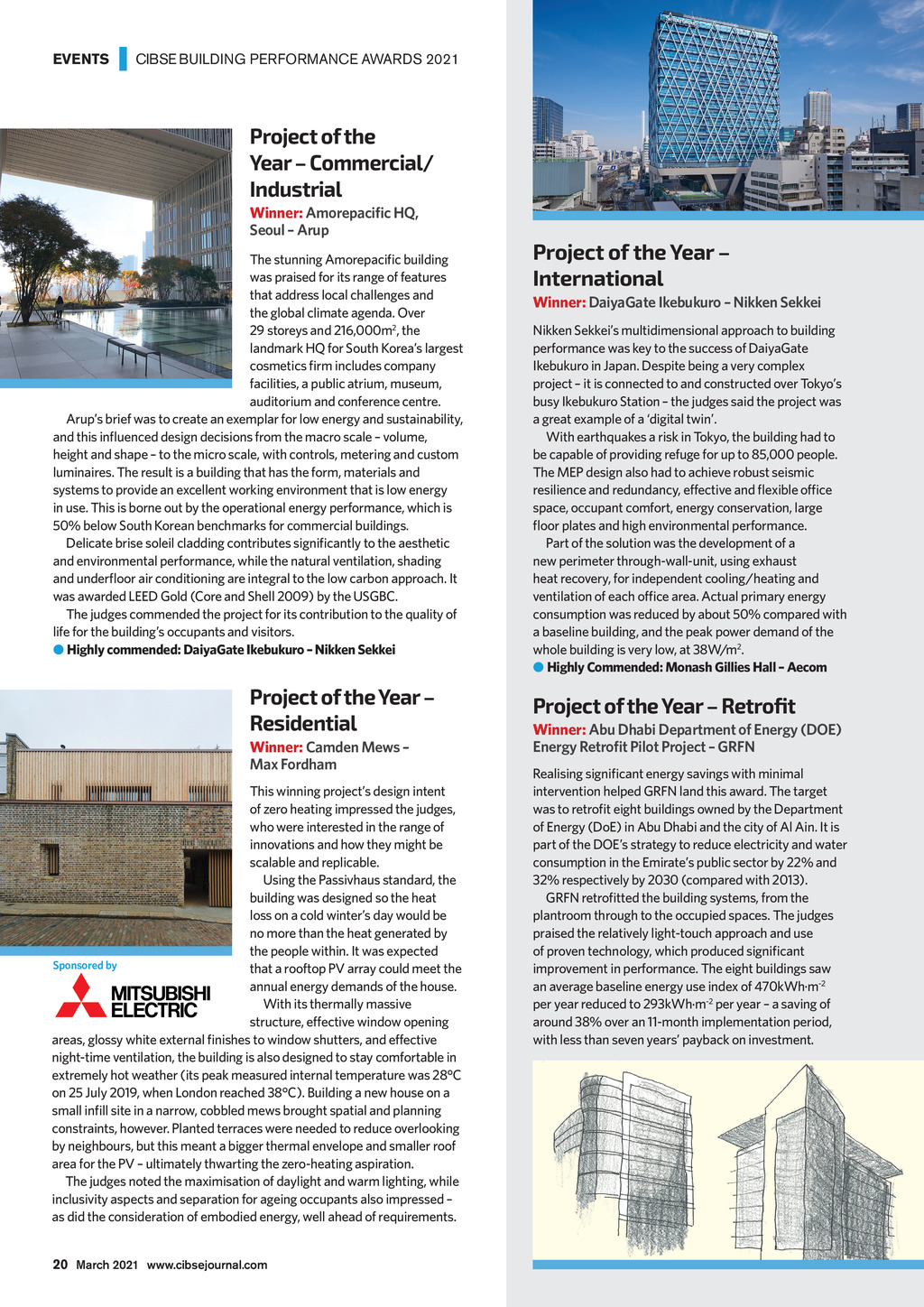


EVENTS | CIBSE BUILDING PERFORMANCE AWARDS 2021 Project of the Year Commercial/ Industrial Winner: Amorepacic HQ, Seoul Arup The stunning Amorepacic building was praised for its range of features that address local challenges and the global climate agenda. Over 29 storeys and 216,000m2, the landmark HQ for South Koreas largest cosmetics rm includes company facilities, a public atrium, museum, auditorium and conference centre. Arups brief was to create an exemplar for low energy and sustainability, and this inuenced design decisions from the macro scale volume, height and shape to the micro scale, with controls, metering and custom luminaires. The result is a building that has the form, materials and systems to provide an excellent working environment that is low energy in use. This is borne out by the operational energy performance, which is 50% below South Korean benchmarks for commercial buildings. Delicate brise soleil cladding contributes signicantly to the aesthetic and environmental performance, while the natural ventilation, shading and underoor air conditioning are integral to the low carbon approach. It was awarded LEED Gold (Core and Shell 2009) by the USGBC. The judges commended the project for its contribution to the quality of life for the buildings occupants and visitors. Highly commended: DaiyaGate Ikebukuro Nikken Sekkei Project of the Year Residential Winner: Camden Mews Max Fordham This winning projects design intent of zero heating impressed the judges, who were interested in the range of innovations and how they might be scalable and replicable. Using the Passivhaus standard, the building was designed so the heat loss on a cold winters day would be no more than the heat generated by the people within. It was expected Sponsored by that a rooftop PV array could meet the annual energy demands of the house. With its thermally massive structure, effective window opening areas, glossy white external nishes to window shutters, and effective night-time ventilation, the building is also designed to stay comfortable in extremely hot weather (its peak measured internal temperature was 28C on 25 July 2019, when London reached 38C). Building a new house on a small inll site in a narrow, cobbled mews brought spatial and planning constraints, however. Planted terraces were needed to reduce overlooking by neighbours, but this meant a bigger thermal envelope and smaller roof area for the PV ultimately thwarting the zero-heating aspiration. The judges noted the maximisation of daylight and warm lighting, while inclusivity aspects and separation for ageing occupants also impressed as did the consideration of embodied energy, well ahead of requirements. Project of the Year International Winner: DaiyaGate Ikebukuro Nikken Sekkei Nikken Sekkeis multidimensional approach to building performance was key to the success of DaiyaGate Ikebukuro in Japan. Despite being a very complex project it is connected to and constructed over Tokyos busy Ikebukuro Station the judges said the project was a great example of a digital twin. With earthquakes a risk in Tokyo, the building had to be capable of providing refuge for up to 85,000 people. The MEP design also had to achieve robust seismic resilience and redundancy, effective and exible ofce space, occupant comfort, energy conservation, large oor plates and high environmental performance. Part of the solution was the development of a new perimeter through-wall-unit, using exhaust heat recovery, for independent cooling/heating and ventilation of each ofce area. Actual primary energy consumption was reduced by about 50% compared with a baseline building, and the peak power demand of the whole building is very low, at 38W/m2. Highly Commended: Monash Gillies Hall Aecom Project of the Year Retrofit Winner: Abu Dhabi Department of Energy (DOE) Energy Retrot Pilot Project GRFN Realising signicant energy savings with minimal intervention helped GRFN land this award. The target was to retrot eight buildings owned by the Department of Energy (DoE) in Abu Dhabi and the city of Al Ain. It is part of the DOEs strategy to reduce electricity and water consumption in the Emirates public sector by 22% and 32% respectively by 2030 (compared with 2013). GRFN retrotted the building systems, from the plantroom through to the occupied spaces. The judges praised the relatively light-touch approach and use of proven technology, which produced signicant improvement in performance. The eight buildings saw an average baseline energy use index of 470kWh.m-2 per year reduced to 293kWh.m-2 per year a saving of around 38% over an 11-month implementation period, with less than seven years payback on investment. 20 March 2021 www.cibsejournal.com CIBSE March 21 pp18-22 Awards.indd 20 19/02/2021 14:09