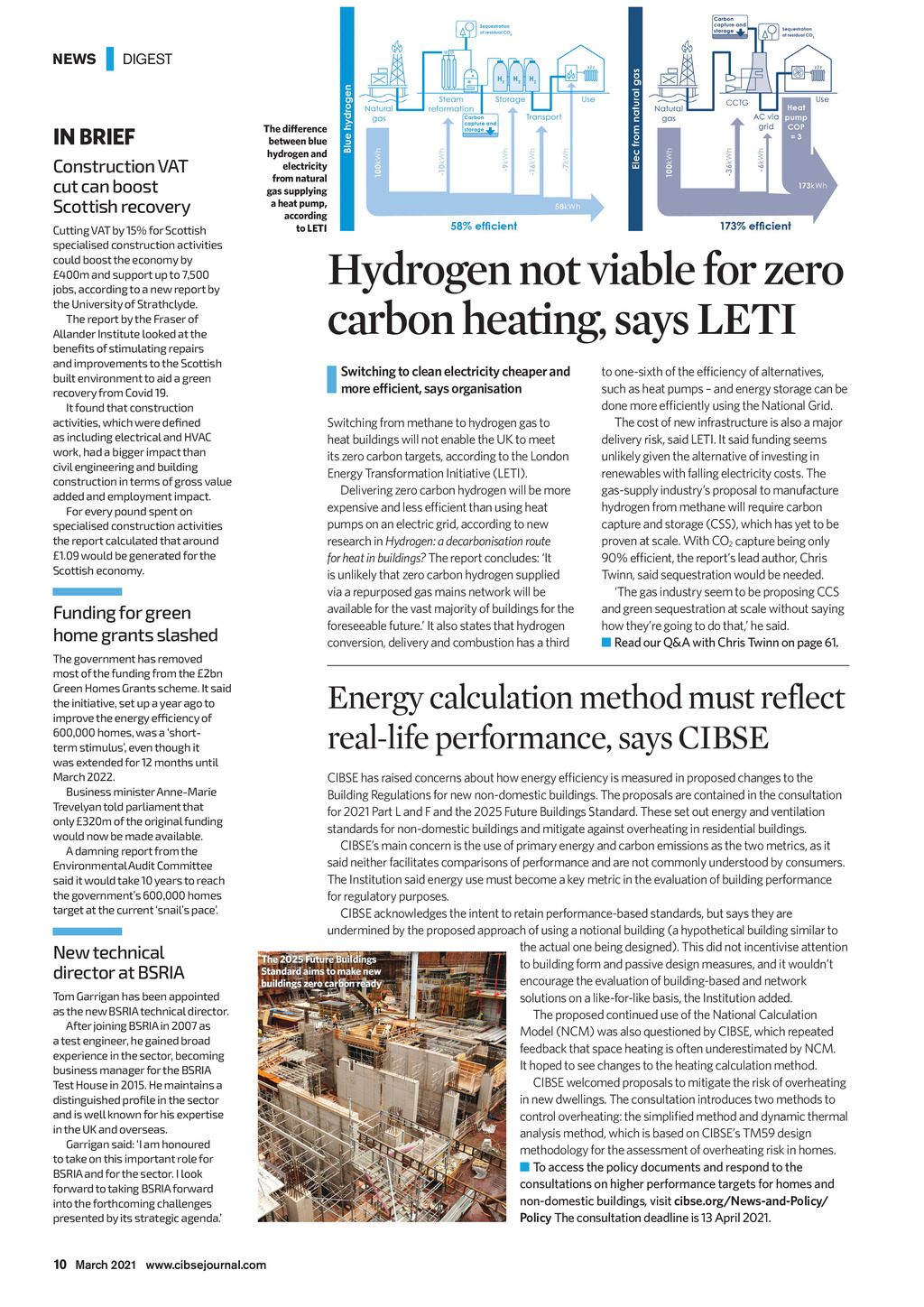


NEWS | DIGEST IN BRIEF Construction VAT cut can boost Scottish recovery Cutting VAT by 15% for Scottish specialised construction activities could boost the economy by 400m and support up to 7,500 jobs, according to a new report by the University of Strathclyde. The report by the Fraser of Allander Institute looked at the benefits of stimulating repairs and improvements to the Scottish built environment to aid a green recovery from Covid 19. It found that construction activities, which were defined as including electrical and HVAC work, had a bigger impact than civil engineering and building construction in terms of gross value added and employment impact. For every pound spent on specialised construction activities the report calculated that around 1.09 would be generated for the Scottish economy. The difference between blue hydrogen and electricity from natural gas supplying a heat pump, according to LETI Hydrogen not viable for zero carbon heating, says LETI Switching to clean electricity cheaper and more efcient, says organisation Switching from methane to hydrogen gas to heat buildings will not enable the UK to meet its zero carbon targets, according to the London Energy Transformation Initiative (LETI). Delivering zero carbon hydrogen will be more expensive and less efcient than using heat pumps on an electric grid, according to new research in Hydrogen: a decarbonisation route for heat in buildings? The report concludes: It is unlikely that zero carbon hydrogen supplied via a repurposed gas mains network will be available for the vast majority of buildings for the foreseeable future. It also states that hydrogen conversion, delivery and combustion has a third Funding for green home grants slashed The government has removed most of the funding from the 2bn Green Homes Grants scheme. It said the initiative, set up a year ago to improve the energy efficiency of 600,000 homes, was a shortterm stimulus, even though it was extended for 12 months until March 2022. Business minister Anne-Marie Trevelyan told parliament that only 320m of the original funding would now be made available. A damning report from the Environmental Audit Committee said it would take 10 years to reach the governments 600,000 homes target at the current snails pace. New technical director at BSRIA Tom Garrigan has been appointed as the new BSRIA technical director. After joining BSRIA in 2007 as a test engineer, he gained broad experience in the sector, becoming business manager for the BSRIA Test House in 2015. He maintains a distinguished profile in the sector and is well known for his expertise in the UK and overseas. Garrigan said: I am honoured to take on this important role for BSRIA and for the sector. I look forward to taking BSRIA forward into the forthcoming challenges presented by its strategic agenda. to one-sixth of the efciency of alternatives, such as heat pumps and energy storage can be done more efciently using the National Grid. The cost of new infrastructure is also a major delivery risk, said LETI. It said funding seems unlikely given the alternative of investing in renewables with falling electricity costs. The gas-supply industrys proposal to manufacture hydrogen from methane will require carbon capture and storage (CSS), which has yet to be proven at scale. With CO2 capture being only 90% efcient, the reports lead author, Chris Twinn, said sequestration would be needed. The gas industry seem to be proposing CCS and green sequestration at scale without saying how theyre going to do that, he said. Read our Q&A with Chris Twinn on page 61. Energy calculation method must reflect real-life performance, says CIBSE CIBSE has raised concerns about how energy efciency is measured in proposed changes to the Building Regulations for new non-domestic buildings. The proposals are contained in the consultation for 2021 Part L and F and the 2025 Future Buildings Standard. These set out energy and ventilation standards for non-domestic buildings and mitigate against overheating in residential buildings. CIBSEs main concern is the use of primary energy and carbon emissions as the two metrics, as it said neither facilitates comparisons of performance and are not commonly understood by consumers. The Institution said energy use must become a key metric in the evaluation of building performance for regulatory purposes. CIBSE acknowledges the intent to retain performance-based standards, but says they are undermined by the proposed approach of using a notional building (a hypothetical building similar to the actual one being designed). This did not incentivise attention The 2025 Future Buildings to building form and passive design measures, and it wouldnt Standard aims to make new encourage the evaluation of building-based and network buildings zero carbon ready solutions on a like-for-like basis, the Institution added. The proposed continued use of the National Calculation Model (NCM) was also questioned by CIBSE, which repeated feedback that space heating is often underestimated by NCM. It hoped to see changes to the heating calculation method. CIBSE welcomed proposals to mitigate the risk of overheating in new dwellings. The consultation introduces two methods to control overheating: the simplied method and dynamic thermal analysis method, which is based on CIBSEs TM59 design methodology for the assessment of overheating risk in homes. To access the policy documents and respond to the consultations on higher performance targets for homes and non-domestic buildings, visit cibse.org/News-and-Policy/ Policy The consultation deadline is 13 April 2021. 10 March 2021 www.cibsejournal.com CIBSE March 21 pp10 News V2.indd 10 19/02/2021 17:34