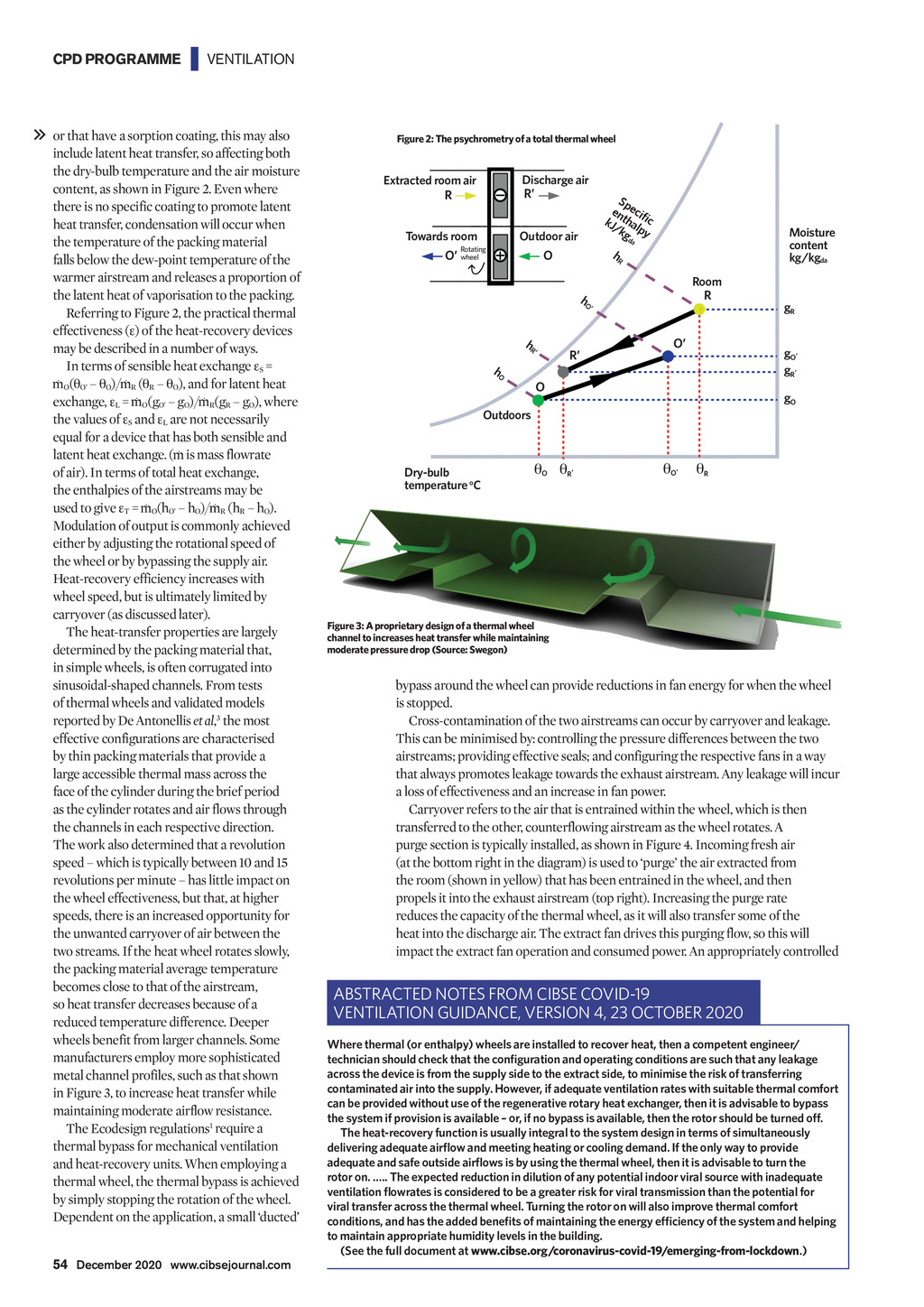


CPD PROGRAMME | VENTILATION or that have a sorption coating, this may also include latent heat transfer, so affecting both the dry-bulb temperature and the air moisture content, as shown in Figure 2. Even where there is no specific coating to promote latent heat transfer, condensation will occur when the temperature of the packing material falls below the dew-point temperature of the warmer airstream and releases a proportion of the latent heat of vaporisation to the packing. Referring to Figure 2, the practical thermal effectiveness () of the heat-recovery devices may be described in a number of ways. In terms of sensible heat exchange S = O(O O)/ R (R O), and for latent heat exchange, L = O(gO gO)/ R(gR gO), where the values of S and L are not necessarily equal for a device that has both sensible and latent heat exchange. ( is mass flowrate of air). In terms of total heat exchange, the enthalpies of the airstreams may be used to give T = O(hO hO)/ R (hR hO). Modulation of output is commonly achieved either by adjusting the rotational speed of the wheel or by bypassing the supply air. Heat-recovery efficiency increases with wheel speed, but is ultimately limited by carryover (as discussed later). The heat-transfer properties are largely determined by the packing material that, in simple wheels, is often corrugated into sinusoidal-shaped channels. From tests of thermal wheels and validated models reported by De Antonellis et al,3 the most effective configurations are characterised by thin packing materials that provide a large accessible thermal mass across the face of the cylinder during the brief period as the cylinder rotates and air flows through the channels in each respective direction. The work also determined that a revolution speed which is typically between 10 and 15 revolutions per minute has little impact on the wheel effectiveness, but that, at higher speeds, there is an increased opportunity for the unwanted carryover of air between the two streams. If the heat wheel rotates slowly, the packing material average temperature becomes close to that of the airstream, so heat transfer decreases because of a reduced temperature difference. Deeper wheels benefit from larger channels. Some manufacturers employ more sophisticated metal channel profiles, such as that shown in Figure 3, to increase heat transfer while maintaining moderate airflow resistance. The Ecodesign regulations1 require a thermal bypass for mechanical ventilation and heat-recovery units. When employing a thermal wheel, the thermal bypass is achieved by simply stopping the rotation of the wheel. Dependent on the application, a small ducted 54 December 2020 www.cibsejournal.com CIBSE Dec20 pp53-56 CPD 172 Swegon v3.indd 54 Figure 2: The psychrometry of a total thermal wheel Discharge air R Extracted room air R Towards room O Sp en eci kJ/ thal fic kg py d Outdoor air Rotating wheel hR O Moisture content kg/kgda a Room R hO hR hO R O gR gO gR O gO Outdoors Dry-bulb temperature oC O R O R Figure 3: A proprietary design of a thermal wheel channel to increases heat transfer while maintaining moderate pressure drop (Source: Swegon) bypass around the wheel can provide reductions in fan energy for when the wheel is stopped. Cross-contamination of the two airstreams can occur by carryover and leakage. This can be minimised by: controlling the pressure differences between the two airstreams; providing effective seals; and configuring the respective fans in a way that always promotes leakage towards the exhaust airstream. Any leakage will incur a loss of effectiveness and an increase in fan power. Carryover refers to the air that is entrained within the wheel, which is then transferred to the other, counterflowing airstream as the wheel rotates. A purge section is typically installed, as shown in Figure 4. Incoming fresh air (at the bottom right in the diagram) is used to purge the air extracted from the room (shown in yellow) that has been entrained in the wheel, and then propels it into the exhaust airstream (top right). Increasing the purge rate reduces the capacity of the thermal wheel, as it will also transfer some of the heat into the discharge air. The extract fan drives this purging flow, so this will impact the extract fan operation and consumed power. An appropriately controlled ABSTRACTED NOTES FROM CIBSE COVID-19 VENTILATION GUIDANCE, VERSION 4, 23 OCTOBER 2020 Where thermal (or enthalpy) wheels are installed to recover heat, then a competent engineer/ technician should check that the configuration and operating conditions are such that any leakage across the device is from the supply side to the extract side, to minimise the risk of transferring contaminated air into the supply. However, if adequate ventilation rates with suitable thermal comfort can be provided without use of the regenerative rotary heat exchanger, then it is advisable to bypass the system if provision is available or, if no bypass is available, then the rotor should be turned off. The heat-recovery function is usually integral to the system design in terms of simultaneously delivering adequate airflow and meeting heating or cooling demand. If the only way to provide adequate and safe outside airflows is by using the thermal wheel, then it is advisable to turn the rotor on. .. The expected reduction in dilution of any potential indoor viral source with inadequate ventilation flowrates is considered to be a greater risk for viral transmission than the potential for viral transfer across the thermal wheel. Turning the rotor on will also improve thermal comfort conditions, and has the added benefits of maintaining the energy efficiency of the system and helping to maintain appropriate humidity levels in the building. (See the full document at www.cibse.org/coronavirus-covid-19/emerging-from-lockdown.) 20/11/2020 15:07