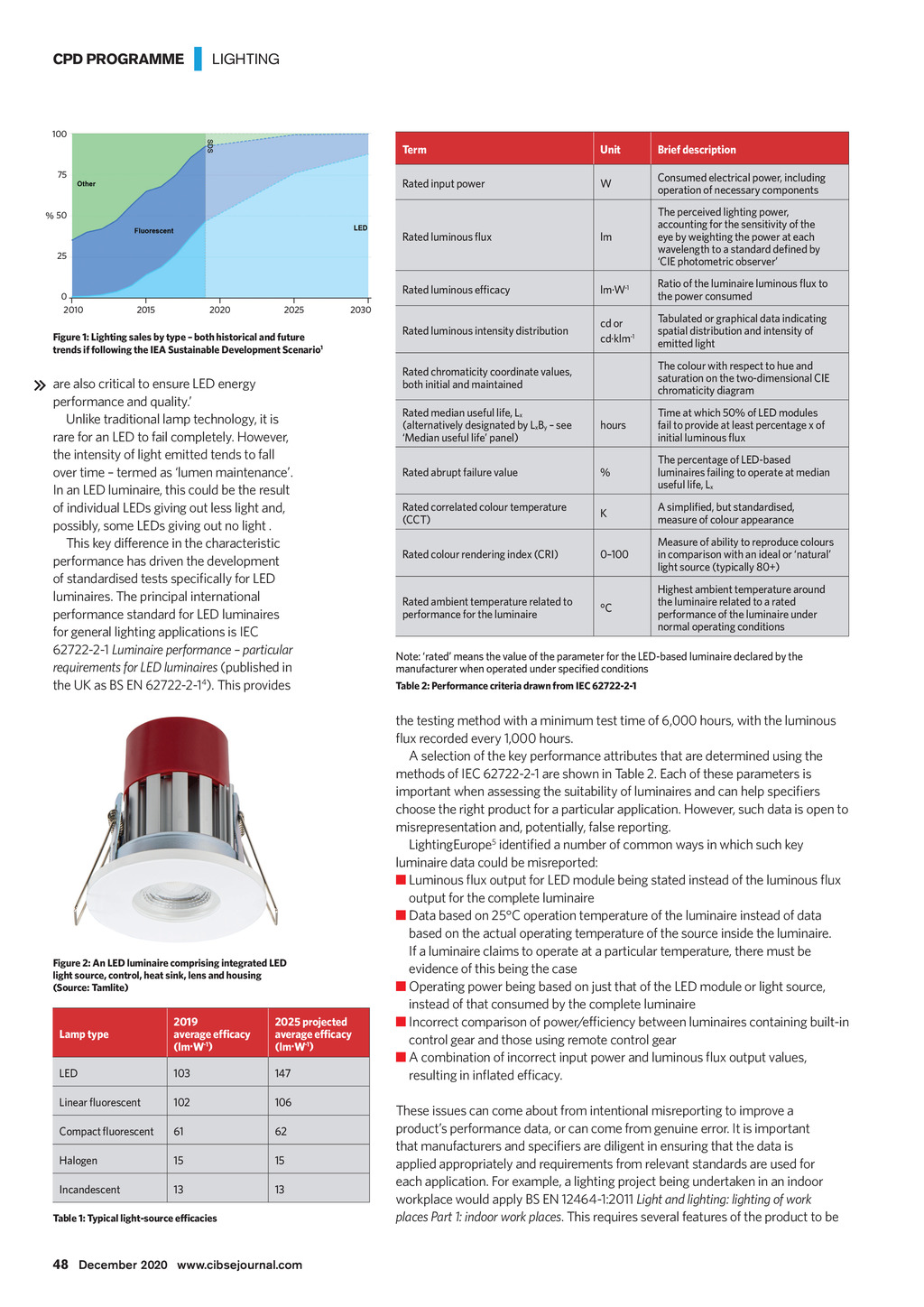


CPD PROGRAMME | LIGHTING 100 75 Term Unit Brief description Rated input power W Consumed electrical power, including operation of necessary components Rated luminous flux lm The perceived lighting power, accounting for the sensitivity of the eye by weighting the power at each wavelength to a standard defined by CIE photometric observer Rated luminous efficacy lm.W-1 Ratio of the luminaire luminous flux to the power consumed Rated luminous intensity distribution cd or cd.klm-1 Tabulated or graphical data indicating spatial distribution and intensity of emitted light % 50 25 0 2010 2015 2020 2025 2030 Figure 1: Lighting sales by type both historical and future trends if following the IEA Sustainable Development Scenario1 are also critical to ensure LED energy performance and quality. Unlike traditional lamp technology, it is rare for an LED to fail completely. However, the intensity of light emitted tends to fall over time termed as lumen maintenance. In an LED luminaire, this could be the result of individual LEDs giving out less light and, possibly, some LEDs giving out no light . This key difference in the characteristic performance has driven the development of standardised tests specifically for LED luminaires. The principal international performance standard for LED luminaires for general lighting applications is IEC 62722-2-1 Luminaire performance particular requirements for LED luminaires (published in the UK as BS EN 62722-2-14). This provides Figure 2: An LED luminaire comprising integrated LED light source, control, heat sink, lens and housing (Source: Tamlite) Lamp type 2019 average efficacy (lm.W-1) 2025 projected average efficacy (lm.W-1) LED 103 147 Linear fluorescent 102 106 Compact fluorescent 61 62 Halogen 15 15 Incandescent 13 13 Table 1: Typical light-source efficacies The colour with respect to hue and saturation on the two-dimensional CIE chromaticity diagram Rated chromaticity coordinate values, both initial and maintained Rated median useful life, Lx (alternatively designated by LxBy see Median useful life panel) hours Time at which 50% of LED modules fail to provide at least percentage x of initial luminous flux Rated abrupt failure value % The percentage of LED-based luminaires failing to operate at median useful life, Lx Rated correlated colour temperature (CCT) K A simplified, but standardised, measure of colour appearance Rated colour rendering index (CRI) 0100 Measure of ability to reproduce colours in comparison with an ideal or natural light source (typically 80+) Rated ambient temperature related to performance for the luminaire C Highest ambient temperature around the luminaire related to a rated performance of the luminaire under normal operating conditions Note: rated means the value of the parameter for the LED-based luminaire declared by the manufacturer when operated under specified conditions Table 2: Performance criteria drawn from IEC 62722-2-1 the testing method with a minimum test time of 6,000 hours, with the luminous flux recorded every 1,000 hours. A selection of the key performance attributes that are determined using the methods of IEC 62722-2-1 are shown in Table 2. Each of these parameters is important when assessing the suitability of luminaires and can help specifiers choose the right product for a particular application. However, such data is open to misrepresentation and, potentially, false reporting. LightingEurope5 identified a number of common ways in which such key luminaire data could be misreported: Luminous flux output for LED module being stated instead of the luminous flux output for the complete luminaire Data based on 25C operation temperature of the luminaire instead of data based on the actual operating temperature of the source inside the luminaire. If a luminaire claims to operate at a particular temperature, there must be evidence of this being the case Operating power being based on just that of the LED module or light source, instead of that consumed by the complete luminaire Incorrect comparison of power/efficiency between luminaires containing built-in control gear and those using remote control gear A combination of incorrect input power and luminous flux output values, resulting in inflated efficacy. These issues can come about from intentional misreporting to improve a products performance data, or can come from genuine error. It is important that manufacturers and specifiers are diligent in ensuring that the data is applied appropriately and requirements from relevant standards are used for each application. For example, a lighting project being undertaken in an indoor workplace would apply BS EN 12464-1:2011 Light and lighting: lighting of work places Part 1: indoor work places. This requires several features of the product to be 48 December 2020 www.cibsejournal.com CIBSE DEC20 pp47-50 Supp CPD173 Tamlite v3.indd 48 20/11/2020 16:25