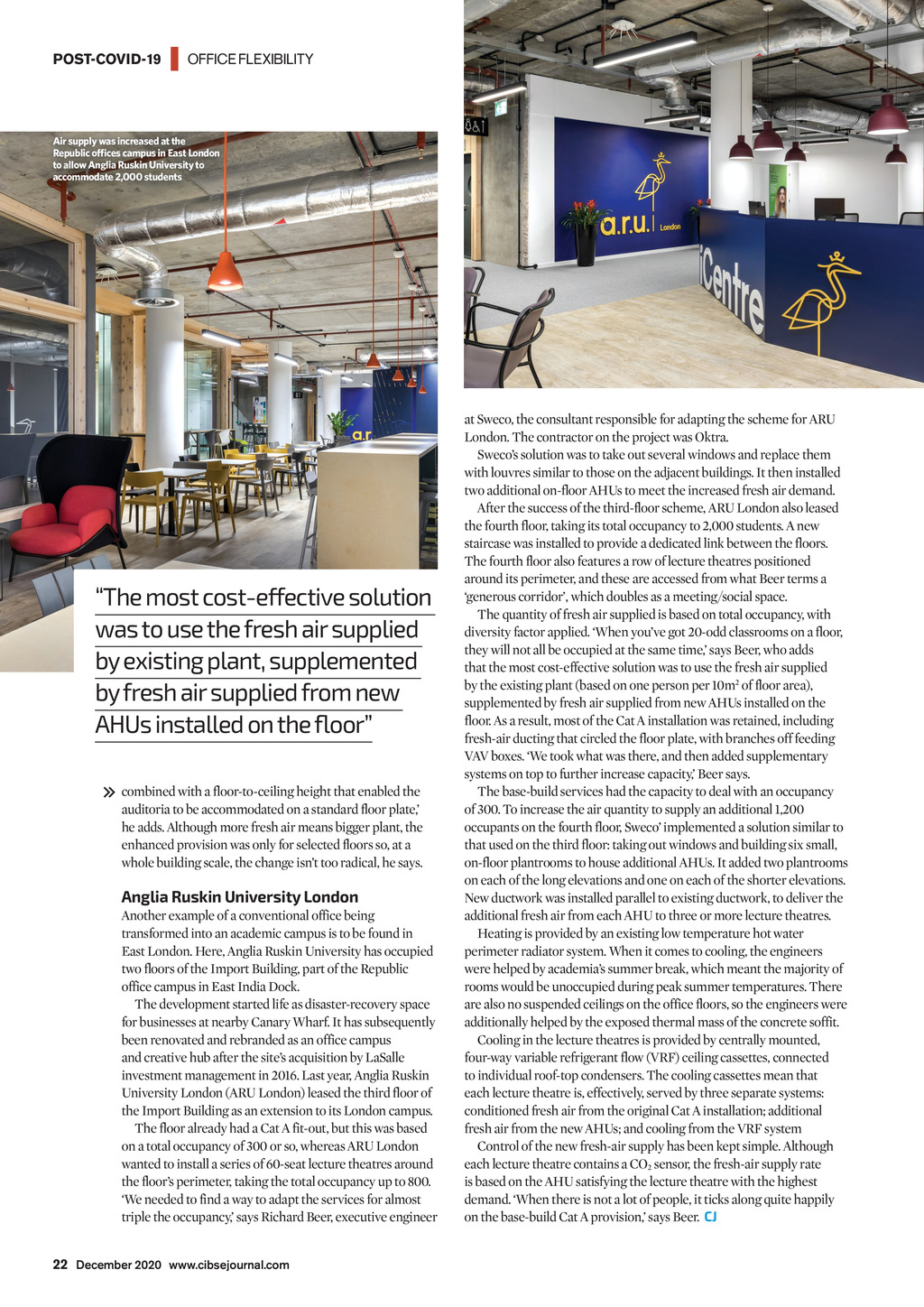


POST-COVID-19 | OFFICE FLEXIBILITY Air supply was increased at the Republic ofces campus in East London to allow Anglia Ruskin University to accommodate 2,000 students The most cost-effective solution was to use the fresh air supplied by existing plant, supplemented by fresh air supplied from new AHUs installed on the floor combined with a floor-to-ceiling height that enabled the auditoria to be accommodated on a standard floor plate, he adds. Although more fresh air means bigger plant, the enhanced provision was only for selected floors so, at a whole building scale, the change isnt too radical, he says. Anglia Ruskin University London Another example of a conventional office being transformed into an academic campus is to be found in East London. Here, Anglia Ruskin University has occupied two floors of the Import Building, part of the Republic office campus in East India Dock. The development started life as disaster-recovery space for businesses at nearby Canary Wharf. It has subsequently been renovated and rebranded as an office campus and creative hub after the sites acquisition by LaSalle investment management in 2016. Last year, Anglia Ruskin University London (ARU London) leased the third floor of the Import Building as an extension to its London campus. The floor already had a Cat A fit-out, but this was based on a total occupancy of 300 or so, whereas ARU London wanted to install a series of 60-seat lecture theatres around the floors perimeter, taking the total occupancy up to 800. We needed to find a way to adapt the services for almost triple the occupancy, says Richard Beer, executive engineer at Sweco, the consultant responsible for adapting the scheme for ARU London. The contractor on the project was Oktra. Swecos solution was to take out several windows and replace them with louvres similar to those on the adjacent buildings. It then installed two additional on-floor AHUs to meet the increased fresh air demand. After the success of the third-floor scheme, ARU London also leased the fourth floor, taking its total occupancy to 2,000 students. A new staircase was installed to provide a dedicated link between the floors. The fourth floor also features a row of lecture theatres positioned around its perimeter, and these are accessed from what Beer terms a generous corridor, which doubles as a meeting/social space. The quantity of fresh air supplied is based on total occupancy, with diversity factor applied. When youve got 20-odd classrooms on a floor, they will not all be occupied at the same time, says Beer, who adds that the most cost-effective solution was to use the fresh air supplied by the existing plant (based on one person per 10m2 of floor area), supplemented by fresh air supplied from new AHUs installed on the floor. As a result, most of the Cat A installation was retained, including fresh-air ducting that circled the floor plate, with branches off feeding VAV boxes. We took what was there, and then added supplementary systems on top to further increase capacity, Beer says. The base-build services had the capacity to deal with an occupancy of 300. To increase the air quantity to supply an additional 1,200 occupants on the fourth floor, Sweco implemented a solution similar to that used on the third floor: taking out windows and building six small, on-floor plantrooms to house additional AHUs. It added two plantrooms on each of the long elevations and one on each of the shorter elevations. New ductwork was installed parallel to existing ductwork, to deliver the additional fresh air from each AHU to three or more lecture theatres. Heating is provided by an existing low temperature hot water perimeter radiator system. When it comes to cooling, the engineers were helped by academias summer break, which meant the majority of rooms would be unoccupied during peak summer temperatures. There are also no suspended ceilings on the office floors, so the engineers were additionally helped by the exposed thermal mass of the concrete soffit. Cooling in the lecture theatres is provided by centrally mounted, four-way variable refrigerant flow (VRF) ceiling cassettes, connected to individual roof-top condensers. The cooling cassettes mean that each lecture theatre is, effectively, served by three separate systems: conditioned fresh air from the original Cat A installation; additional fresh air from the new AHUs; and cooling from the VRF system Control of the new fresh-air supply has been kept simple. Although each lecture theatre contains a CO2 sensor, the fresh-air supply rate is based on the AHU satisfying the lecture theatre with the highest demand. When there is not a lot of people, it ticks along quite happily on the base-build Cat A provision, says Beer. CJ 22 December 2020 www.cibsejournal.com CIBSE Dec20 pp20-22 Covid office flexibility .indd 22 20/11/2020 14:57