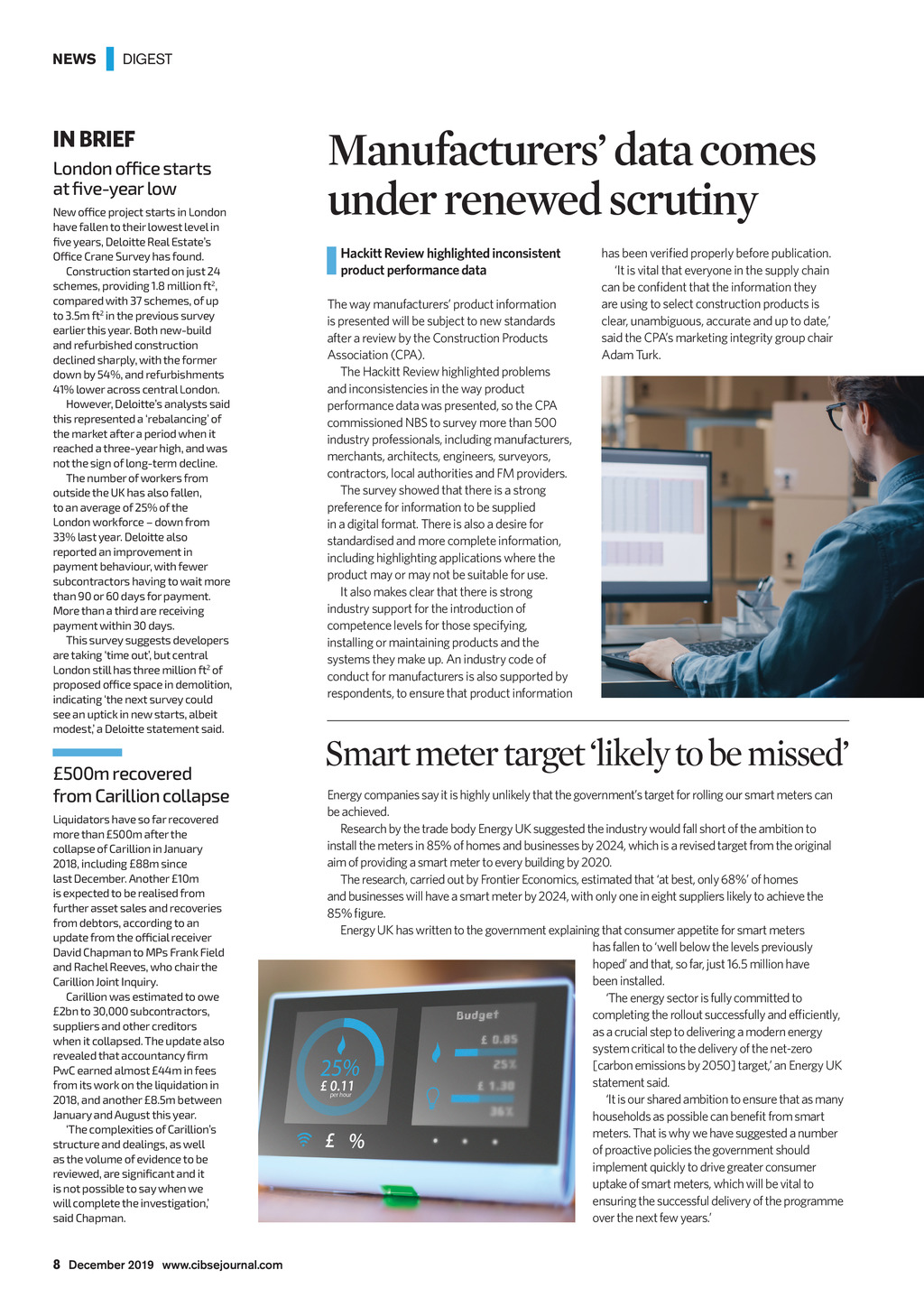


EWS | DIGEST IN BRIEF London office starts at five-year low New office project starts in London have fallen to their lowest level in five years, Deloitte Real Estates Office Crane Survey has found. Construction started on just 24 schemes, providing 1.8 million ft2, compared with 37 schemes, of up to 3.5m ft2 in the previous survey earlier this year. Both new-build and refurbished construction declined sharply, with the former down by 54%, and refurbishments 41% lower across central London. However, Deloittes analysts said this represented a rebalancing of the market after a period when it reached a three-year high, and was not the sign of long-term decline. The number of workers from outside the UK has also fallen, to an average of 25% of the London workforce down from 33% last year. Deloitte also reported an improvement in payment behaviour, with fewer subcontractors having to wait more than 90 or 60 days for payment. More than a third are receiving payment within 30 days. This survey suggests developers are taking time out, but central London still has three million ft2 of proposed office space in demolition, indicating the next survey could see an uptick in new starts, albeit modest, a Deloitte statement said. 500m recovered from Carillion collapse Liquidators have so far recovered more than 500m after the collapse of Carillion in January 2018, including 88m since last December. Another 10m is expected to be realised from further asset sales and recoveries from debtors, according to an update from the official receiver David Chapman to MPs Frank Field and Rachel Reeves, who chair the Carillion Joint Inquiry. Carillion was estimated to owe 2bn to 30,000 subcontractors, suppliers and other creditors when it collapsed. The update also revealed that accountancy firm PwC earned almost 44m in fees from its work on the liquidation in 2018, and another 8.5m between January and August this year. The complexities of Carillions structure and dealings, as well as the volume of evidence to be reviewed, are significant and it is not possible to say when we will complete the investigation, said Chapman. Manufacturers data comes under renewed scrutiny Hackitt Review highlighted inconsistent product performance data The way manufacturers product information is presented will be subject to new standards after a review by the Construction Products Association (CPA). The Hackitt Review highlighted problems and inconsistencies in the way product performance data was presented, so the CPA commissioned NBS to survey more than 500 industry professionals, including manufacturers, merchants, architects, engineers, surveyors, contractors, local authorities and FM providers. The survey showed that there is a strong preference for information to be supplied in a digital format. There is also a desire for standardised and more complete information, including highlighting applications where the product may or may not be suitable for use. It also makes clear that there is strong industry support for the introduction of competence levels for those specifying, installing or maintaining products and the systems they make up. An industry code of conduct for manufacturers is also supported by respondents, to ensure that product information has been verified properly before publication. It is vital that everyone in the supply chain can be confident that the information they are using to select construction products is clear, unambiguous, accurate and up to date, said the CPAs marketing integrity group chair Adam Turk. Smart meter target likely to be missed Energy companies say it is highly unlikely that the governments target for rolling our smart meters can be achieved. Research by the trade body Energy UK suggested the industry would fall short of the ambition to install the meters in 85% of homes and businesses by 2024, which is a revised target from the original aim of providing a smart meter to every building by 2020. The research, carried out by Frontier Economics, estimated that at best, only 68% of homes and businesses will have a smart meter by 2024, with only one in eight suppliers likely to achieve the 85% figure. Energy UK has written to the government explaining that consumer appetite for smart meters has fallen to well below the levels previously hoped and that, so far, just 16.5 million have been installed. The energy sector is fully committed to completing the rollout successfully and efficiently, as a crucial step to delivering a modern energy system critical to the delivery of the net-zero [carbon emissions by 2050] target, an Energy UK statement said. It is our shared ambition to ensure that as many households as possible can benefit from smart meters. That is why we have suggested a number of proactive policies the government should implement quickly to drive greater consumer uptake of smart meters, which will be vital to ensuring the successful delivery of the programme over the next few years. 8 December 2019 www.cibsejournal.com CIBSE Dec19 pp08 News.indd 8 22/11/2019 15:08