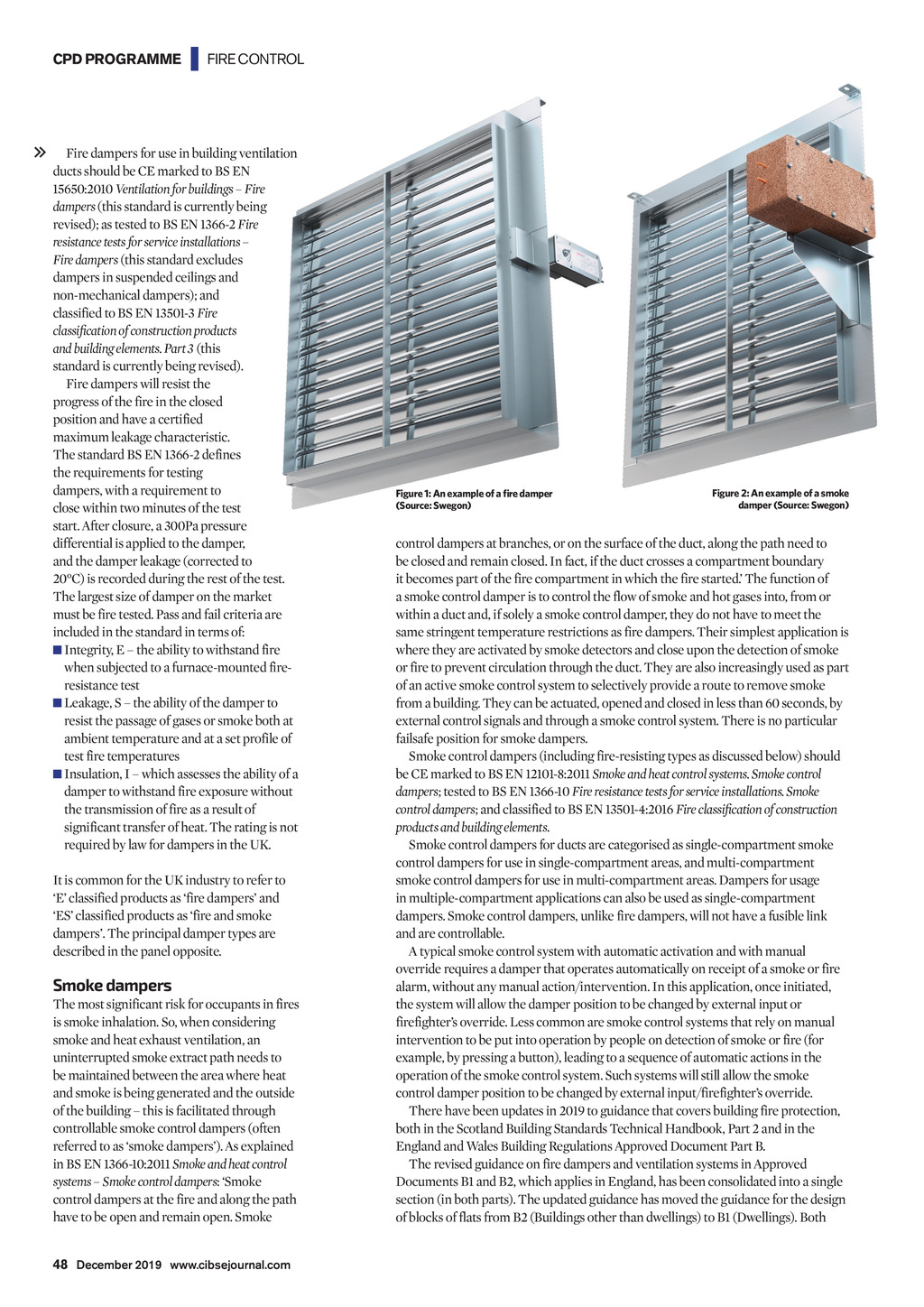


CPD PROGRAMME | FIRE CONTROL Fire dampers for use in building ventilation ducts should be CE marked to BS EN 15650:2010 Ventilation for buildings Fire dampers (this standard is currently being revised); as tested to BS EN 1366-2 Fire resistance tests for service installations Fire dampers (this standard excludes dampers in suspended ceilings and non-mechanical dampers); and classified to BS EN 13501-3 Fire classification of construction products and building elements. Part 3 (this standard is currently being revised). Fire dampers will resist the progress of the fire in the closed position and have a certified maximum leakage characteristic. The standard BS EN 1366-2 defines the requirements for testing dampers, with a requirement to close within two minutes of the test start. After closure, a 300Pa pressure differential is applied to the damper, and the damper leakage (corrected to 20C) is recorded during the rest of the test. The largest size of damper on the market must be fire tested. Pass and fail criteria are included in the standard in terms of: Integrity, E the ability to withstand fire when subjected to a furnace-mounted fireresistance test Leakage, S the ability of the damper to resist the passage of gases or smoke both at ambient temperature and at a set profile of test fire temperatures Insulation, I which assesses the ability of a damper to withstand fire exposure without the transmission of fire as a result of significant transfer of heat. The rating is not required by law for dampers in the UK. It is common for the UK industry to refer to E classified products as fire dampers and ES classified products as fire and smoke dampers. The principal damper types are described in the panel opposite. Smoke dampers The most significant risk for occupants in fires is smoke inhalation. So, when considering smoke and heat exhaust ventilation, an uninterrupted smoke extract path needs to be maintained between the area where heat and smoke is being generated and the outside of the building this is facilitated through controllable smoke control dampers (often referred to as smoke dampers). As explained in BS EN 1366-10:2011 Smoke and heat control systems Smoke control dampers: Smoke control dampers at the fire and along the path have to be open and remain open. Smoke Figure 1: An example of a fire damper (Source: Swegon) Figure 2: An example of a smoke damper (Source: Swegon) control dampers at branches, or on the surface of the duct, along the path need to be closed and remain closed. In fact, if the duct crosses a compartment boundary it becomes part of the fire compartment in which the fire started. The function of a smoke control damper is to control the flow of smoke and hot gases into, from or within a duct and, if solely a smoke control damper, they do not have to meet the same stringent temperature restrictions as fire dampers. Their simplest application is where they are activated by smoke detectors and close upon the detection of smoke or fire to prevent circulation through the duct. They are also increasingly used as part of an active smoke control system to selectively provide a route to remove smoke from a building. They can be actuated, opened and closed in less than 60 seconds, by external control signals and through a smoke control system. There is no particular failsafe position for smoke dampers. Smoke control dampers (including fire-resisting types as discussed below) should be CE marked to BS EN 12101-8:2011 Smoke and heat control systems. Smoke control dampers; tested to BS EN 1366-10 Fire resistance tests for service installations. Smoke control dampers; and classified to BS EN 13501-4:2016 Fire classification of construction products and building elements. Smoke control dampers for ducts are categorised as single-compartment smoke control dampers for use in single-compartment areas, and multi-compartment smoke control dampers for use in multi-compartment areas. Dampers for usage in multiple-compartment applications can also be used as single-compartment dampers. Smoke control dampers, unlike fire dampers, will not have a fusible link and are controllable. A typical smoke control system with automatic activation and with manual override requires a damper that operates automatically on receipt of a smoke or fire alarm, without any manual action/intervention. In this application, once initiated, the system will allow the damper position to be changed by external input or firefighters override. Less common are smoke control systems that rely on manual intervention to be put into operation by people on detection of smoke or fire (for example, by pressing a button), leading to a sequence of automatic actions in the operation of the smoke control system. Such systems will still allow the smoke control damper position to be changed by external input/firefighters override. There have been updates in 2019 to guidance that covers building fire protection, both in the Scotland Building Standards Technical Handbook, Part 2 and in the England and Wales Building Regulations Approved Document Part B. The revised guidance on fire dampers and ventilation systems in Approved Documents B1 and B2, which applies in England, has been consolidated into a single section (in both parts). The updated guidance has moved the guidance for the design of blocks of flats from B2 (Buildings other than dwellings) to B1 (Dwellings). Both 48 December 2019 www.cibsejournal.com CIBSE Dec19 pp47-50 CPD.indd 48 22/11/2019 15:28