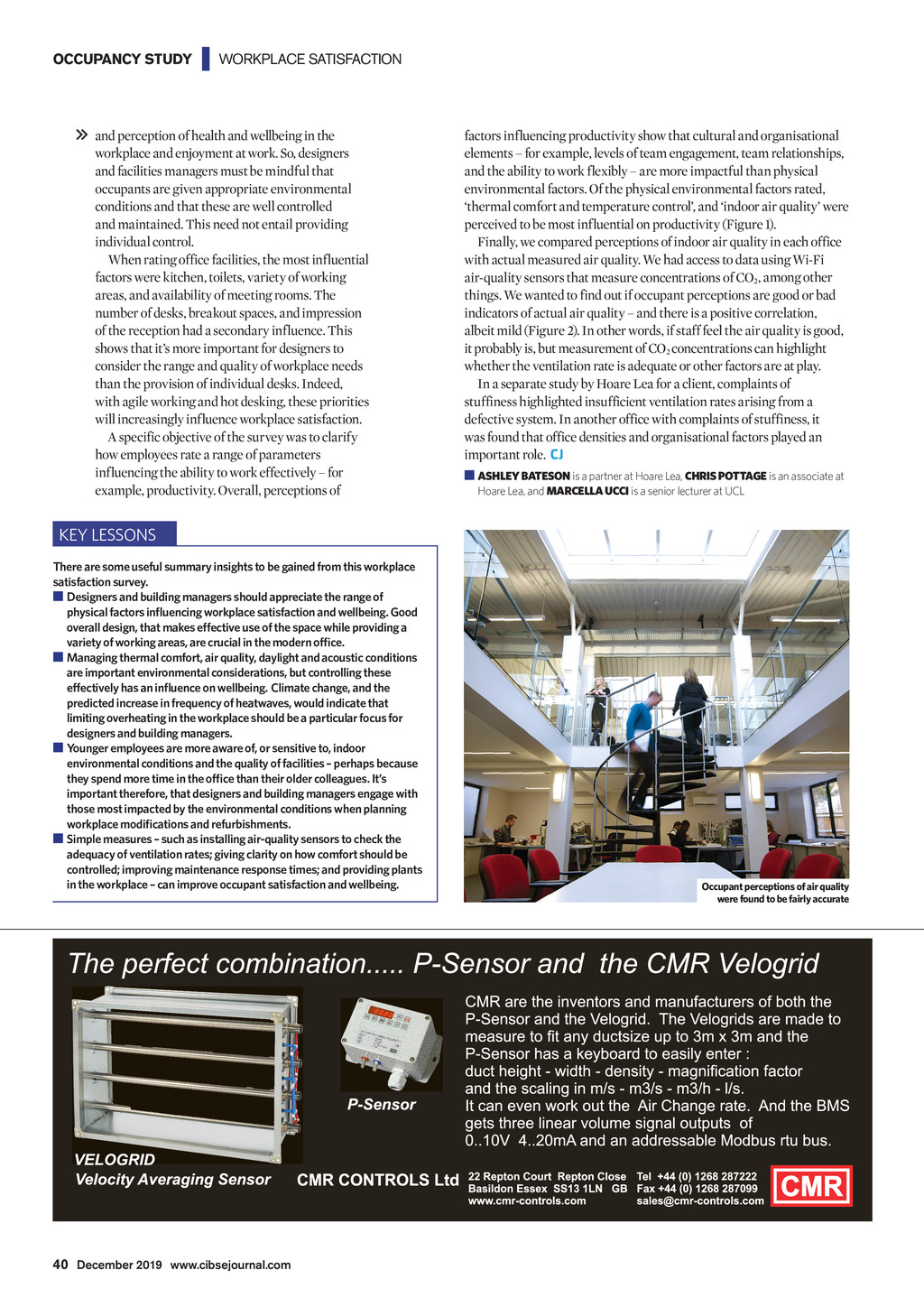


OCCUPANCY STUDY | WORKPLACE SATISFACTION and perception of health and wellbeing in the workplace and enjoyment at work. So, designers and facilities managers must be mindful that occupants are given appropriate environmental conditions and that these are well controlled and maintained. This need not entail providing individual control. When rating office facilities, the most influential factors were kitchen, toilets, variety of working areas, and availability of meeting rooms. The number of desks, breakout spaces, and impression of the reception had a secondary influence. This shows that its more important for designers to consider the range and quality of workplace needs than the provision of individual desks. Indeed, with agile working and hot desking, these priorities will increasingly influence workplace satisfaction. A specific objective of the survey was to clarify how employees rate a range of parameters influencing the ability to work effectively for example, productivity. Overall, perceptions of factors influencing productivity show that cultural and organisational elements for example, levels of team engagement, team relationships, and the ability to work flexibly are more impactful than physical environmental factors. Of the physical environmental factors rated, thermal comfort and temperature control, and indoor air quality were perceived to be most influential on productivity (Figure 1). Finally, we compared perceptions of indoor air quality in each office with actual measured air quality. We had access to data using Wi-Fi air-quality sensors that measure concentrations of CO2, among other things. We wanted to find out if occupant perceptions are good or bad indicators of actual air quality and there is a positive correlation, albeit mild (Figure 2). In other words, if staff feel the air quality is good, it probably is, but measurement of CO2 concentrations can highlight whether the ventilation rate is adequate or other factors are at play. In a separate study by Hoare Lea for a client, complaints of stuffiness highlighted insufficient ventilation rates arising from a defective system. In another office with complaints of stuffiness, it was found that office densities and organisational factors played an important role. CJ ASHLEY BATESON is a partner at Hoare Lea, CHRIS POTTAGE is an associate at Hoare Lea, and MARCELLA UCCI is a senior lecturer at UCL KEY LESSONS There are some useful summary insights to be gained from this workplace satisfaction survey. Designers and building managers should appreciate the range of physical factors influencing workplace satisfaction and wellbeing. Good overall design, that makes effective use of the space while providing a variety of working areas, are crucial in the modern office. Managing thermal comfort, air quality, daylight and acoustic conditions are important environmental considerations, but controlling these effectively has an influence on wellbeing. Climate change, and the predicted increase in frequency of heatwaves, would indicate that limiting overheating in the workplace should be a particular focus for designers and building managers. Younger employees are more aware of, or sensitive to, indoor environmental conditions and the quality of facilities perhaps because they spend more time in the office than their older colleagues. Its important therefore, that designers and building managers engage with those most impacted by the environmental conditions when planning workplace modifications and refurbishments. Simple measures such as installing air-quality sensors to check the adequacy of ventilation rates; giving clarity on how comfort should be controlled; improving maintenance response times; and providing plants in the workplace can improve occupant satisfaction and wellbeing. Occupant perceptions of air quality were found to be fairly accurate 40 December 2019 www.cibsejournal.com CIBSE Dec19 pp38-40 Hoare Lea POE.indd 40 22/11/2019 16:59