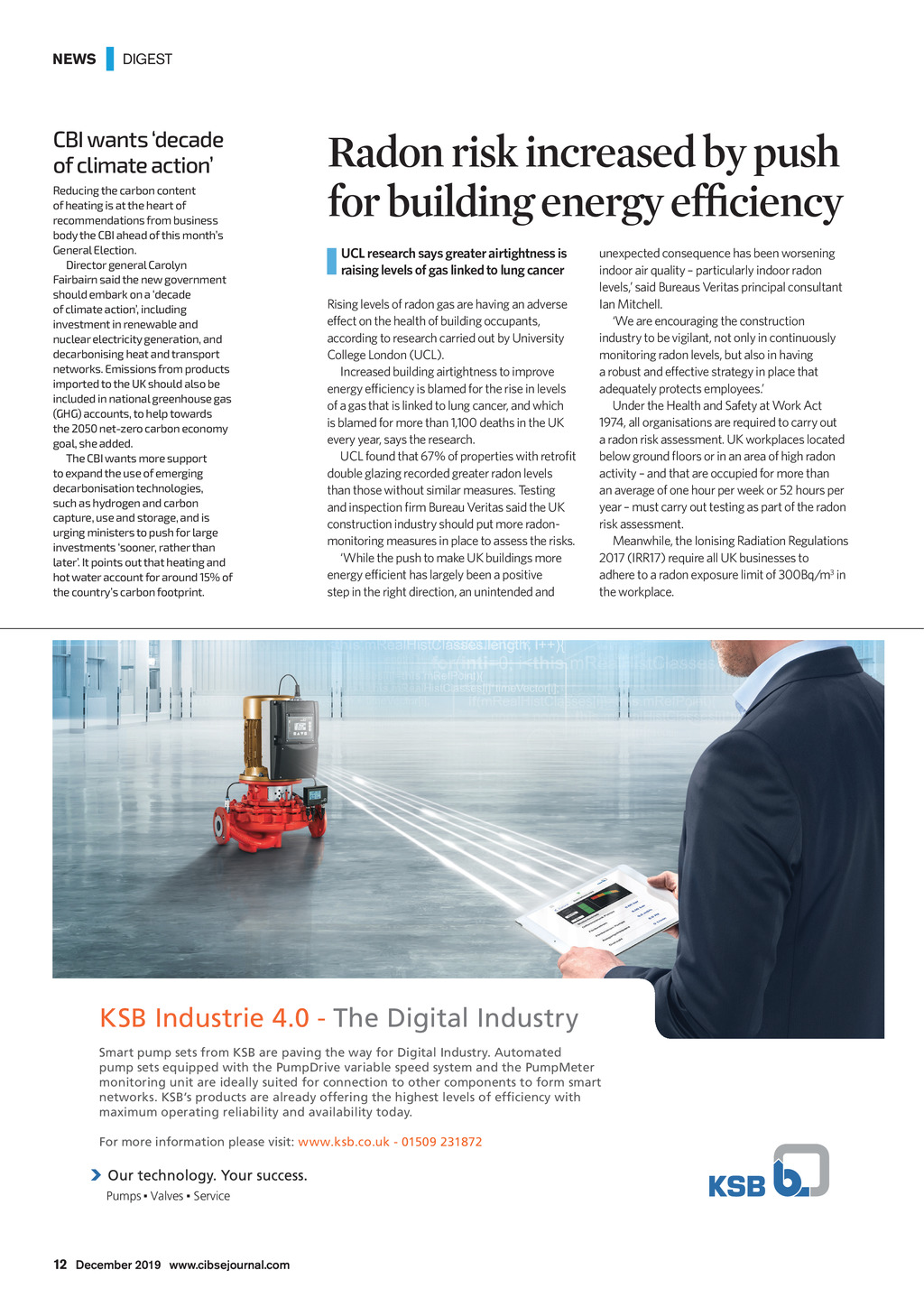


| DIGEST CBI wants decade of climate action Reducing the carbon content of heating is at the heart of recommendations from business body the CBI ahead of this months General Election. Director general Carolyn Fairbairn said the new government should embark on a decade of climate action, including investment in renewable and nuclear electricity generation, and decarbonising heat and transport networks. Emissions from products imported to the UK should also be included in national greenhouse gas (GHG) accounts, to help towards the 2050 net-zero carbon economy goal, she added. The CBI wants more support to expand the use of emerging decarbonisation technologies, such as hydrogen and carbon capture, use and storage, and is urging ministers to push for large investments sooner, rather than later. It points out that heating and hot water account for around 15% of the countrys carbon footprint. Radon risk increased by push for building energy efciency UCL research says greater airtightness is raising levels of gas linked to lung cancer Rising levels of radon gas are having an adverse effect on the health of building occupants, according to research carried out by University College London (UCL). Increased building airtightness to improve energy efciency is blamed for the rise in levels of a gas that is linked to lung cancer, and which is blamed for more than 1,100 deaths in the UK every year, says the research. UCL found that 67% of properties with retrot double glazing recorded greater radon levels than those without similar measures. Testing and inspection rm Bureau Veritas said the UK construction industry should put more radonmonitoring measures in place to assess the risks. While the push to make UK buildings more energy efcient has largely been a positive step in the right direction, an unintended and unexpected consequence has been worsening indoor air quality particularly indoor radon levels, said Bureaus Veritas principal consultant Ian Mitchell. We are encouraging the construction industry to be vigilant, not only in continuously monitoring radon levels, but also in having a robust and effective strategy in place that adequately protects employees. Under the Health and Safety at Work Act 1974, all organisations are required to carry out a radon risk assessment. UK workplaces located below ground oors or in an area of high radon activity and that are occupied for more than an average of one hour per week or 52 hours per year must carry out testing as part of the radon risk assessment. Meanwhile, the Ionising Radiation Regulations 2017 (IRR17) require all UK businesses to adhere to a radon exposure limit of 300Bq/m3 in the workplace. Here is the new design. Any enquires should be sent to: sean.austen@ksb.com KSB Industrie 4.0 - The Digital Industry Smart pump sets from KSB are paving the way for Digital Industry. Automated pump sets equipped with the PumpDrive variable speed system and the PumpMeter monitoring unit are ideally suited for connection to other components to form smart networks. KSBs products are already offering the highest levels of efficiency with maximum operating reliability and availability today. Here is the new design. Any enquires should be sent to: NEWS For more information please visit: www.ksb.co.uk - 01509 231872 Pumps Valves Service 12 December 2019 www.cibsejournal.com CIBSE Dec19 pp12 News.indd 12 22/11/2019 15:13