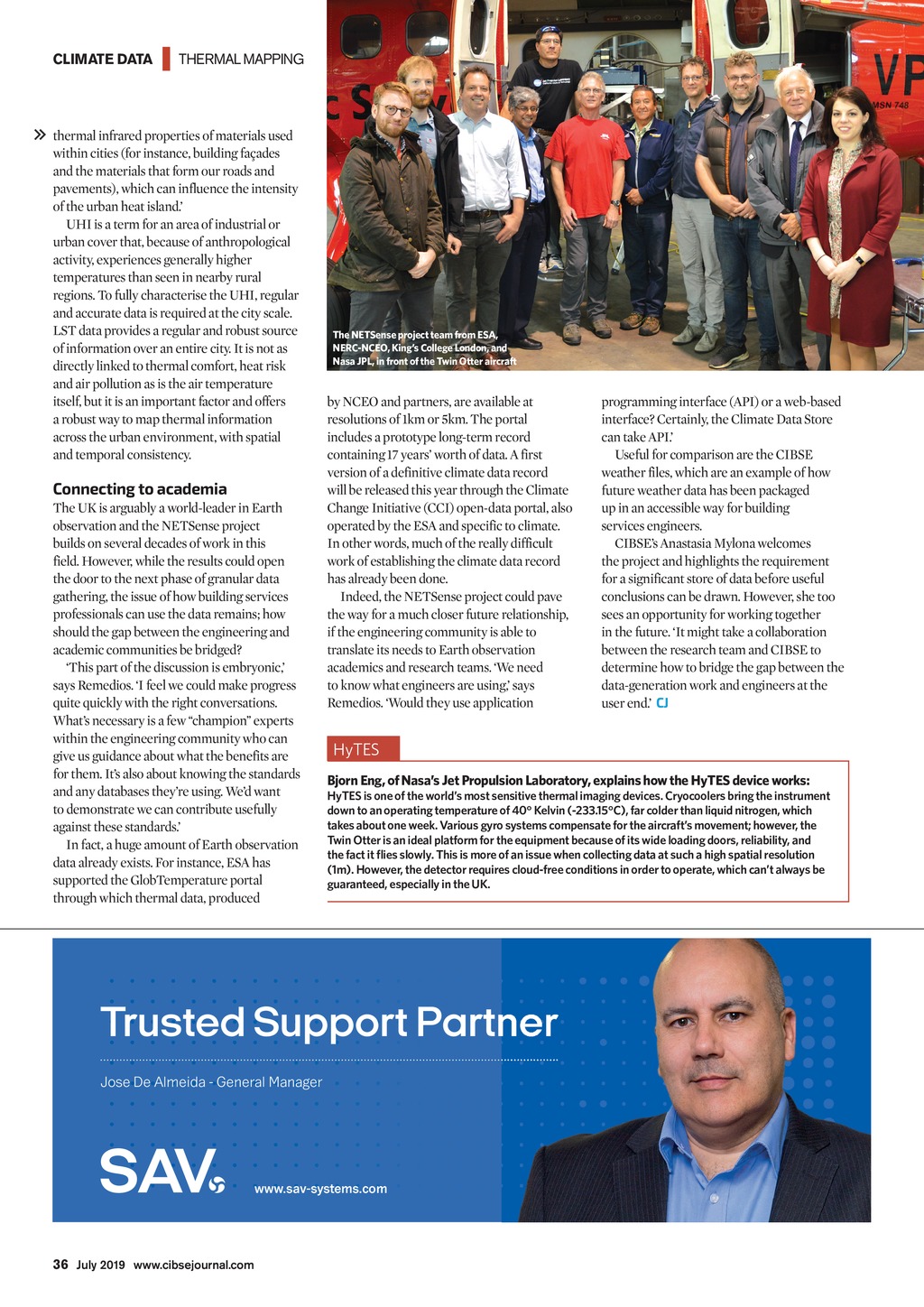


CLIMATE DATA | THERMAL MAPPING thermal infrared properties of materials used within cities (for instance, building faades and the materials that form our roads and pavements), which can influence the intensity of the urban heat island. UHI is a term for an area of industrial or urban cover that, because of anthropological activity, experiences generally higher temperatures than seen in nearby rural regions. To fully characterise the UHI, regular and accurate data is required at the city scale. LST data provides a regular and robust source of information over an entire city. It is not as directly linked to thermal comfort, heat risk and air pollution as is the air temperature itself, but it is an important factor and offers a robust way to map thermal information across the urban environment, with spatial and temporal consistency. Connecting to academia The UK is arguably a world-leader in Earth observation and the NETSense project builds on several decades of work in this field. However, while the results could open the door to the next phase of granular data gathering, the issue of how building services professionals can use the data remains; how should the gap between the engineering and academic communities be bridged? This part of the discussion is embryonic, says Remedios. I feel we could make progress quite quickly with the right conversations. Whats necessary is a few champion experts within the engineering community who can give us guidance about what the benefits are for them. Its also about knowing the standards and any databases theyre using. Wed want to demonstrate we can contribute usefully against these standards. In fact, a huge amount of Earth observation data already exists. For instance, ESA has supported the GlobTemperature portal through which thermal data, produced The NETSense project team from ESA, NERC-NCEO, Kings College London, and Nasa JPL, in front of the Twin Otter aircraft by NCEO and partners, are available at resolutions of 1km or 5km. The portal includes a prototype long-term record containing 17 years worth of data. A first version of a definitive climate data record will be released this year through the Climate Change Initiative (CCI) open-data portal, also operated by the ESA and specific to climate. In other words, much of the really difficult work of establishing the climate data record has already been done. Indeed, the NETSense project could pave the way for a much closer future relationship, if the engineering community is able to translate its needs to Earth observation academics and research teams. We need to know what engineers are using, says Remedios. Would they use application programming interface (API) or a web-based interface? Certainly, the Climate Data Store can take API. Useful for comparison are the CIBSE weather files, which are an example of how future weather data has been packaged up in an accessible way for building services engineers. CIBSEs Anastasia Mylona welcomes the project and highlights the requirement for a significant store of data before useful conclusions can be drawn. However, she too sees an opportunity for working together in the future. It might take a collaboration between the research team and CIBSE to determine how to bridge the gap between the data-generation work and engineers at the user end. CJ HyTES Bjorn Eng, of Nasas Jet Propulsion Laboratory, explains how the HyTES device works: HyTES is one of the worlds most sensitive thermal imaging devices. Cryocoolers bring the instrument down to an operating temperature of 40 Kelvin (-233.15C), far colder than liquid nitrogen, which takes about one week. Various gyro systems compensate for the aircrafts movement; however, the Twin Otter is an ideal platform for the equipment because of its wide loading doors, reliability, and the fact it ies slowly. This is more of an issue when collecting data at such a high spatial resolution (1m). However, the detector requires cloud-free conditions in order to operate, which cant always be guaranteed, especially in the UK. Trusted Support Partner Jose De Almeida - General Manager www.sav-systems.com 36 July 2019 www.cibsejournal.com CIBSE July19 pp34-36 Temperature sensing.indd 36 21/06/2019 14:57