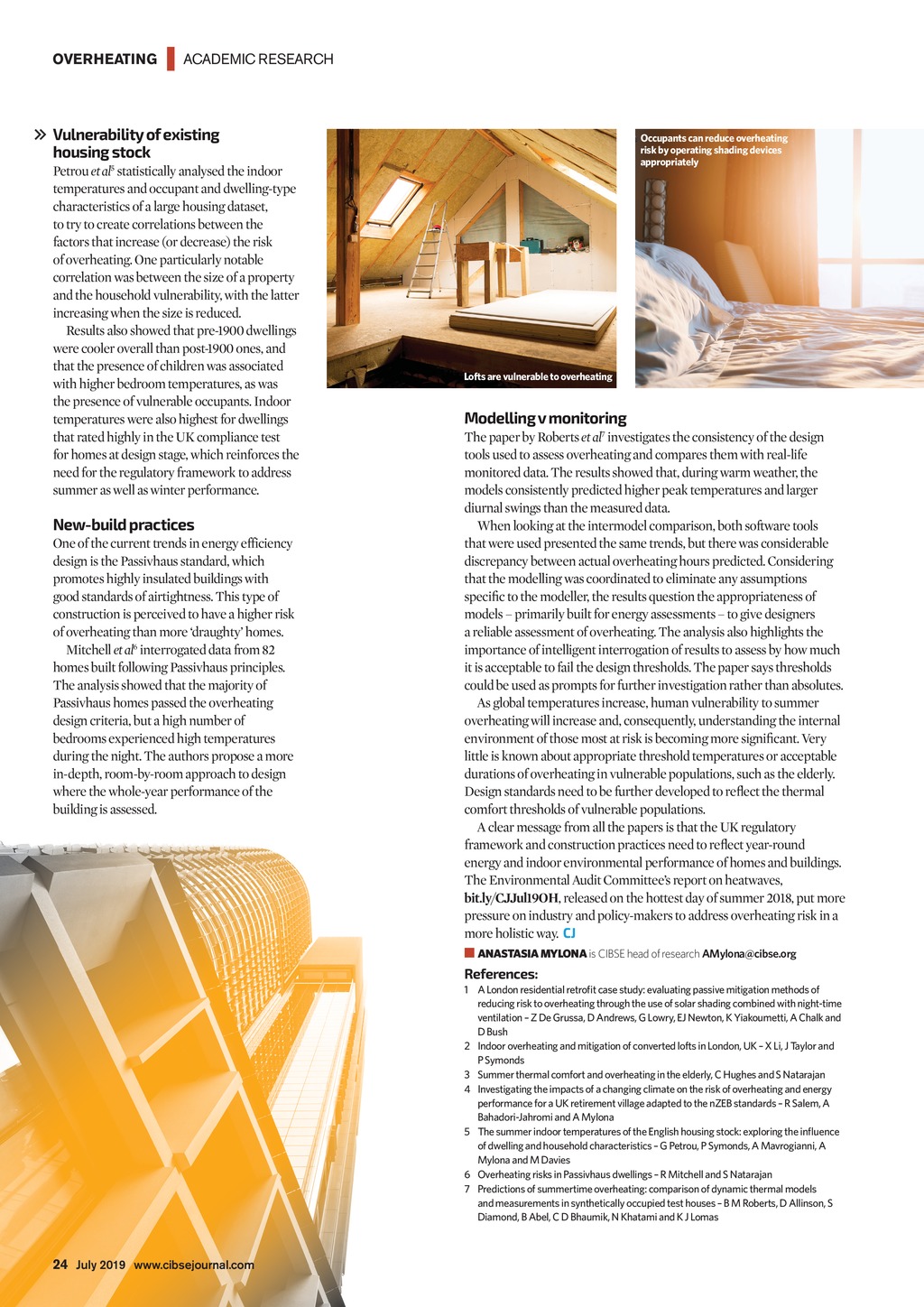


OVERHEATING | ACADEMIC RESEARCH Vulnerability of existing housing stock Petrou et al5 statistically analysed the indoor temperatures and occupant and dwelling-type characteristics of a large housing dataset, to try to create correlations between the factors that increase (or decrease) the risk of overheating. One particularly notable correlation was between the size of a property and the household vulnerability, with the latter increasing when the size is reduced. Results also showed that pre-1900 dwellings were cooler overall than post-1900 ones, and that the presence of children was associated with higher bedroom temperatures, as was the presence of vulnerable occupants. Indoor temperatures were also highest for dwellings that rated highly in the UK compliance test for homes at design stage, which reinforces the need for the regulatory framework to address summer as well as winter performance. New-build practices One of the current trends in energy efficiency design is the Passivhaus standard, which promotes highly insulated buildings with good standards of airtightness. This type of construction is perceived to have a higher risk of overheating than more draughty homes. Mitchell et al6 interrogated data from 82 homes built following Passivhaus principles. The analysis showed that the majority of Passivhaus homes passed the overheating design criteria, but a high number of bedrooms experienced high temperatures during the night. The authors propose a more in-depth, room-by-room approach to design where the whole-year performance of the building is assessed. Occupants can reduce overheating risk by operating shading devices appropriately Lofts are vulnerable to overheating Modelling v monitoring The paper by Roberts et al7 investigates the consistency of the design tools used to assess overheating and compares them with real-life monitored data. The results showed that, during warm weather, the models consistently predicted higher peak temperatures and larger diurnal swings than the measured data. When looking at the intermodel comparison, both software tools that were used presented the same trends, but there was considerable discrepancy between actual overheating hours predicted. Considering that the modelling was coordinated to eliminate any assumptions specific to the modeller, the results question the appropriateness of models primarily built for energy assessments to give designers a reliable assessment of overheating. The analysis also highlights the importance of intelligent interrogation of results to assess by how much it is acceptable to fail the design thresholds. The paper says thresholds could be used as prompts for further investigation rather than absolutes. As global temperatures increase, human vulnerability to summer overheating will increase and, consequently, understanding the internal environment of those most at risk is becoming more significant. Very little is known about appropriate threshold temperatures or acceptable durations of overheating in vulnerable populations, such as the elderly. Design standards need to be further developed to reflect the thermal comfort thresholds of vulnerable populations. A clear message from all the papers is that the UK regulatory framework and construction practices need to reflect year-round energy and indoor environmental performance of homes and buildings. The Environmental Audit Committees report on heatwaves, bit.ly/CJJul19OH, released on the hottest day of summer 2018, put more pressure on industry and policy-makers to address overheating risk in a more holistic way. CJ ANASTASIA MYLONA is CIBSE head of research AMylona@cibse.org References: 1 A London residential retrot case study: evaluating passive mitigation methods of reducing risk to overheating through the use of solar shading combined with night-time ventilation Z De Grussa, D Andrews, G Lowry, EJ Newton, K Yiakoumetti, A Chalk and D Bush 2 Indoor overheating and mitigation of converted lofts in London, UK X Li, J Taylor and P Symonds 3 Summer thermal comfort and overheating in the elderly, C Hughes and S Natarajan 4 Investigating the impacts of a changing climate on the risk of overheating and energy performance for a UK retirement village adapted to the nZEB standards R Salem, A Bahadori-Jahromi and A Mylona 5 The summer indoor temperatures of the English housing stock: exploring the inuence of dwelling and household characteristics G Petrou, P Symonds, A Mavrogianni, A Mylona and M Davies 6 Overheating risks in Passivhaus dwellings R Mitchell and S Natarajan 7 Predictions of summertime overheating: comparison of dynamic thermal models and measurements in synthetically occupied test houses B M Roberts, D Allinson, S Diamond, B Abel, C D Bhaumik, N Khatami and K J Lomas 24 July 2019 www.cibsejournal.com CIBSE July19 pp22-24 BSERT overheating.indd 24 21/06/2019 14:45