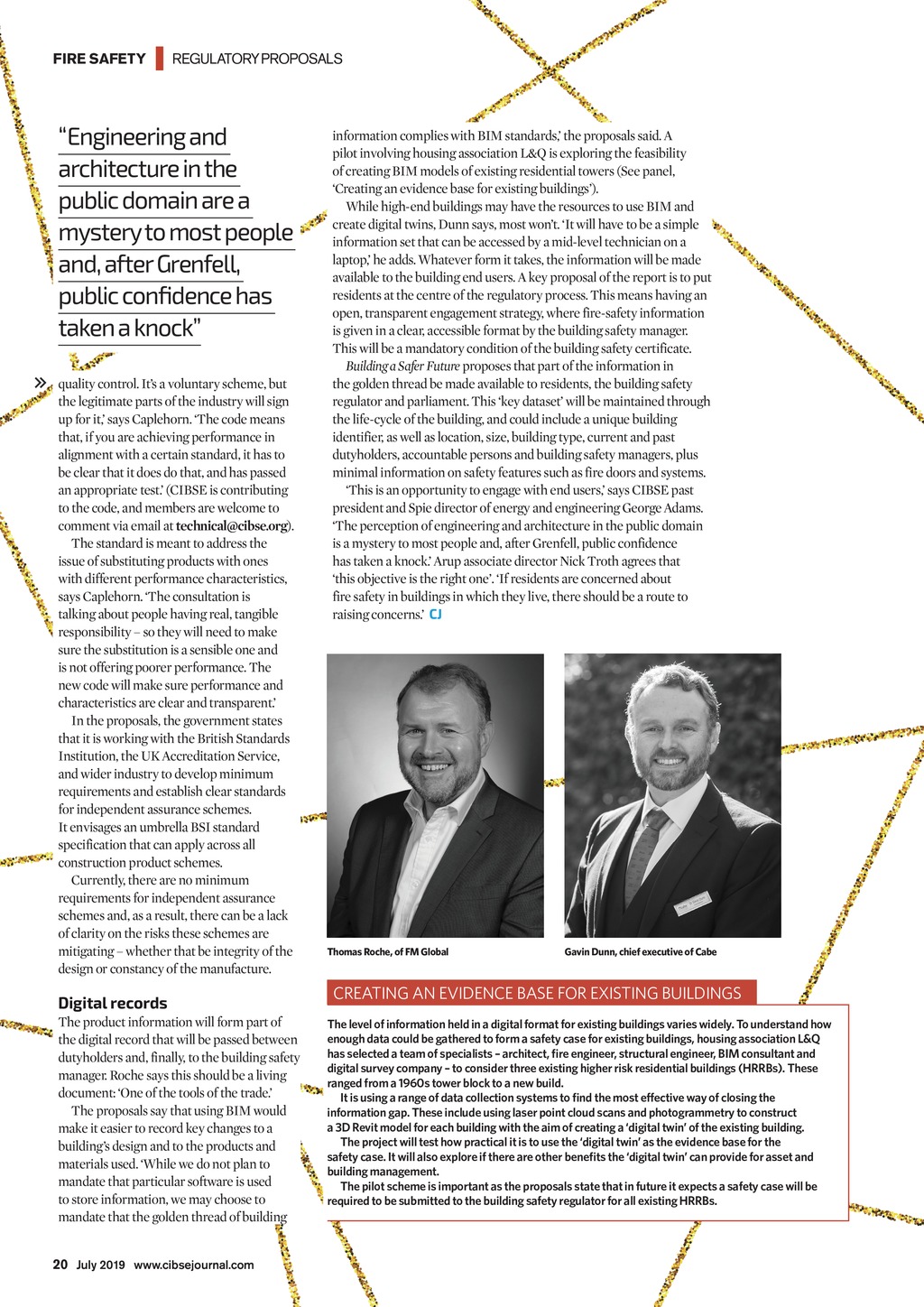


FIRE SAFETY | REGULATORY PROPOSALS Engineering and architecture in the public domain are a mystery to most people and, after Grenfell, public confidence has taken a knock quality control. Its a voluntary scheme, but the legitimate parts of the industry will sign up for it, says Caplehorn. The code means that, if you are achieving performance in alignment with a certain standard, it has to be clear that it does do that,and has passed an appropriate test. (CIBSE is contributing to the code, and members are welcome to comment via email at technical@cibse.org). The standard is meant to address the issue of substituting products with ones with different performance characteristics, says Caplehorn. The consultation is talking about people having real, tangible responsibility so they will need to make sure the substitution is a sensible one and is not offering poorer performance. The new code will make sure performance and characteristics are clear and transparent. In the proposals, the government states that it is working with the British Standards Institution, the UK Accreditation Service, and wider industry to develop minimum requirements and establish clear standards for independent assurance schemes. It envisages an umbrella BSI standard specification that can apply across all construction product schemes. Currently, there are no minimum requirements for independent assurance schemes and, as a result, there can be a lack of clarity on the risks these schemes are mitigating whether that be integrity of the design or constancy of the manufacture. Digital records The product information will form part of the digital record that will be passed between dutyholders and, finally, to the building safety manager. Roche says this should be a living document: One of the tools of the trade. The proposals say that using BIM would make it easier to record key changes to a buildings design and to the products and materials used. While we do not plan to mandate that particular software is used to store information, we may choose to mandate that the golden thread of building information complies with BIM standards, the proposals said. A pilot involving housing association L&Q is exploring the feasibility of creating BIM models of existing residential towers (See panel, Creating an evidence base for existing buildings). While high-end buildings may have the resources to use BIM and create digital twins, Dunn says, most wont. It will have to be a simple information set that can be accessed by a mid-level technician on a laptop, he adds. Whatever form it takes, the information will be made available to the building end users. A key proposal of the report is to put residents at the centre of the regulatory process. This means having an open, transparent engagement strategy, where fire-safety information is given in a clear, accessible format by the building safety manager. This will be a mandatory condition of the building safety certificate. Building a Safer Future proposes that part of the information in the golden thread be made available to residents, the building safety regulator and parliament. This key dataset will be maintained through the life-cycle of the building, and could include a unique building identifier, as well as location, size, building type, current and past dutyholders, accountable persons and building safety managers, plus minimal information on safety features such as fire doors and systems. This is an opportunity to engage with end users, says CIBSE past president and Spie director of energy and engineering George Adams. The perception of engineering and architecture in the public domain is a mystery to most people and, after Grenfell, public confidence has taken a knock. Arup associate director Nick Troth agrees that this objective is the right one. If residents are concerned about fire safety in buildings in which they live, there should be a route to raisingconcerns. CJ Thomas Roche, of FM Global Gavin Dunn, chief executive of Cabe CREATING AN EVIDENCE BASE FOR EXISTING BUILDINGS The level of information held in a digital format for existing buildings varies widely. To understand how enough data could be gathered to form a safety case for existing buildings, housing association L&Q has selected a team of specialists architect, fire engineer, structural engineer, BIM consultant and digital survey company to consider three existing higher risk residential buildings (HRRBs). These ranged from a 1960s tower block to a new build. It is using a range of data collection systems to find the most effective way of closing the information gap. These include using laser point cloud scans and photogrammetry to construct a 3D Revit model for each building with the aim of creating a digital twin of the existing building. The project will test how practical it is to use the digital twin as the evidence base for the safety case. It will also explore if there are other benefits the digital twin can provide for asset and buildingmanagement. The pilot scheme is important as the proposals state that in future it expects a safety case will be required to be submitted to the building safety regulator for all existing HRRBs. 20 July 2019 www.cibsejournal.com CIBSE July19 pp18-20 Grenfell.indd 20 21/06/2019 17:16