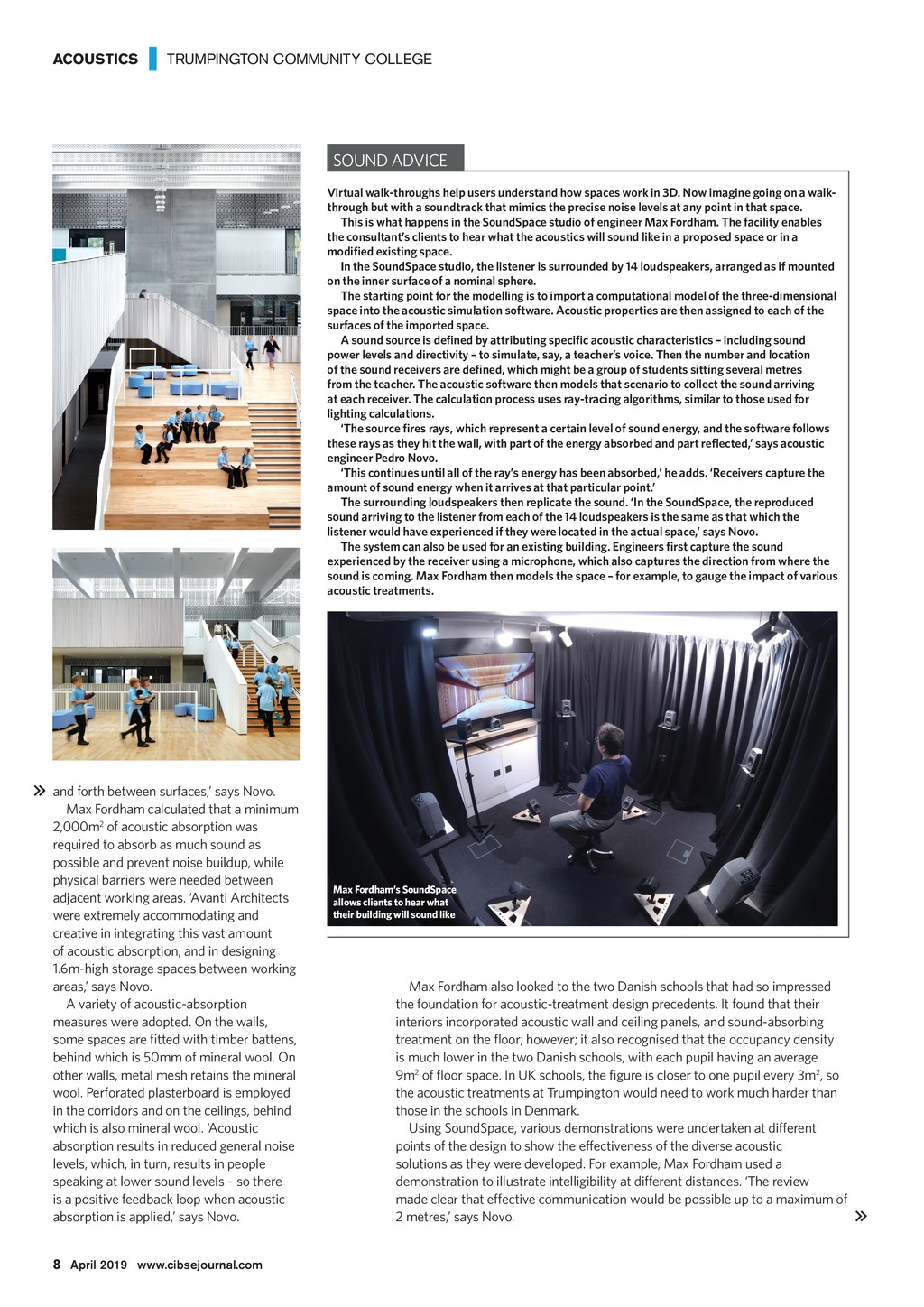


COUSTICS | TRUMPINGTON COMMUNITY COLLEGE SOUND ADVICE Virtual walk-throughs help users understand how spaces work in 3D. Now imagine going on a walkthrough but with a soundtrack that mimics the precise noise levels at any point in that space. This is what happens in the SoundSpace studio of engineer Max Fordham. The facility enables the consultants clients to hear what the acoustics will sound like in a proposed space or in a modified existing space. In the SoundSpace studio, the listener is surrounded by 14 loudspeakers, arranged as if mounted on the inner surface of a nominal sphere. The starting point for the modelling is to import a computational model of the three-dimensional space into the acoustic simulation software. Acoustic properties are then assigned to each of the surfaces of the imported space. A sound source is defined by attributing specific acoustic characteristics including sound power levels and directivity to simulate, say, a teachers voice. Then the number and location of the sound receivers are defined, which might be a group of students sitting several metres from the teacher. The acoustic software then models that scenario to collect the sound arriving at each receiver. The calculation process uses ray-tracing algorithms, similar to those used for lightingcalculations. The source fires rays, which represent a certain level of sound energy, and the software follows these rays as they hit the wall, with part of the energy absorbed and part reflected, says acoustic engineer Pedro Novo. This continues until all of the rays energy has been absorbed, he adds. Receivers capture the amount of sound energy when it arrives at that particular point. The surrounding loudspeakers then replicate the sound. In the SoundSpace, the reproduced sound arriving to the listener from each of the 14 loudspeakers is the same as that which the listener would have experienced if they were located in the actual space, says Novo. The system can also be used for an existing building. Engineers first capture the sound experienced by the receiver using a microphone, which also captures the direction from where the sound is coming. Max Fordham then models the space for example, to gauge the impact of various acoustic treatments. and forth between surfaces, says Novo. Max Fordham calculated that a minimum 2,000m2 of acoustic absorption was required to absorb as much sound as possible and prevent noise buildup, while physical barriers were needed between adjacent working areas. Avanti Architects were extremely accommodating and creative in integrating this vast amount of acoustic absorption, and in designing 1.6m-high storage spaces between working areas, says Novo. A variety of acoustic-absorption measures were adopted. On the walls, some spaces are fitted with timber battens, behind which is 50mm of mineral wool. On other walls, metal mesh retains the mineral wool. Perforated plasterboard is employed in the corridors and on the ceilings, behind which is also mineral wool. Acoustic absorption results in reduced general noise levels, which, in turn, results in people speaking at lower sound levels so there is a positive feedback loop when acoustic absorption is applied, says Novo. Max Fordhams SoundSpace allows clients to hear what their building will sound like Max Fordham also looked to the two Danish schools that had so impressed the foundation for acoustic-treatment design precedents. It found that their interiors incorporated acoustic wall and ceiling panels, and sound-absorbing treatment on the floor; however; it also recognised that the occupancy density is much lower in the two Danish schools, with each pupil having an average 9m2 of floor space. In UK schools, the figure is closer to one pupil every 3m2, so the acoustic treatments at Trumpington would need to work much harder than those in the schools in Denmark. Using SoundSpace, various demonstrations were undertaken at different points of the design to show the effectiveness of the diverse acoustic solutionsas they were developed. For example, Max Fordham used a demonstration to illustrate intelligibility at different distances. The review madeclear that effective communication would be possible up to a maximum of 2 metres, says Novo. 8 April 2019 www.cibsejournal.com CIBSE Apr19 pp06-08,10 School Supp Trumpington Acousticsl.indd 8 22/03/2019 13:12