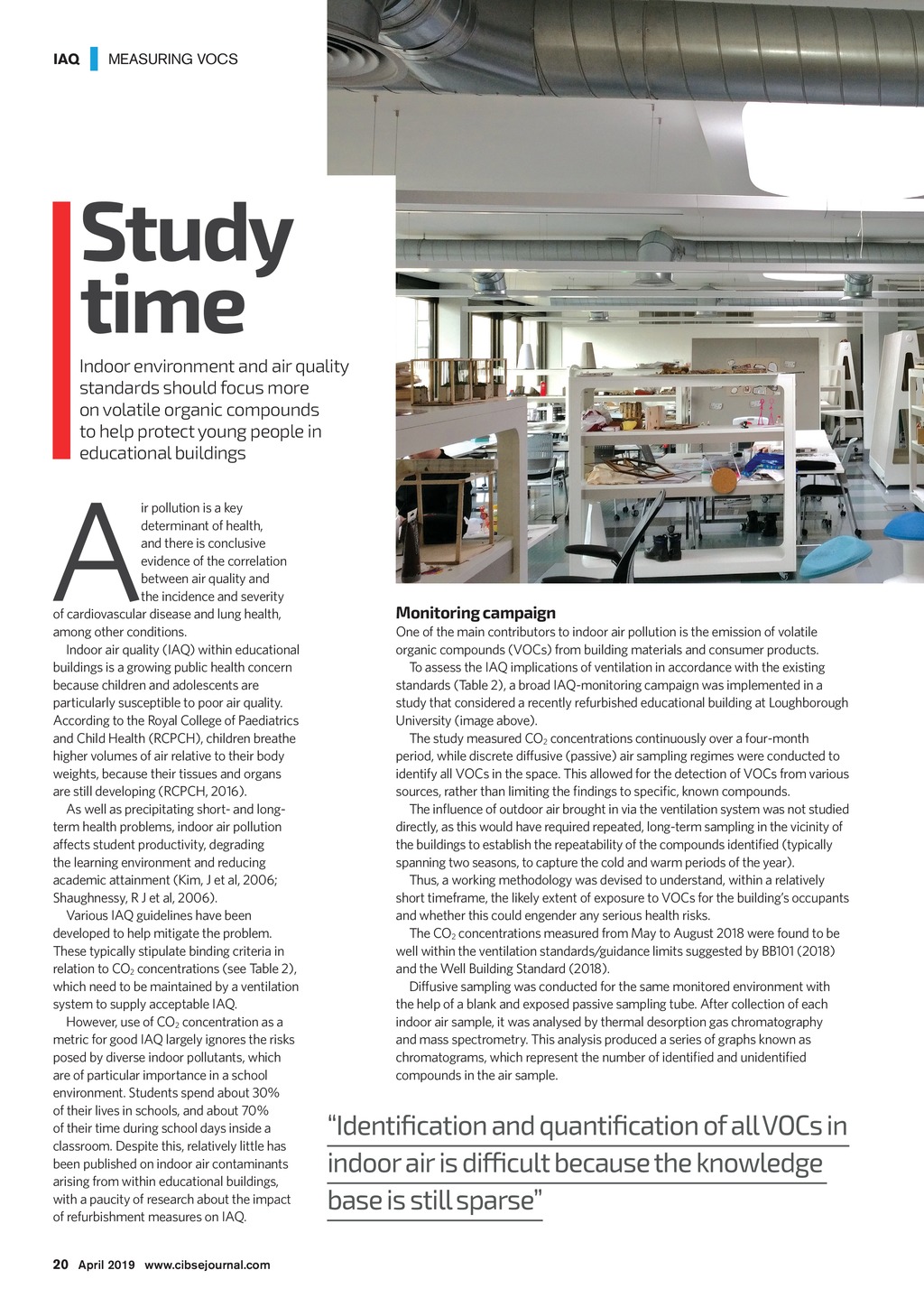


IAQ | MEASURING VOCS Study time Indoor environment and air quality standards should focus more on volatile organic compounds to help protect young people in educationalbuildings A ir pollution is a key determinant of health, and there is conclusive evidence of the correlation between air quality and the incidence and severity of cardiovascular disease and lung health, among other conditions. Indoor air quality (IAQ) within educational buildings is a growing public health concern because children and adolescents are particularly susceptible to poor air quality. According to the Royal College of Paediatrics and Child Health (RCPCH), children breathe higher volumes of air relative to their body weights, because their tissues and organs are still developing (RCPCH, 2016). As well as precipitating short- and longterm health problems, indoor air pollution affects student productivity, degrading the learning environment and reducing academic attainment (Kim, J et al, 2006; Shaughnessy, R J et al, 2006). Various IAQ guidelines have been developed to help mitigate the problem. These typically stipulate binding criteria in relation to CO2 concentrations (see Table 2), which need to be maintained by a ventilation system to supply acceptable IAQ. However, use of CO2 concentration as a metric for good IAQ largely ignores the risks posed by diverse indoor pollutants, which are of particular importance in a school environment. Students spend about 30% of their lives in schools, and about 70% of their time during school days inside a classroom. Despite this, relatively little has been published on indoor air contaminants arising from within educational buildings, with a paucity of research about the impact of refurbishment measures on IAQ. Monitoring campaign One of the main contributors to indoor air pollution is the emission of volatile organic compounds (VOCs) from building materials and consumer products. To assess the IAQ implications of ventilation in accordance with the existing standards (Table 2), a broad IAQ-monitoring campaign was implemented in a study that considered a recently refurbished educational building at Loughborough University (image above). The study measured CO2 concentrations continuously over a four-month period, while discrete diffusive (passive) air sampling regimes were conducted to identify all VOCs in the space. This allowed for the detection of VOCs from various sources, rather than limiting the findings to specific, known compounds. The influence of outdoor air brought in via the ventilation system was not studied directly, as this would have required repeated, long-term sampling in the vicinity of the buildings to establish the repeatability of the compounds identified (typically spanning two seasons, to capture the cold and warm periods of the year). Thus, a working methodology was devised to understand, within a relatively short timeframe, the likely extent of exposure to VOCs for the buildings occupants and whether this could engender any serious health risks. The CO2 concentrations measured from May to August 2018 were found to be well within the ventilation standards/guidance limits suggested by BB101 (2018) and the Well Building Standard (2018). Diffusive sampling was conducted for the same monitored environment with the help of a blank and exposed passive sampling tube. After collection of each indoor air sample, it was analysed by thermal desorption gas chromatography and mass spectrometry. This analysis produced a series of graphs known as chromatograms, which represent the number of identified and unidentified compounds in the air sample. Identification and quantification of all VOCs in indoor air is difficult because the knowledge base is still sparse 20 April 2019 www.cibsejournal.com CIBSE Apr19 pp20-22 School Supp VOCs.indd 20 22/03/2019 13:17