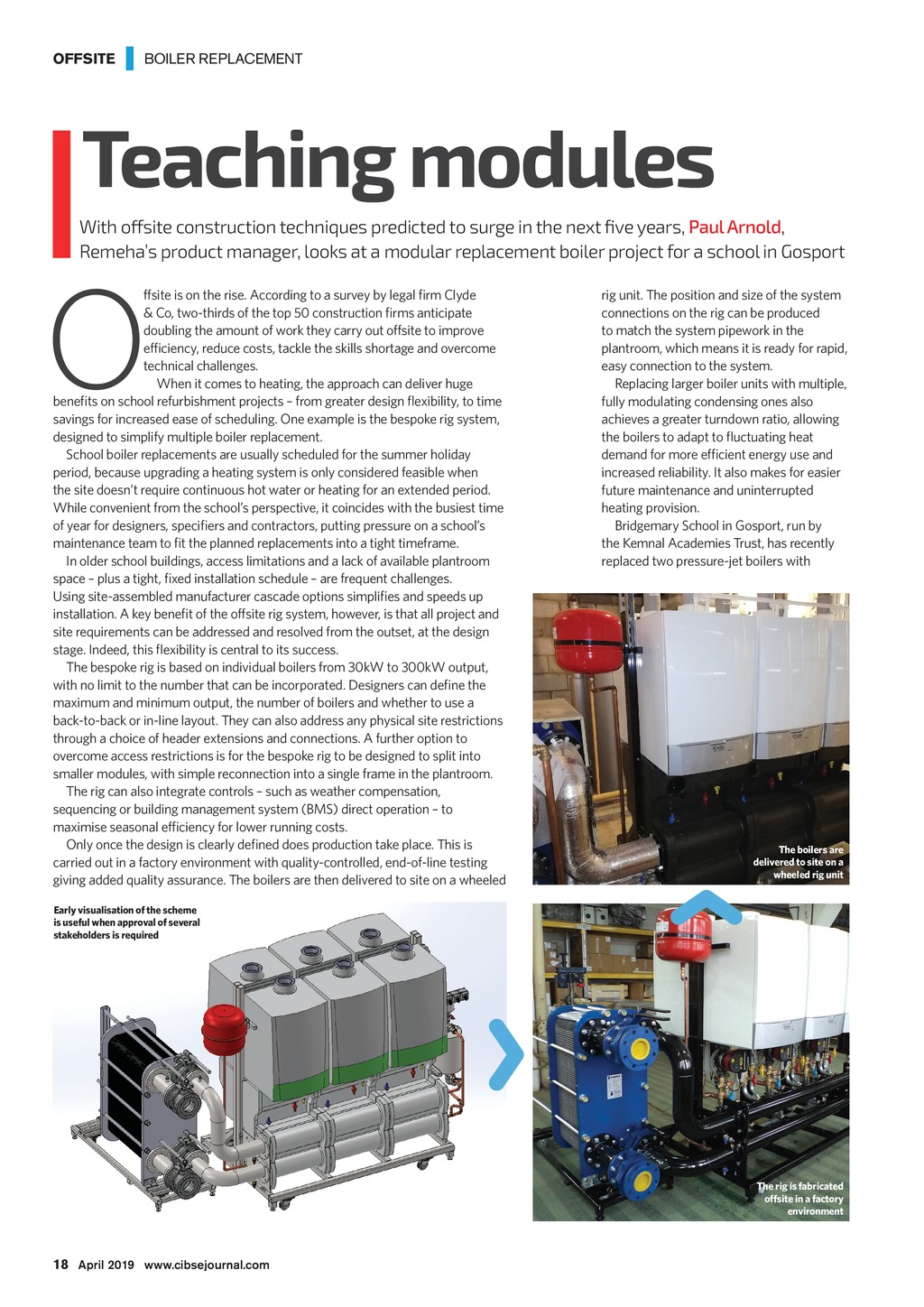


OFFSITE | BOILER REPLACEMENT Teaching modules With offsite construction techniques predicted to surge in the next five years, Paul Arnold, Remehas product manager, looks at a modular replacement boiler project for a school in Gosport O ffsite is on the rise. According to a survey by legal firm Clyde & Co, two-thirds of the top 50 construction firms anticipate doubling the amount of work they carry out offsite to improve efficiency, reduce costs, tackle the skills shortage and overcome technical challenges. When it comes to heating, the approach can deliver huge benefits on school refurbishment projects from greater design flexibility, to time savings for increased ease of scheduling. One example is the bespoke rig system, designed to simplify multiple boiler replacement. School boiler replacements are usually scheduled for the summer holiday period, because upgrading a heating system is only considered feasible when the site doesnt require continuous hot water or heating for an extended period. While convenient from the schools perspective, it coincides with the busiest time of year for designers, specifiers and contractors, putting pressure on a schools maintenance team to fit the planned replacements into a tight timeframe. In older school buildings, access limitations and a lack of available plantroom space plus a tight, fixed installation schedule are frequent challenges. Using site-assembled manufacturer cascade options simplifies and speeds up installation. A key benefit of the offsite rig system, however, is that all project and site requirements can be addressed and resolved from the outset, at the design stage. Indeed, this flexibility is central to its success. The bespoke rig is based on individual boilers from 30kW to 300kW output, with no limit to the number that can be incorporated. Designers can define the maximum and minimum output, the number of boilers and whether to use a back-to-back or in-line layout. They can also address any physical site restrictions through a choice of header extensions and connections. A further option to overcome access restrictions is for the bespoke rig to be designed to split into smaller modules, with simple reconnection into a single frame in the plantroom. The rig can also integrate controls such as weather compensation, sequencing or building management system (BMS) direct operation to maximise seasonal efficiency for lower running costs. Only once the design is clearly defined does production take place. This is carried out in a factory environment with quality-controlled, end-of-line testing giving added quality assurance. The boilers are then delivered to site on a wheeled rig unit. The position and size of the system connections on the rig can be produced to match the system pipework in the plantroom, which means it is ready for rapid, easy connection to the system. Replacing larger boiler units with multiple, fully modulating condensing ones also achieves a greater turndown ratio, allowing the boilers to adapt to fluctuating heat demand for more efficient energy use and increased reliability. It also makes for easier future maintenance and uninterrupted heating provision. Bridgemary School in Gosport, run by the Kemnal Academies Trust, has recently replaced two pressure-jet boilers with The boilers are delivered to site on a wheeled rig unit Early visualisation of the scheme is useful when approval of several stakeholders is required The rig is fabricated offsite in a factory environment 18 April 2019 www.cibsejournal.com CIBSE Apr19 pp18-19 School Supp Remeha.indd 18 22/03/2019 13:15