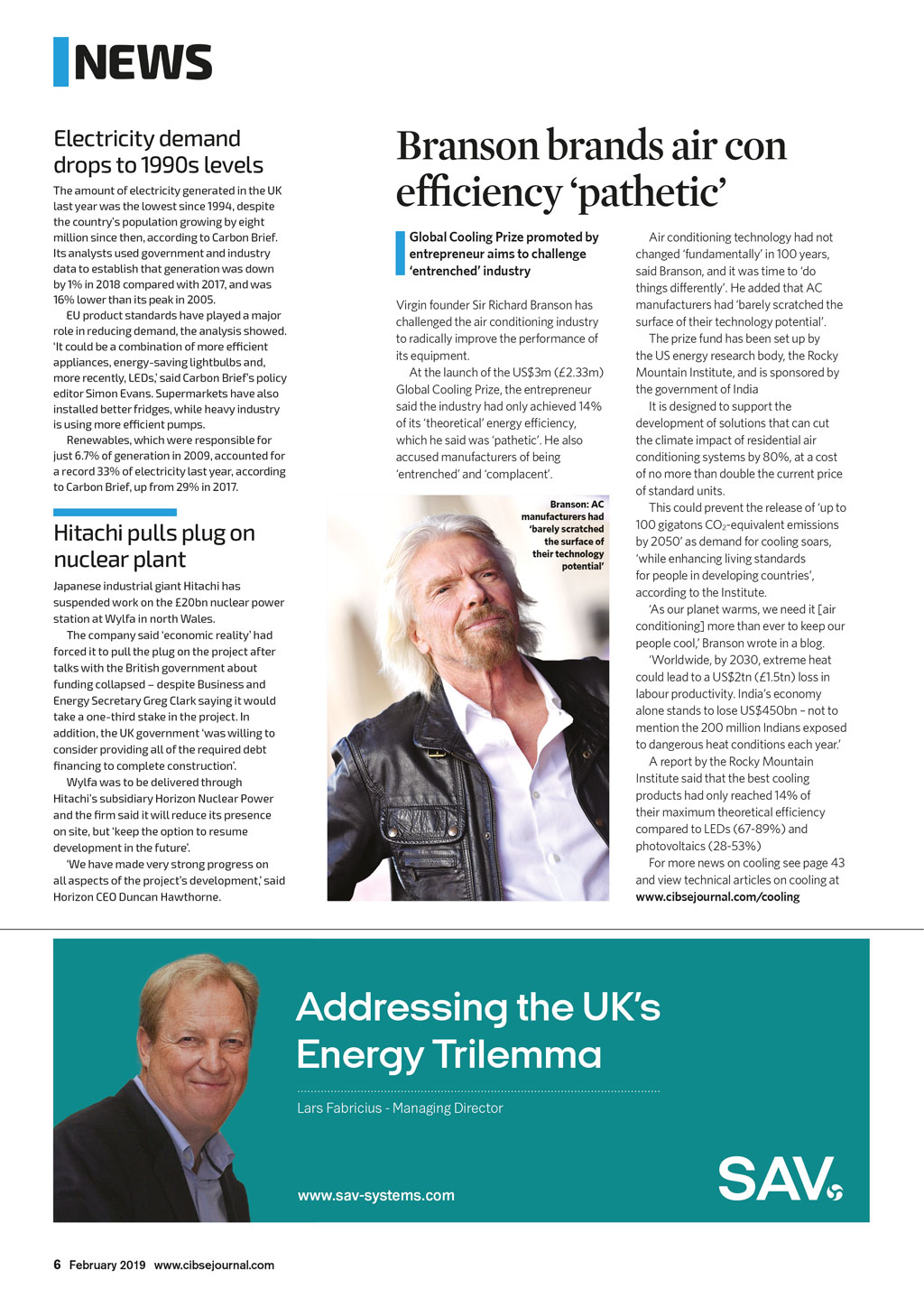


EWS Electricity demand drops to 1990s levels The amount of electricity generated in the UK last year was the lowest since 1994, despite the countrys population growing by eight million since then, according to Carbon Brief. Its analysts used government and industry data to establish that generation was down by 1% in 2018 compared with 2017, and was 16% lower than its peak in 2005. EU product standards have played a major role in reducing demand, the analysis showed. It could be a combination of more efficient appliances, energy-saving lightbulbs and, more recently, LEDs, said Carbon Briefs policy editor Simon Evans. Supermarkets have also installed better fridges, while heavy industry is using more efficient pumps. Renewables, which were responsible for just 6.7% of generation in 2009, accounted for a record 33% of electricity last year, according to Carbon Brief, up from 29% in 2017. Branson brands air con efficiency pathetic Global Cooling Prize promoted by entrepreneur aims to challenge entrenched industry Virgin founder Sir Richard Branson has challenged the air conditioning industry to radically improve the performance of its equipment. At the launch of the US$3m (2.33m) Global Cooling Prize, the entrepreneur said the industry had only achieved 14% of its theoretical energy efficiency, which he said was pathetic. He also accused manufacturers of being entrenched and complacent. Branson: AC manufacturers had barely scratched the surface of their technology potential Hitachi pulls plug on nuclear plant Japanese industrial giant Hitachi has suspended work on the 20bn nuclear power station at Wylfa in north Wales. The company said economic reality had forced it to pull the plug on the project after talks with the British government about funding collapsed despite Business and Energy Secretary Greg Clark saying it would take a one-third stake in the project. In addition, the UK government was willing to consider providing all of the required debt financing to complete construction. Wylfa was to be delivered through Hitachis subsidiary Horizon Nuclear Power and the firm said it will reduce its presence on site, but keep the option to resume development in the future. We have made very strong progress on allaspects of the projects development, said Horizon CEO Duncan Hawthorne. Air conditioning technology had not changed fundamentally in 100 years, said Branson, and it was time to do things differently. He added that AC manufacturers had barely scratched the surface of their technology potential. The prize fund has been set up by the US energy research body, the Rocky Mountain Institute, and is sponsored by the government of India It is designed to support the development of solutions that can cut the climate impact of residential air conditioning systems by 80%, at a cost of no more than double the current price of standard units. This could prevent the release of up to 100 gigatons CO2-equivalent emissions by 2050 as demand for cooling soars, while enhancing living standards for people in developing countries, according to the Institute. As our planet warms, we need it [air conditioning] more than ever to keep our people cool, Branson wrote in a blog. Worldwide, by 2030, extreme heat could lead to a US$2tn (1.5tn) loss in labour productivity. Indias economy alone stands to lose US$450bn not to mention the 200 million Indians exposed to dangerous heat conditions each year. A report by the Rocky Mountain Institute said that the best cooling products had only reached 14% of their maximum theoretical efficiency compared to LEDs (67-89%) and photovoltaics (28-53%) For more news on cooling see page 43 and view technical articles on cooling at www.cibsejournal.com/cooling Addressing the UKs Energy Trilemma Lars Fabricius - Managing Director www.sav-systems.com 6 February 2019 www.cibsejournal.com CIBSE Feb19 pp06-07 News.indd 6 25/01/2019 16:14