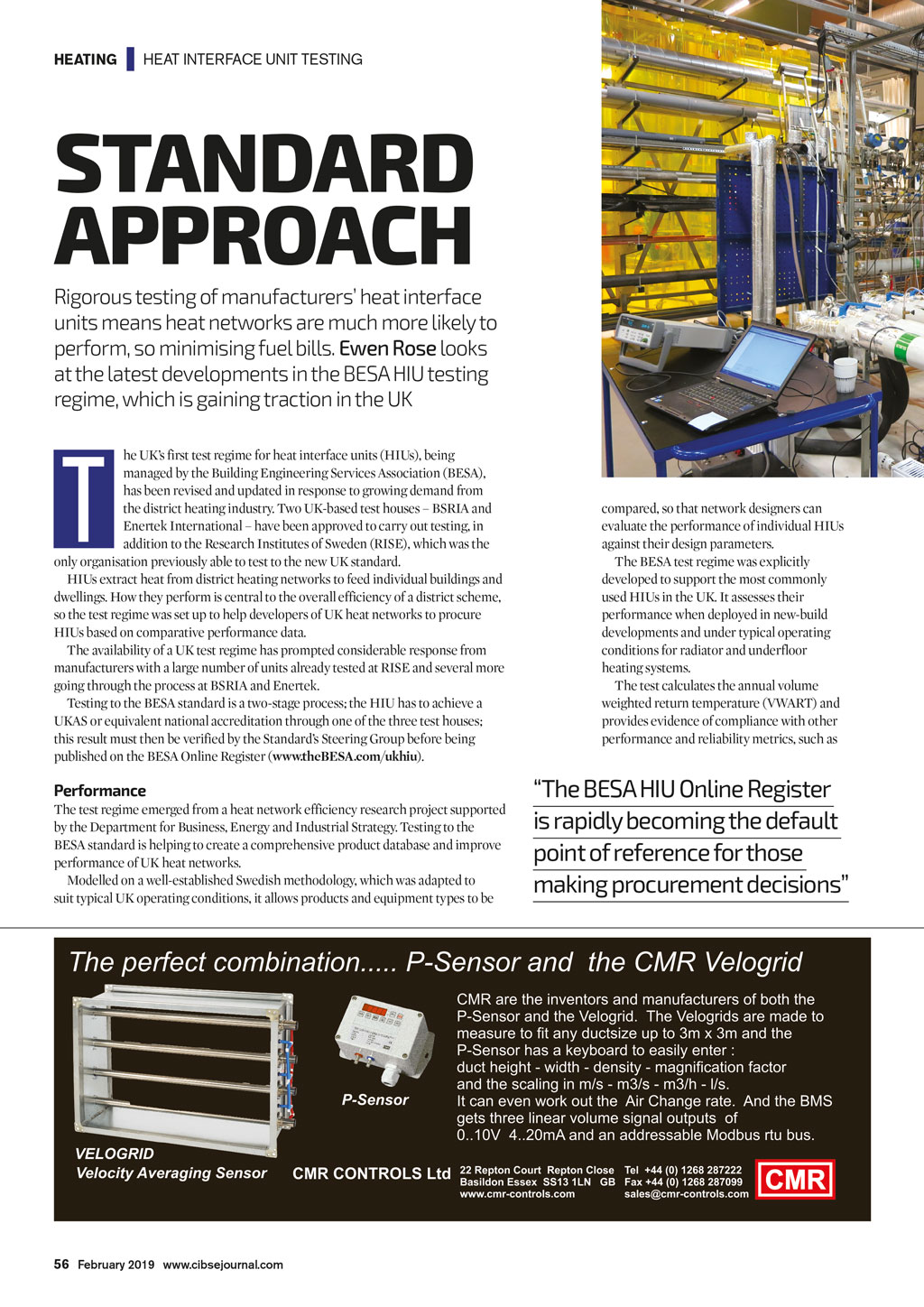


HEATING | HEAT INTERFACE UNIT TESTING STANDARD APPROACH Rigorous testing of manufacturers heat interface units means heat networks are much more likely to perform, so minimising fuel bills. Ewen Rose looks at the latest developments in the BESA HIU testing regime, which is gaining traction in the UK T he UKs first test regime for heat interface units (HIUs), being managed by the Building Engineering Services Association (BESA), has been revised and updated in response to growing demand from the district heating industry. Two UK-based test houses BSRIA and Enertek International have been approved to carry out testing, in addition to the Research Institutes of Sweden (RISE), which was the only organisation previously able to test to the new UK standard. HIUs extract heat from district heating networks to feed individual buildings and dwellings. How they perform is central to the overall efficiency of a district scheme, so the test regime was set up to help developers of UK heat networks to procure HIUs based on comparative performance data. The availability of a UK test regime has prompted considerable response from manufacturers with a large number of units already tested at RISE and several more going through the process at BSRIA and Enertek. Testing to the BESA standard is a two-stage process; the HIU has to achieve a UKAS or equivalent national accreditation through one of the three test houses; this result must then be verified by the Standards Steering Group before being published on the BESA Online Register (www.theBESA.com/ukhiu). Performance The test regime emerged from a heat network efficiency research project supported by the Department for Business, Energy and Industrial Strategy. Testing to the BESA standard is helping to create a comprehensive product database and improve performance of UK heat networks. Modelled on a well-established Swedish methodology, which was adapted to suit typical UK operating conditions, it allows products and equipment types to be compared, so that network designers can evaluate the performance of individual HIUs against their design parameters. The BESA test regime was explicitly developed to support the most commonly used HIUs in the UK. It assesses their performance when deployed in new-build developments and under typical operating conditions for radiator and underfloor heating systems. The test calculates the annual volume weighted return temperature (VWART) and provides evidence of compliance with other performance and reliability metrics, such as The BESA HIU Online Register is rapidly becoming the default point of reference for those making procurement decisions 56 February 2019 www.cibsejournal.com CIBSE Feb19 pp56-57 HIU article.indd 56 25/01/2019 16:16